An ID number for almost every resident, a bank account for almost every adult, and a phone payment system that now carries half the world’s instant payments.
The payments boom
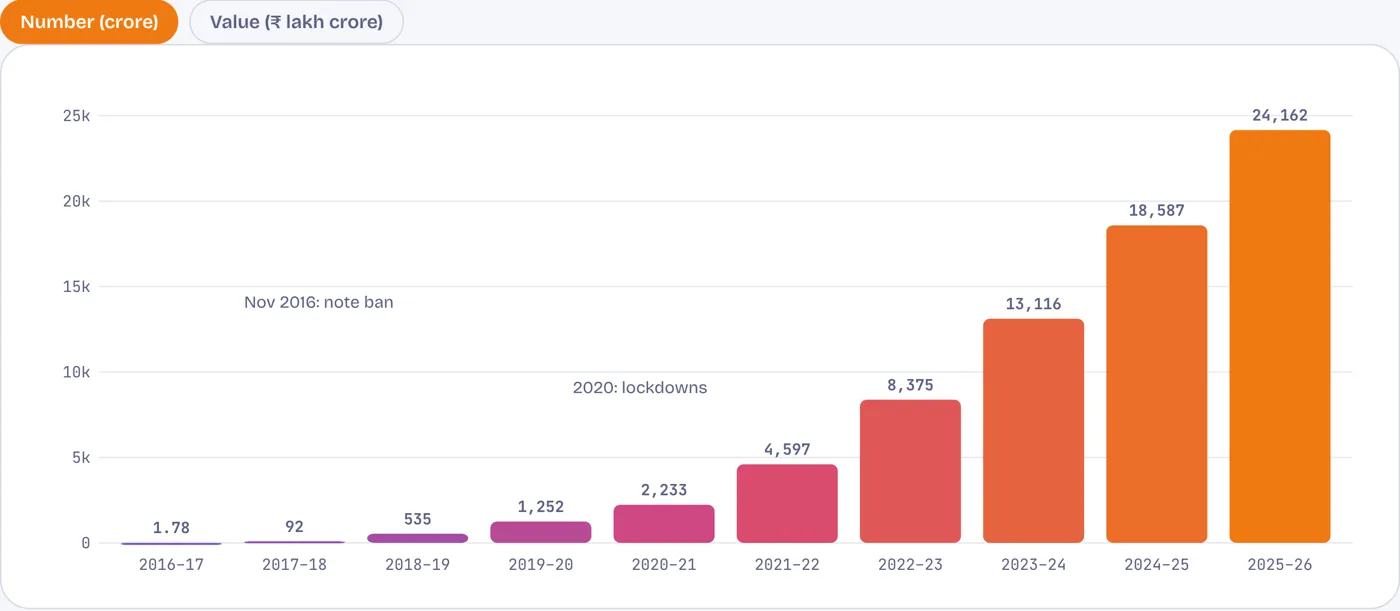
From 1.8 crore payments a year to 2,400 crore a month
Payments made over UPI each financial year. Switch between the number of payments and their value.
The number of payments rose about 13,000 times in nine years. The note ban of November 2016 pushed people off cash, and the lockdowns of 2020 pushed shops onto QR codes. In August 2026 UPI carried a record 2,451 crore payments worth ₹29.8 lakh crore, about 790 million on an average day.
Source: NPCI annual volumes via Department of Financial Services and press reports; FY 2025–26 from the government’s reply in the Lok Sabha via YourStory and Outlook Money; August 2026 from NPCI via DT Next.
The stack
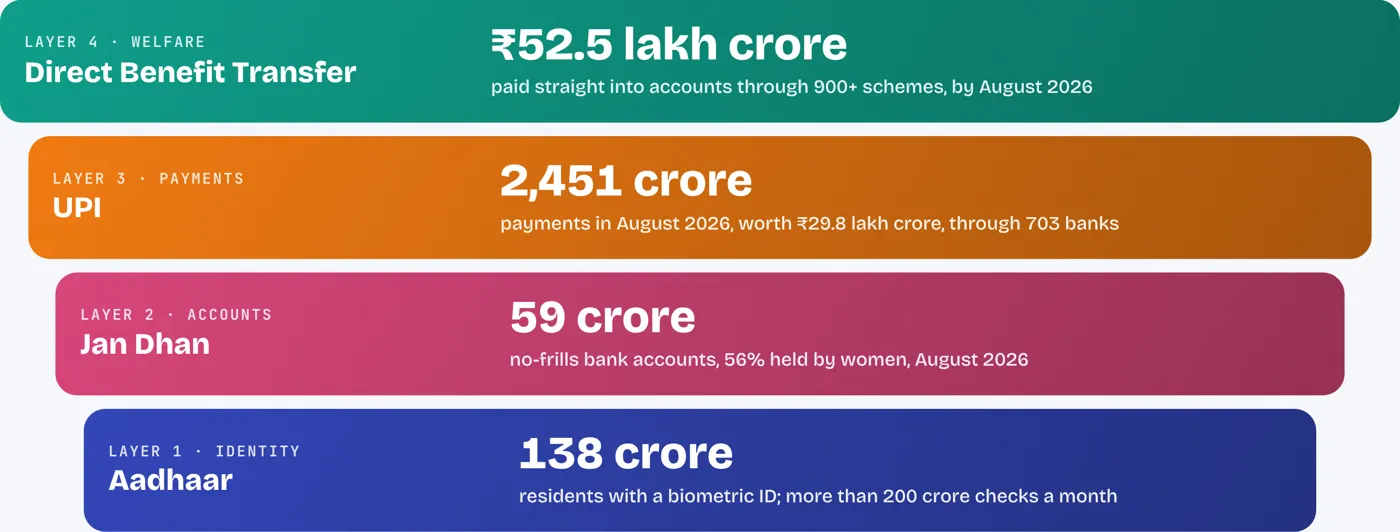
Four layers, each built on the one below
India’s public digital infrastructure and its reach, latest figures
Each layer made the next one cheap. A verified ID allowed a no-frills bank account to be opened in minutes; the account and the phone made instant payments possible; and all three let the state pay welfare straight into the account instead of through officials.
Source: Wikipedia (Aadhaar, October 2024); UIDAI via The Tribune (May 2025); Policy Edge (Jan Dhan, August 2026); NPCI (August 2026); New India Samachar, PIB (DBT, August 2026).
Half the world
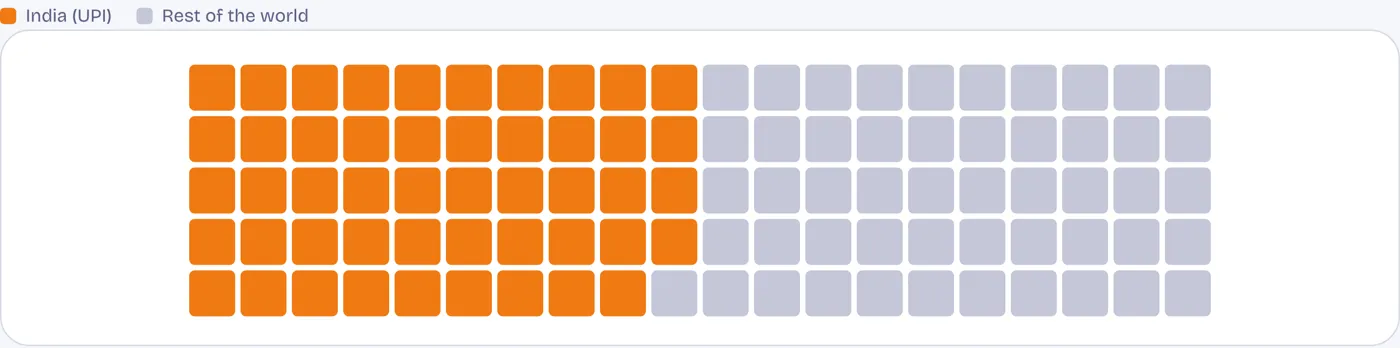
India makes about half of the world’s real-time payments
Share of global real-time payment transactions, 2023. One square = 1%.
Brazil’s Pix, China’s systems and the rest of the world together make up the other half. The IMF named UPI the largest retail fast-payment system in the world by volume.
Source: ACI Worldwide, Prime Time for Real-Time 2024, via Ministry of Finance and Business Standard (December 2025).
Accounts
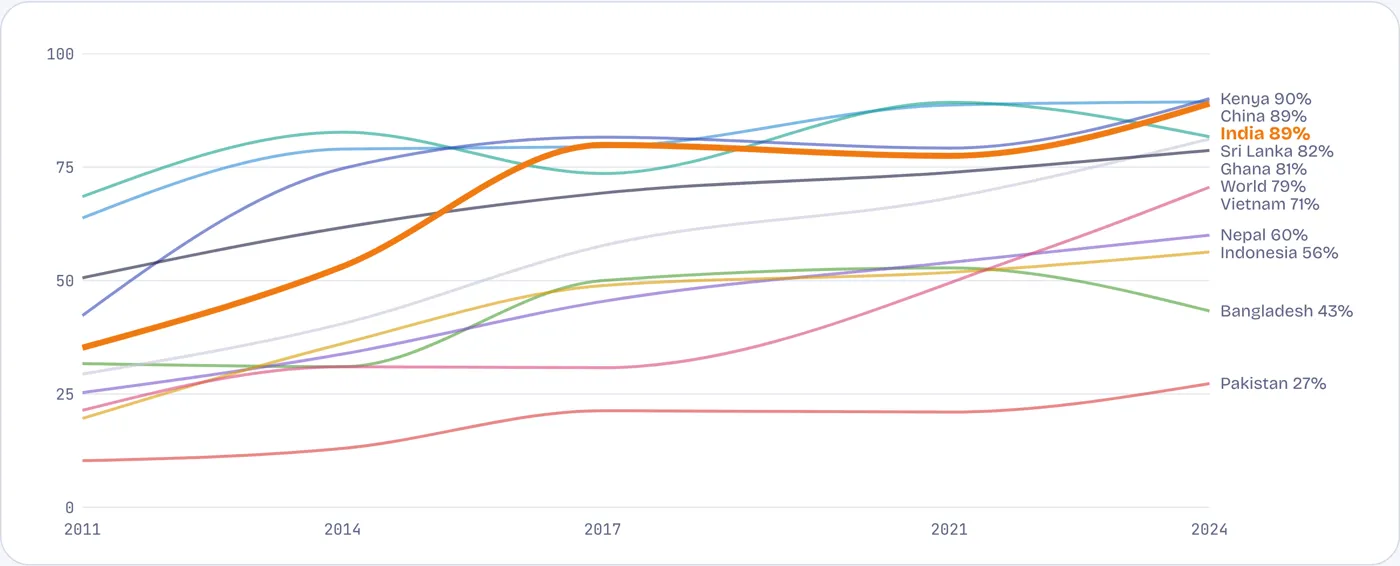
Account ownership leapt from below the world average to above it
Adults with an account at a bank or mobile-money provider. Tap or hover a line.
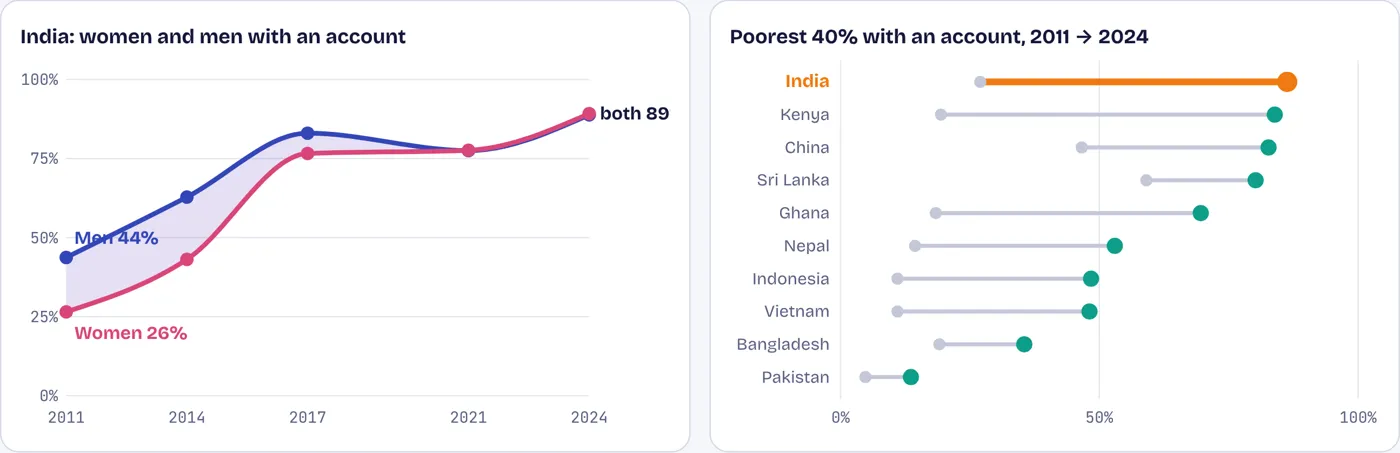
India went from 35% in 2011 to 89% in 2024, ten points above the world average. The biggest jump, 27 points, came between 2014 and 2017, the first three years of Jan Dhan. Only China and Kenya in the peer panel are level.
Source: World Bank Global Findex, via World Development Indicators. Survey years 2011, 2014, 2017, 2021 and 2024 (Vietnam 2022).
The poorest and women
The poorest and women were reached too
Account ownership among women and men in India, and among the poorest 40% across the peer panel
In 2011 men were 17 points more likely than women to have an account; by 2024 the gap had gone. Among the poorest 40% of adults, 86% have an account, more than in China and far more than in Bangladesh, Pakistan or Indonesia. In Pakistan only 12% of women do.
Source: World Bank Global Findex, via WDI.
Jan Dhan
59 crore no-frills accounts, one in four lying idle
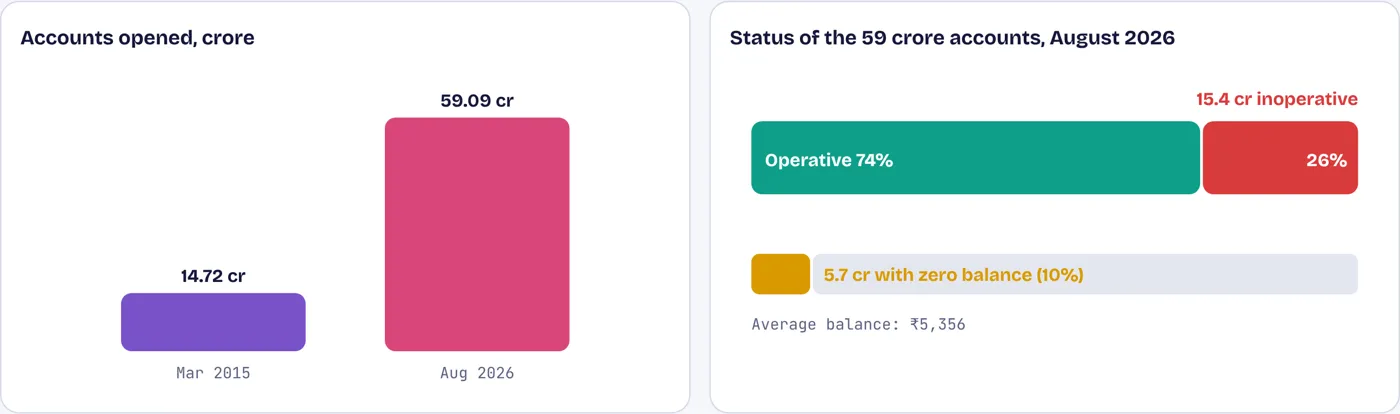
Jan Dhan accounts, crore
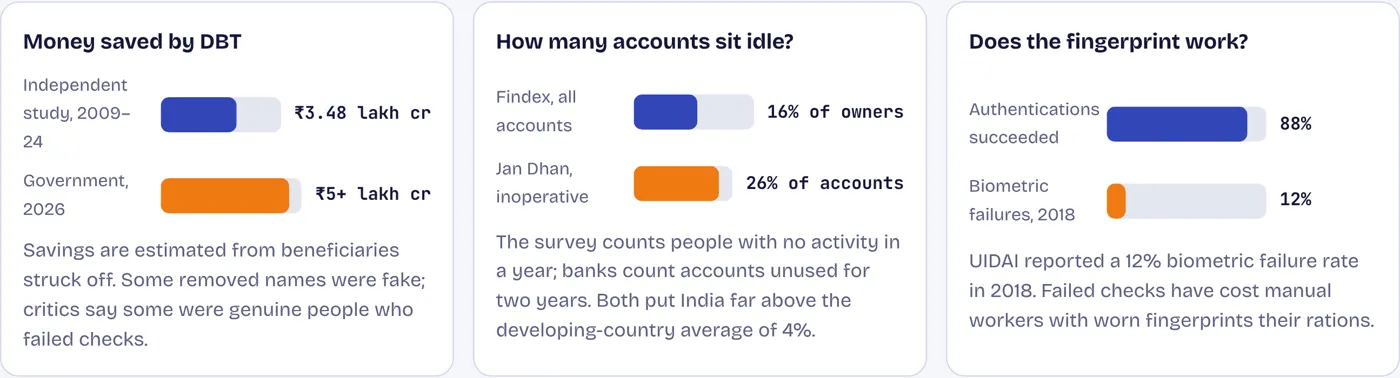
Accounts quadrupled from 14.7 crore in March 2015 to 59.1 crore in August 2026, and deposits grew twentyfold to ₹3.17 lakh crore. Average balance is about ₹5,356. But 15.4 crore accounts are inoperative and 5.7 crore hold nothing.
Source: Policy Edge, from Ministry of Finance data (August 2026); Department of Financial Services reply to an RTI application, via Free Press Journal (12 August 2026 data).
Idle accounts
Indians are four times as likely as others to leave an account unused
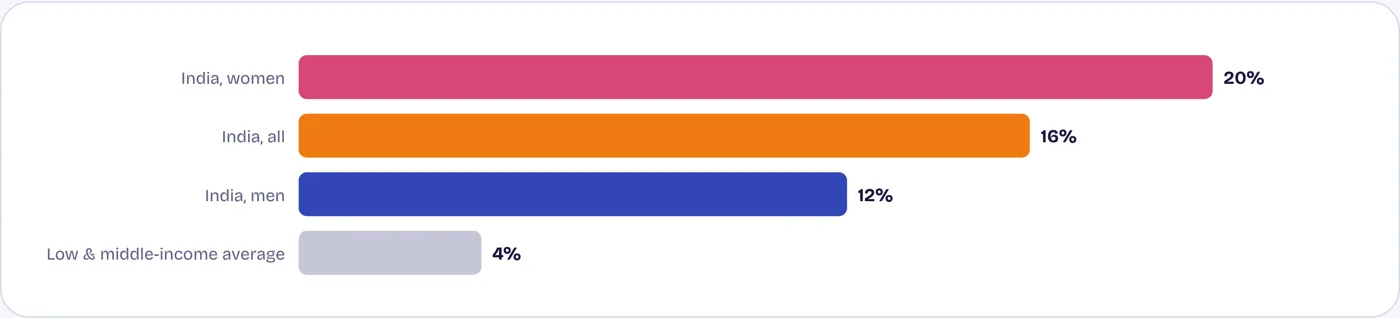
Account owners with no deposit or withdrawal in the past year, 2024
One in six Indian account owners neither paid in nor took out money in a year, against one in twenty-five across low- and middle-income countries. Women’s accounts are idle far more often than men’s.
Source: World Bank Global Findex 2025, via Data for India.
Welfare by wire
₹52 lakh crore paid straight into accounts
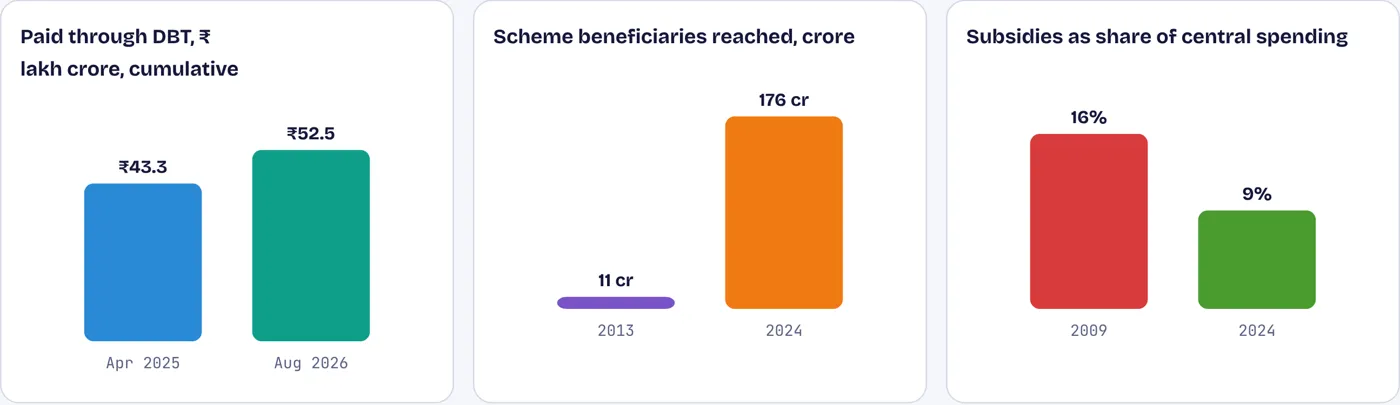
Direct Benefit Transfer: cumulative amount paid, beneficiaries reached (counted once per scheme, so one person can count several times) and subsidy share
More than 900 schemes now pay through DBT. Subsidies fell from 16% of central government spending in 2009 to 9% in 2024, partly because duplicate and fake ration cards and gas connections were weeded out.
Source: Government data via The Sentinel (April 2025); New India Samachar, PIB (August 2026); Business Today (beneficiaries, subsidy share).
How it was built
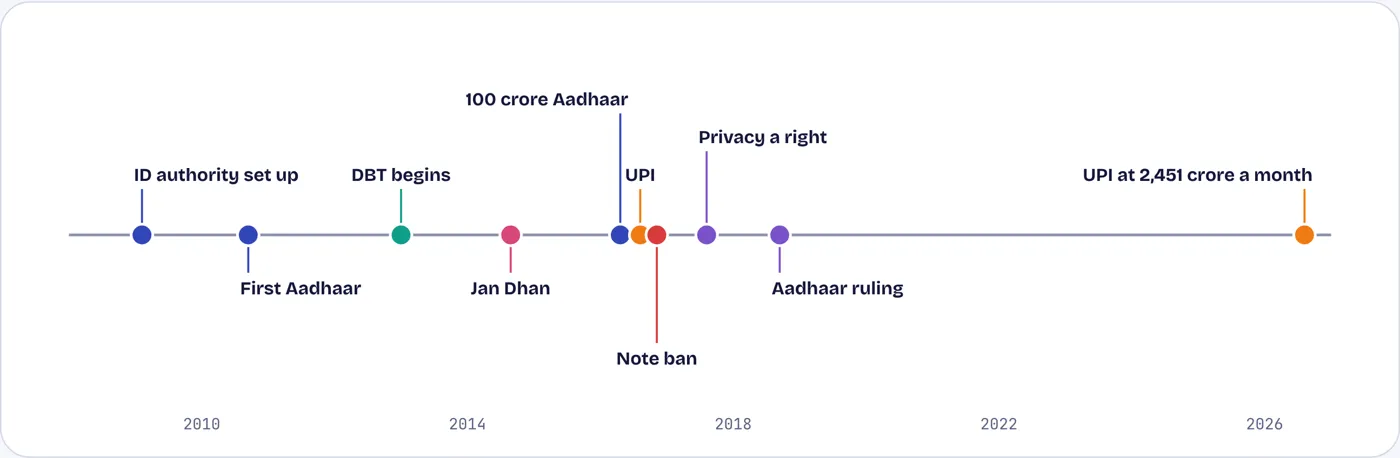
Seventeen years from an ID authority to a world payment system
Key steps. Tap or hover a dot.
The stack was started under one government and scaled under the next. Courts shaped it too: privacy was declared a fundamental right in 2017, and in 2018 private firms were barred from demanding Aadhaar.
Source: UIDAI; NPCI; Supreme Court of India; Wikipedia, Aadhaar.
Contested numbers
Three numbers that need a second look
Source: Business Today (Viksit Bharat study, 2025); New India Samachar (2026); Global Findex 2025; RTI reply via Free Press Journal; UIDAI via Wikipedia.