Labour hours lost to heat, 2024
247 bn
about 420 hours per person
Income lost to heat, 2024
$194 bn
about 5% of GDP
Households with an air conditioner
4%vs17%
rural vs urban, 2024 survey
India is about 0.9°C warmer than in 1901, and 2024 was its hottest year on record. Heat now costs the economy hundreds of billions of dollars a year in lost work, and the loss falls on farm labourers, builders and street vendors who cannot stop working or buy cooling. Rising temperatures widen the gap between those who can escape the heat and those who cannot.
The warming
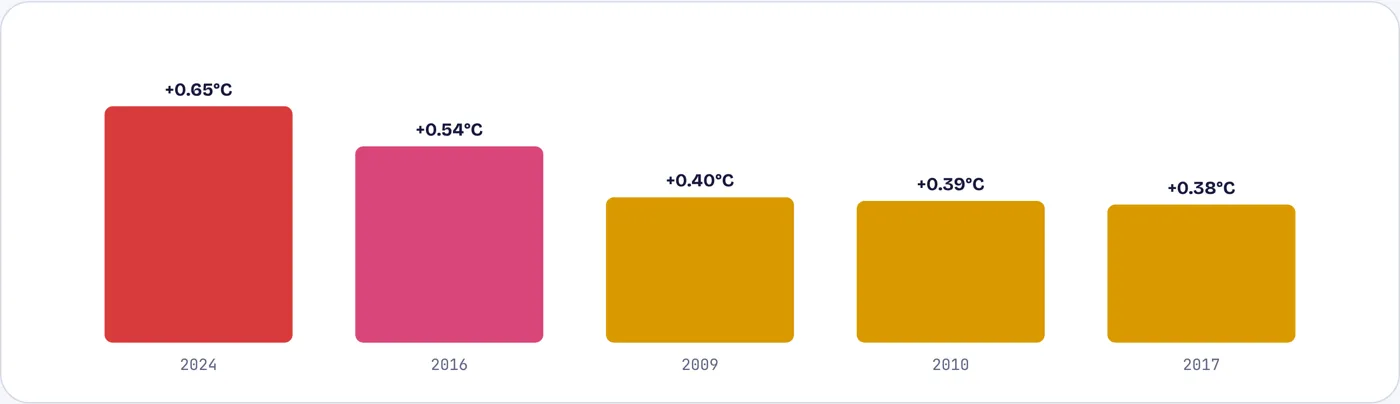
The five warmest years on record all came after 2008
India’s annual mean temperature, °C above the 1991–2020 average, warmest years since 1901
2024 was 0.65°C above the 1991–2020 average, beating 2016. Night-time minimum temperatures have risen slightly faster than daytime maxima, which matters for the poor: hot nights in crowded, uncooled homes deny the body its recovery.
Source: India Meteorological Department, via Data for India.
Lost work
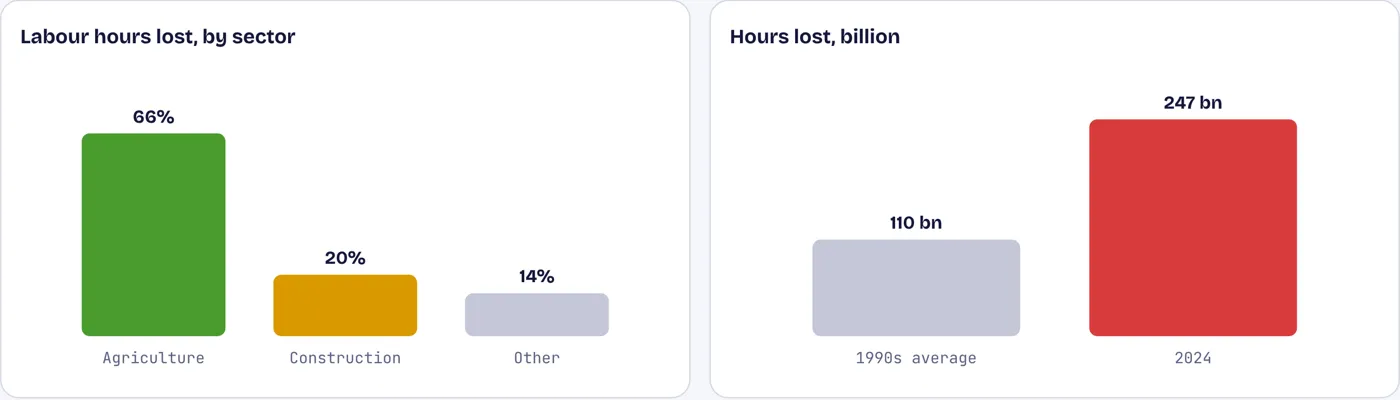
Heat cost India 247 billion working hours in 2024, two-thirds of them in farming
Potential labour hours lost to heat exposure, India, 2024: share by sector
The Lancet Countdown estimates India lost 247 billion potential labour hours to heat in 2024, about 2.2 times the 1990s level, and $194 billion in income. Agriculture accounted for 66% of the hours and construction 20%. These are the sectors where most of India’s poorest workers earn a daily wage.
Source: 2025 Lancet Countdown on Health and Climate Change, India data sheet, via Outlook Business. Share of GDP computed against 2024 GDP of $3.9 trillion.
Who is exposed
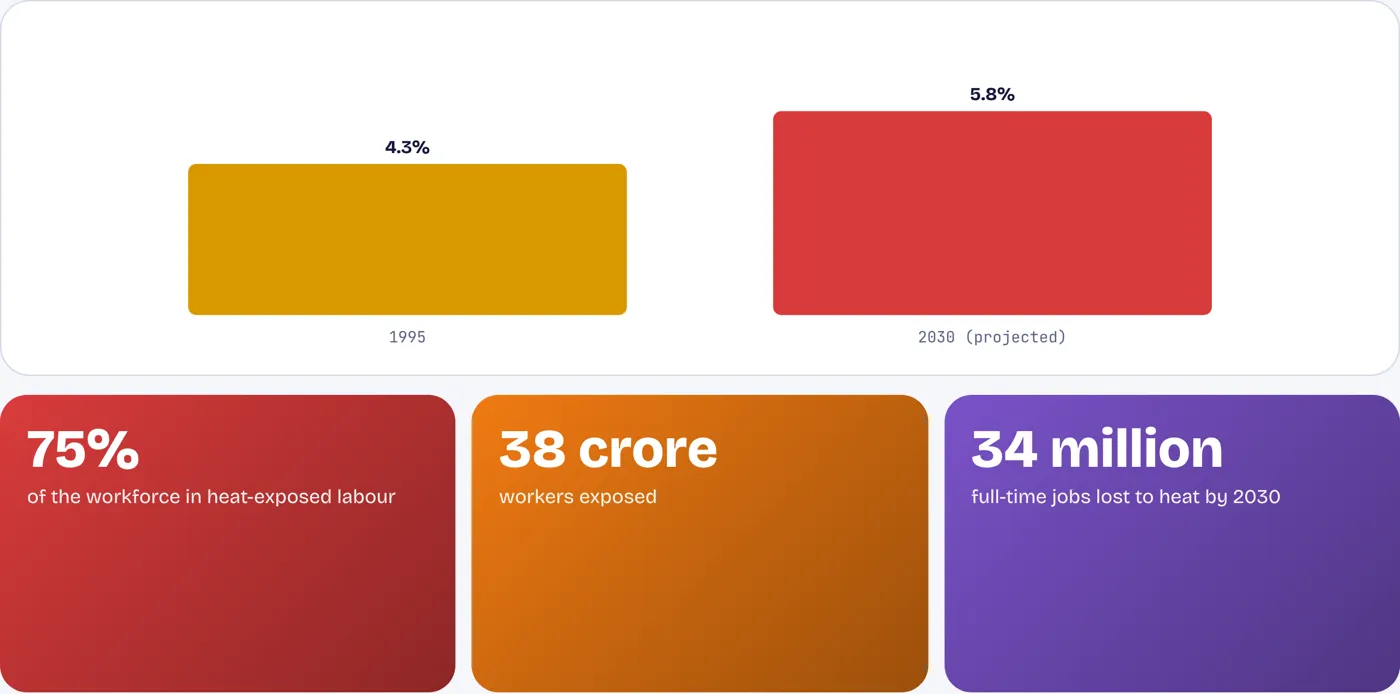
Three-quarters of India’s workers labour in the heat
Share of working hours lost to heat stress, %, ILO estimate and projection
The World Bank estimates that 75% of India’s workforce, about 38 crore people, depend on heat-exposed labour. The ILO projected India would lose 5.8% of all working hours to heat by 2030, the equivalent of 34 million full-time jobs, over two-fifths of the global total of 80 million.
Source: ILO, Working on a Warmer Planet (2019), via YourStory; World Bank, Climate Investment Opportunities in India’s Cooling Sector (2022), via Business Today.
The pay cut
Each extra degree cuts an informal worker’s earnings by about a seventh
Change in net earnings (red) and coping costs (gold) of informal workers in north-west Delhi, May–June 2019, %
A study of 396 self-employed and daily-wage workers in Delhi found that a 1°C rise in maximum temperature cut net earnings by 14%, and during heatwaves earnings fell 40%. At the same time spending on medicine, water and ice rose 14% per degree. The hotter it gets, the more the poor pay and the less they earn.
Source: Das and Somanathan, Delhi informal workers study, via Mongabay India (January 2025).
Who can cool
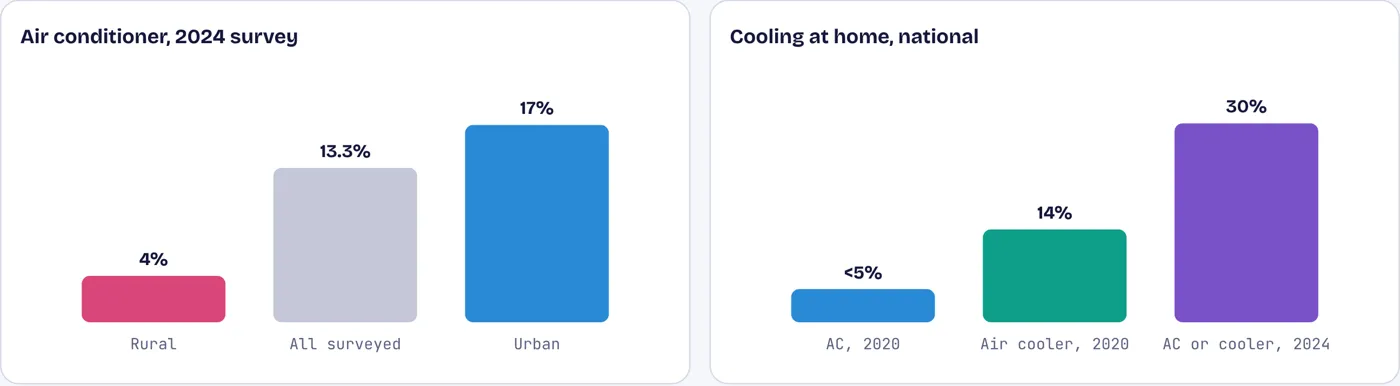
One urban home in six has an air conditioner; one rural home in twenty-five does
Households owning an air conditioner, %, 2024
Air conditioning is the clearest line between those who can escape heat and those who cannot. Ownership is concentrated among the richest urban households; most Indians rely on fans or coolers that do little in humid heat. As temperatures rise, the comfort gap becomes a health and productivity gap.
Source: CLASP and Bureau of Energy Efficiency household survey 2024 (4,321 households, 20 states), via Down To Earth (May 2026); NSS Multiple Indicator Survey 2020, via Data for India.
Contested numbers
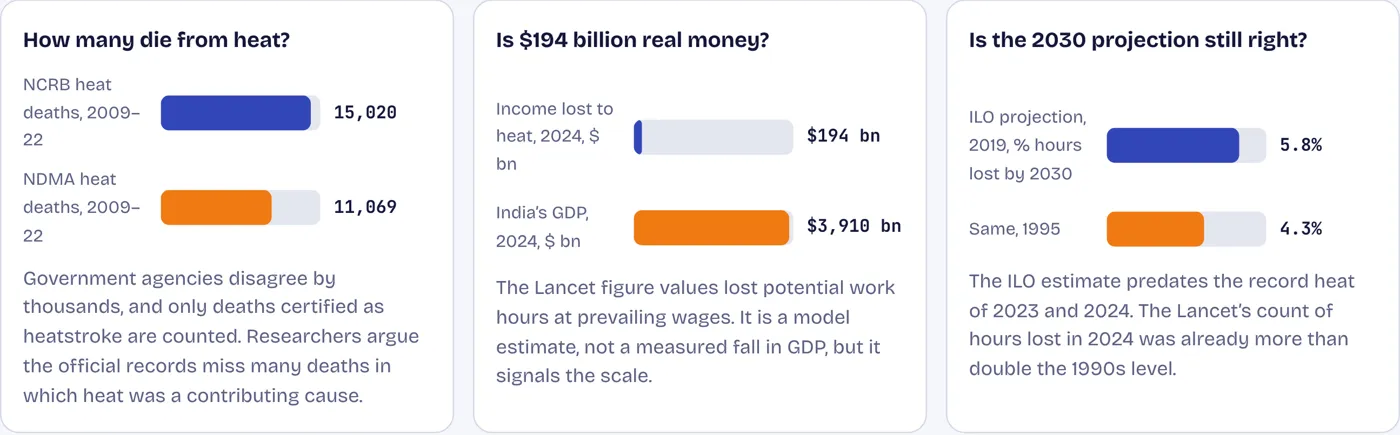
Three numbers that need a second look
Source: Factly (government heat-death records); Lancet Countdown; ILO.
The takeaway
Heat is a tax that rises with the temperature and falls on the poorest: the farmhand, the builder and the vendor lose wages, pay more to cope, and go home to houses that do not cool.