In 2004 forty crore Indians lived without electricity, nearly a third of all the people on earth who did. Today almost everyone is connected, and village power runs most of the day.
The connection
From a third without power to almost none
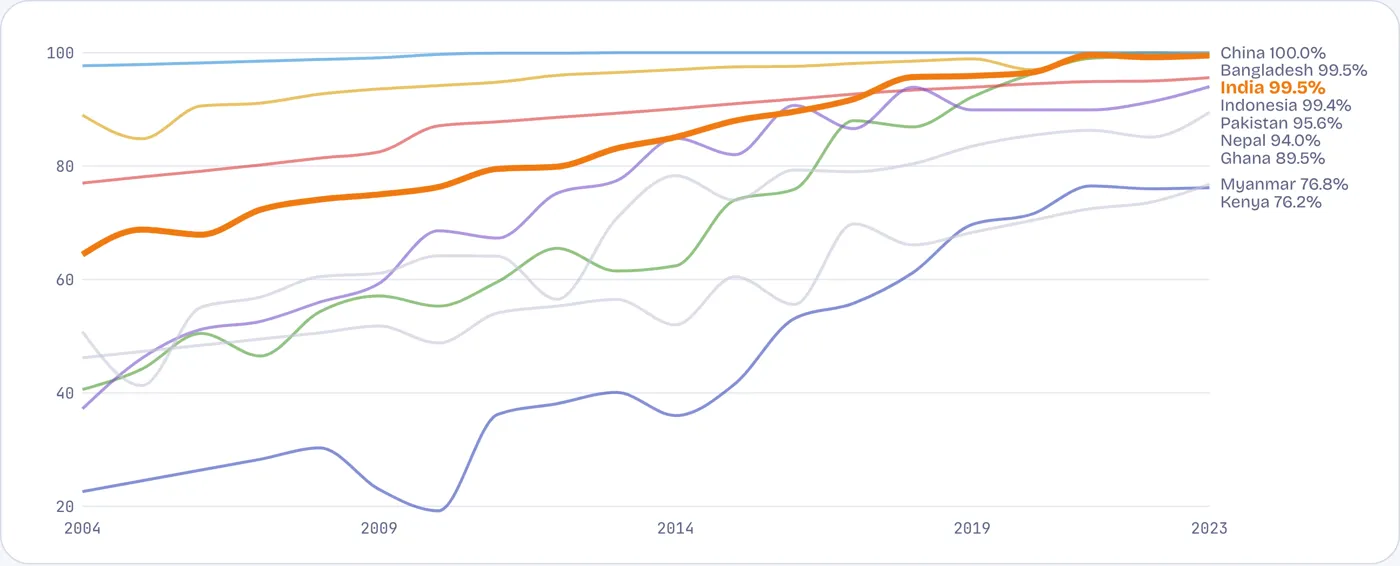
Share of people with access to electricity, India and the peer panel. Tap or hover a line.
India’s access rose about two points a year for two decades. It passed Pakistan in 2018, drew level with Indonesia by 2021, and stands with Bangladesh at 99.5%. Kenya and Myanmar, at about 76%, are where India was in 2010.
Source: World Bank WDI (Tracking SDG 7), 2004–2023.
People
Forty crore people connected
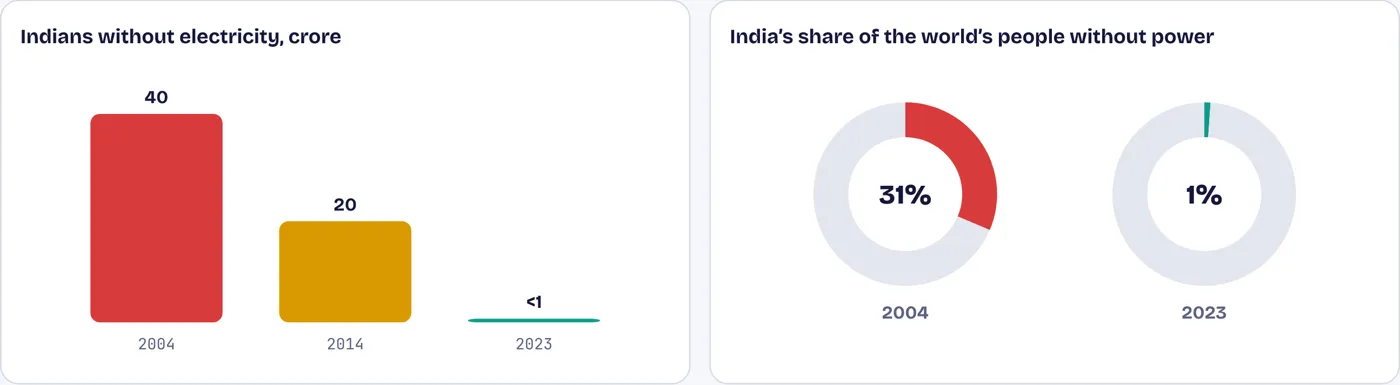
Indians without electricity, crore, and India’s share of everyone in the world without it
About 40 crore Indians had no electricity in 2004, 20 crore in 2014 and under 1 crore in 2023. In 2004 India was home to 31% of the world’s people without power; by 2023, about 1%. Most of the world’s unconnected now live in sub-Saharan Africa.
Source: calculated from World Bank WDI access shares and population.
Villages
Rural India caught up with the towns
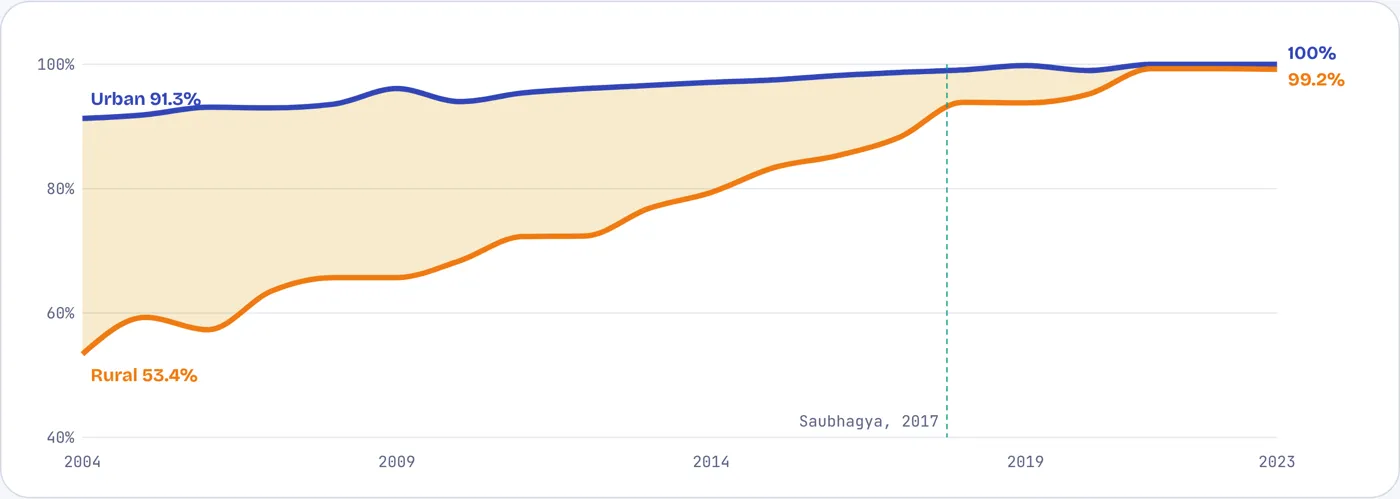
Share of people with electricity, rural and urban India
Only about half of rural Indians had electricity in 2004. The gap with towns closed by 2023. Two programmes did most of it: village grid extension, which ran under both the UPA and NDA governments, and the Saubhagya household connection drive from 2017, which wired 2.86 crore homes.
Source: World Bank WDI; Ministry of Power via SolarQuarter (August 2025).
Two governments
Most villages were reached before 2014; most homes after
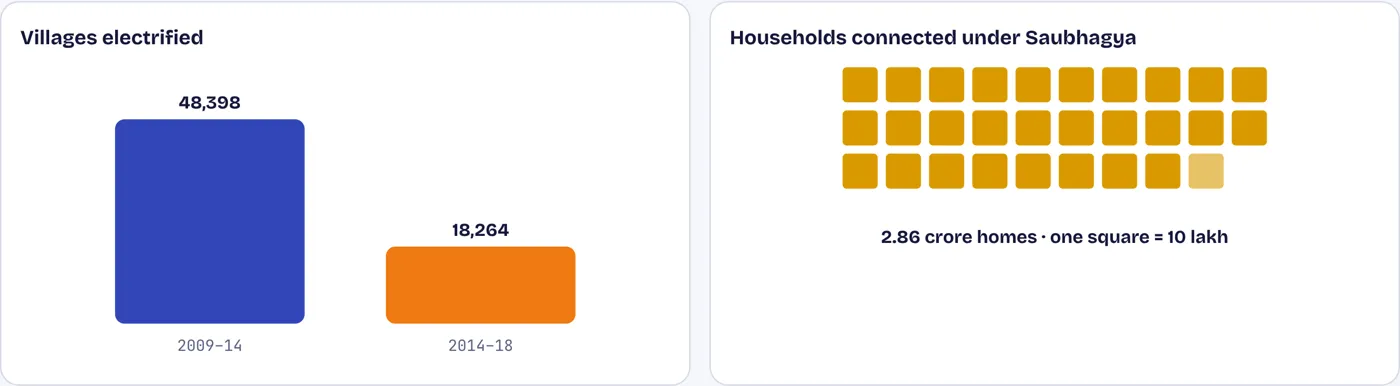
Villages electrified and homes connected
48,398 villages were electrified from 2009 to 2014 and 18,264 from 2014 to April 2018, when the last inhabited village was declared electrified. Connecting the homes inside those villages came later, through Saubhagya.
Source: IndiaSpend (village counts); Ministry of Power via SolarQuarter (Saubhagya).
Hours
Power now stays on most of the day
Average hours of electricity supply per day
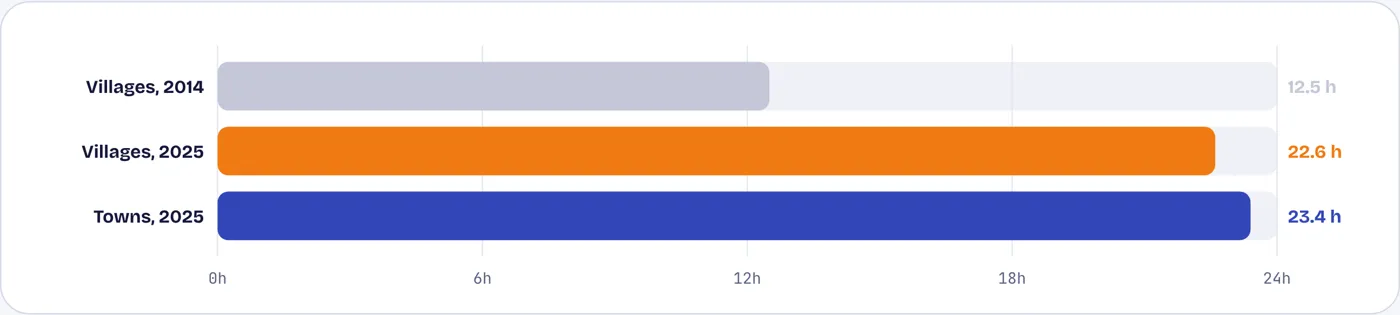
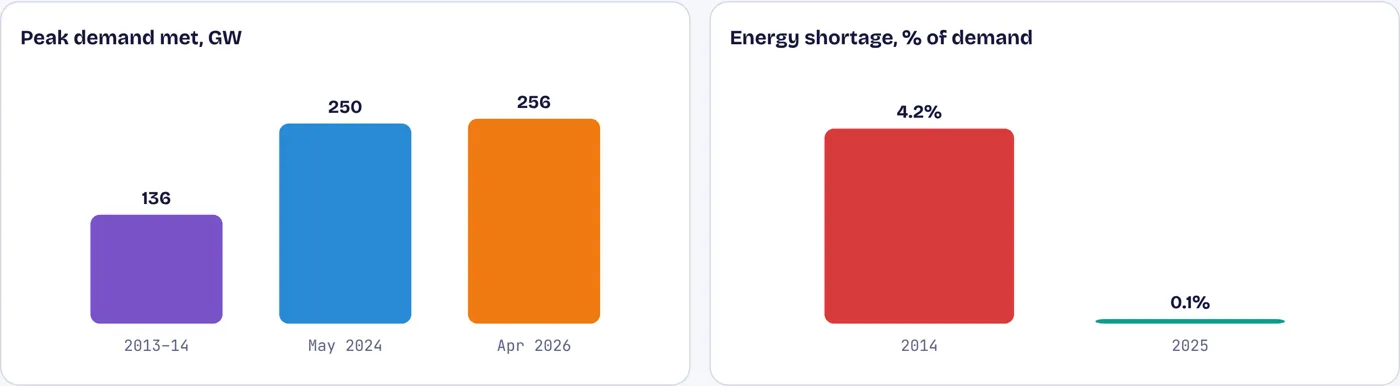
A connection is only as good as the supply behind it. Rural supply rose from 12.5 hours a day in 2014 to 22.6 in 2025; towns get 23.4. Nationally, the gap between electricity demanded and supplied fell from 4.2% to 0.1%.
Source: Ministry of Power reply in Parliament, via The Sentinel (February 2025).
The grid
Peak demand nearly doubled, and the grid kept up
Highest electricity demand met in a single moment, gigawatts; and energy shortage, % of demand
Demand peaked at a record 256 GW on 25 April 2026. Transmission lines grew from 2.91 to 4.92 lakh circuit km, and India turned from a net importer of power to a net exporter.
Source: Down To Earth (April 2026); Ministry of Power via The Sentinel; Central Electricity Authority (2013–14 peak).
Overtaking
India moved past 21 countries
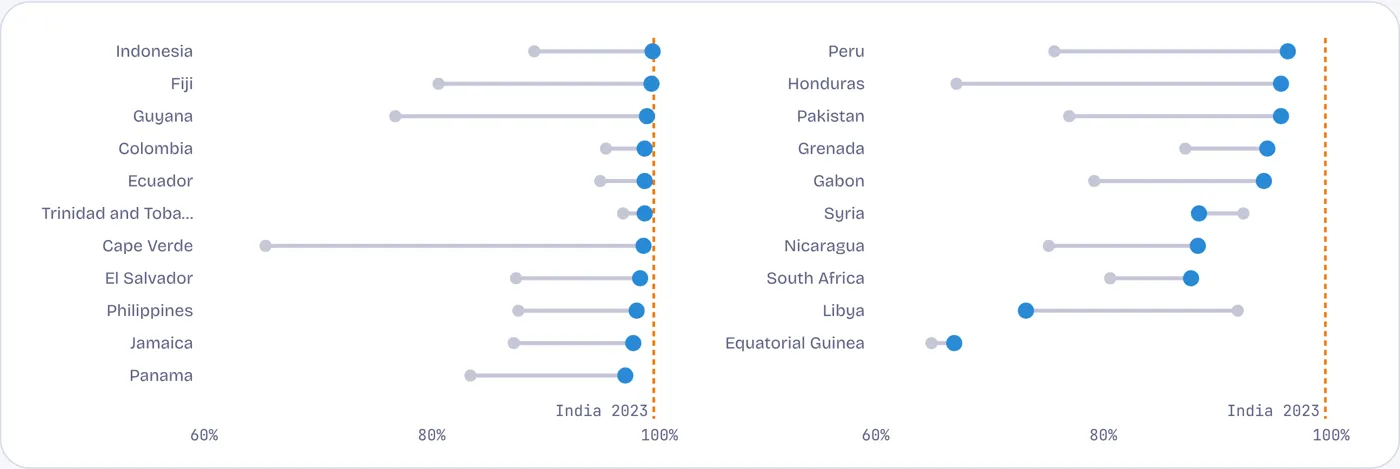
Countries with more electricity access than India in 2004 but less in 2023: access in 2004 → 2023
India overtook Pakistan, Indonesia, the Philippines, Peru, South Africa and most of Central America. A few, like Libya and Syria, fell back because of war.
Source: World Bank WDI.
The kitchen
Clean cooking spread fast, but a quarter still burn wood or dung
Share of people using clean cooking fuel, mainly LPG, 2004 → 2023
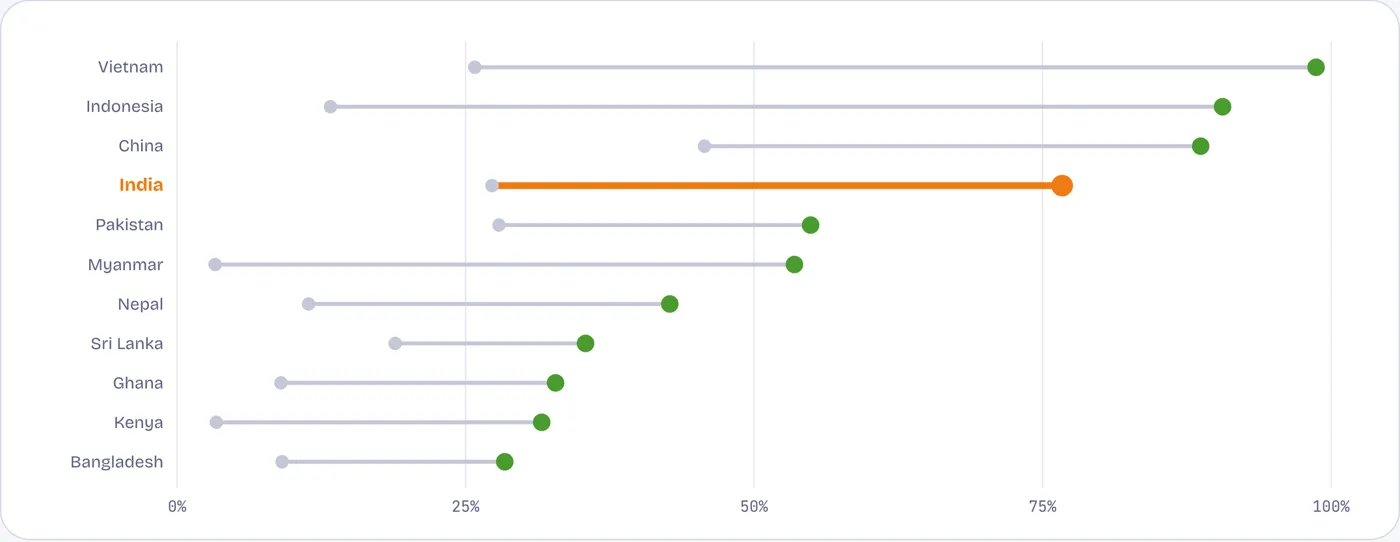
India nearly tripled clean cooking, to 77%, a bigger gain than China’s and far ahead of Bangladesh, Pakistan and Sri Lanka. In villages it rose from 9% to 66%. The Ujjwala scheme has given 10.35 crore poor households an LPG connection since 2016, but many still cook partly on wood because refills cost money.
Source: World Bank WDI (WHO); Ministry of Petroleum via Free Press Journal (December 2025).
Leaks
The grid still loses a seventh of its power
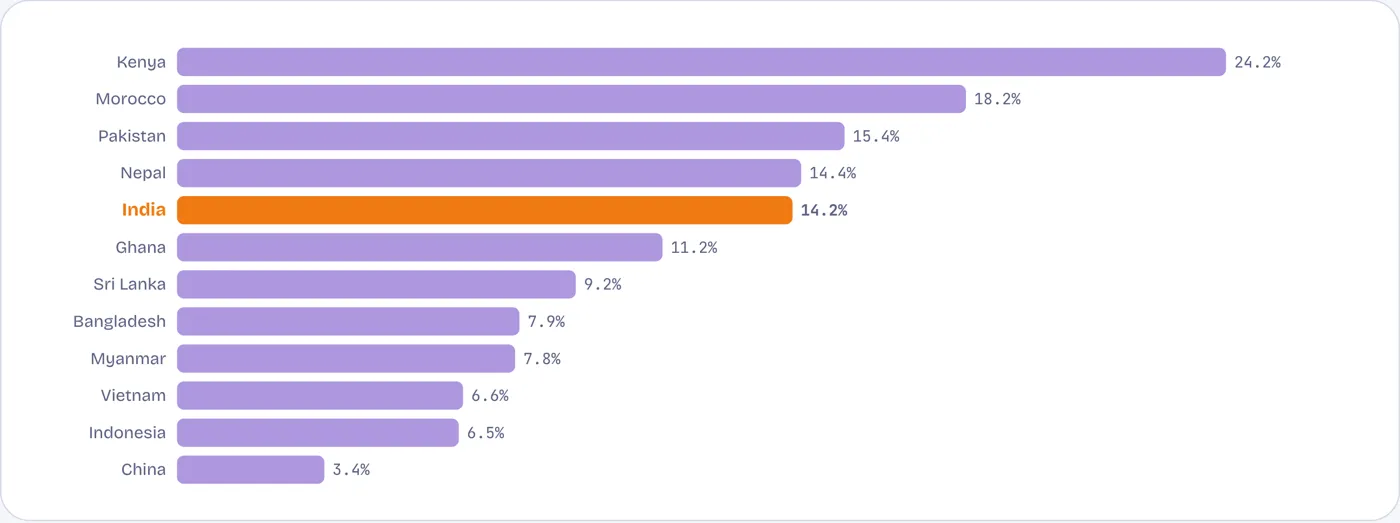
Transmission and distribution losses, % of output, 2023
Losses fell from 26% in 2004 to 14%, but that is still four times China’s rate and twice Vietnam’s or Bangladesh’s. Theft, unmetered supply and old wires keep state power companies in debt.
Source: World Bank WDI (IEA).
Contested numbers
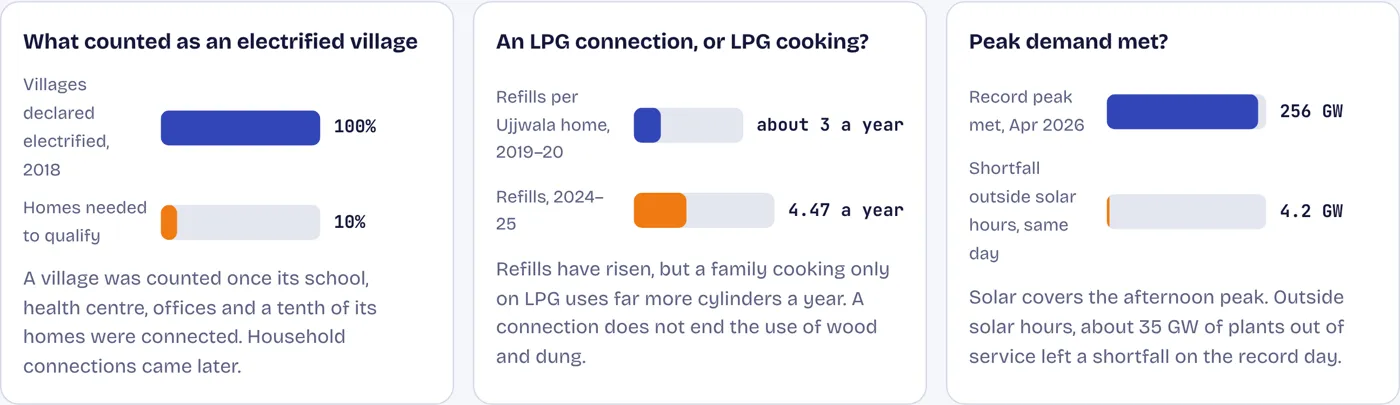
Three numbers that need a second look
Source: IndiaSpend; World Bank WDI; Ministry of Petroleum via Free Press Journal; Down To Earth.