India has one of the five or six largest economies in the world. Its average citizen still earns less than the average person in three of every four countries.
Two rankings
Two rankings, two different countries
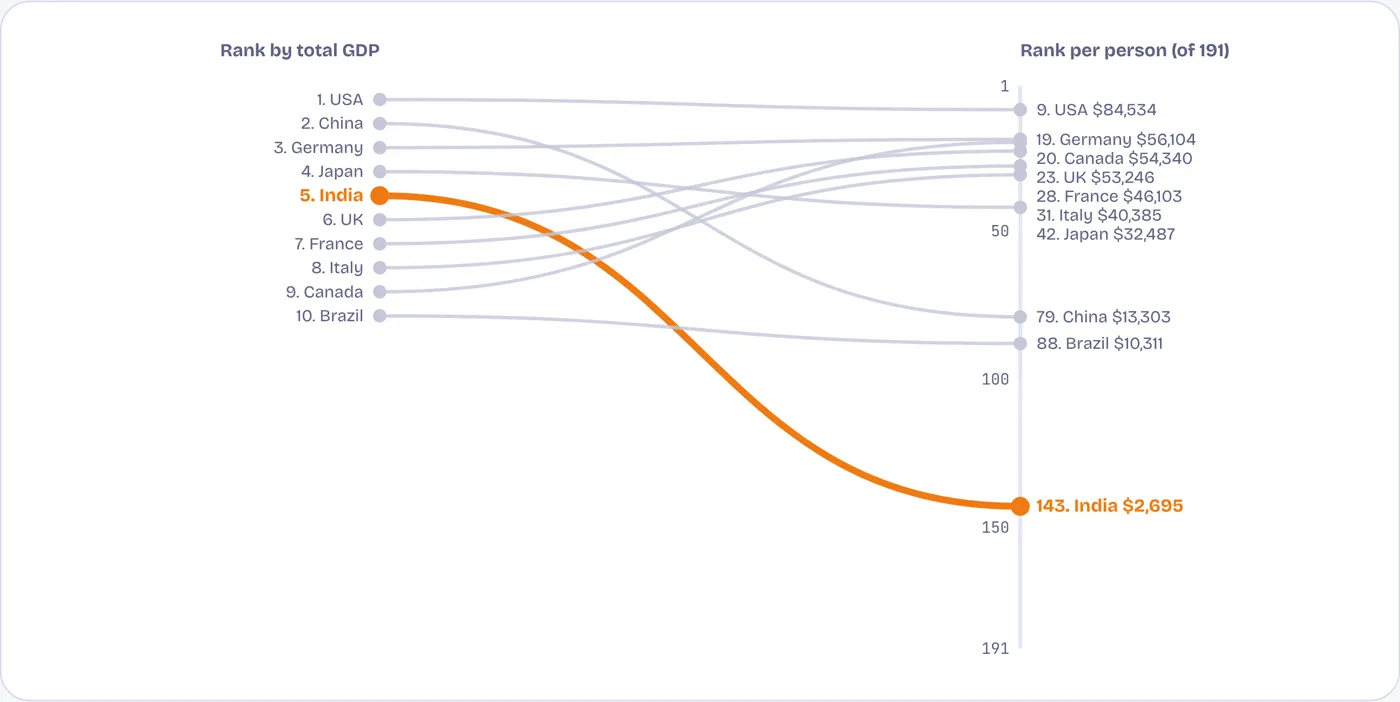
The ten largest economies in 2024: rank by total GDP and rank by GDP per person, current US dollars. Tap or hover a line.
Every other large economy is also rich or upper-middle income per person. India is the only one of the ten where the average income, $2,695, is below the world median. Brazil, the next poorest of the ten, has almost four times India’s income per person.
Source: World Bank WDI, GDP and GDP per capita, current US$, 2024. Per-person rank among 191 countries with 2024 data.
Twenty years
The economy climbed seven places; the citizen barely moved
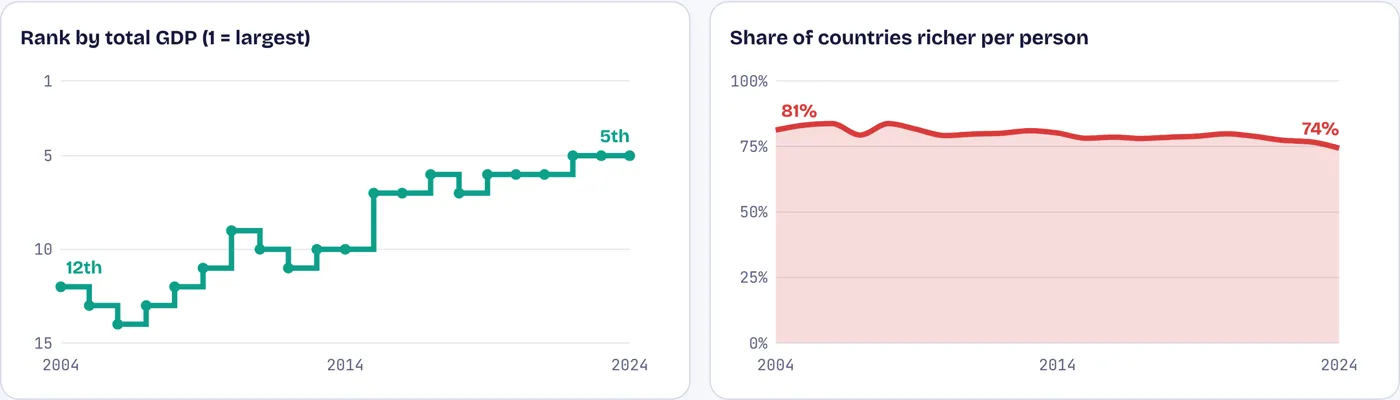
India’s rank by size of economy, and the share of countries richer than India per person
India rose from 12th to 5th by total output because of its population and steady growth. Per person, about four in five countries were richer than India in 2004 and about three in four still are.
Source: World Bank WDI, current US$. The number of countries with data varies from 191 to 212 a year, so the share is used rather than the rank.
Against the peer panel
Behind Vietnam, Indonesia, Sri Lanka and Egypt in income per person
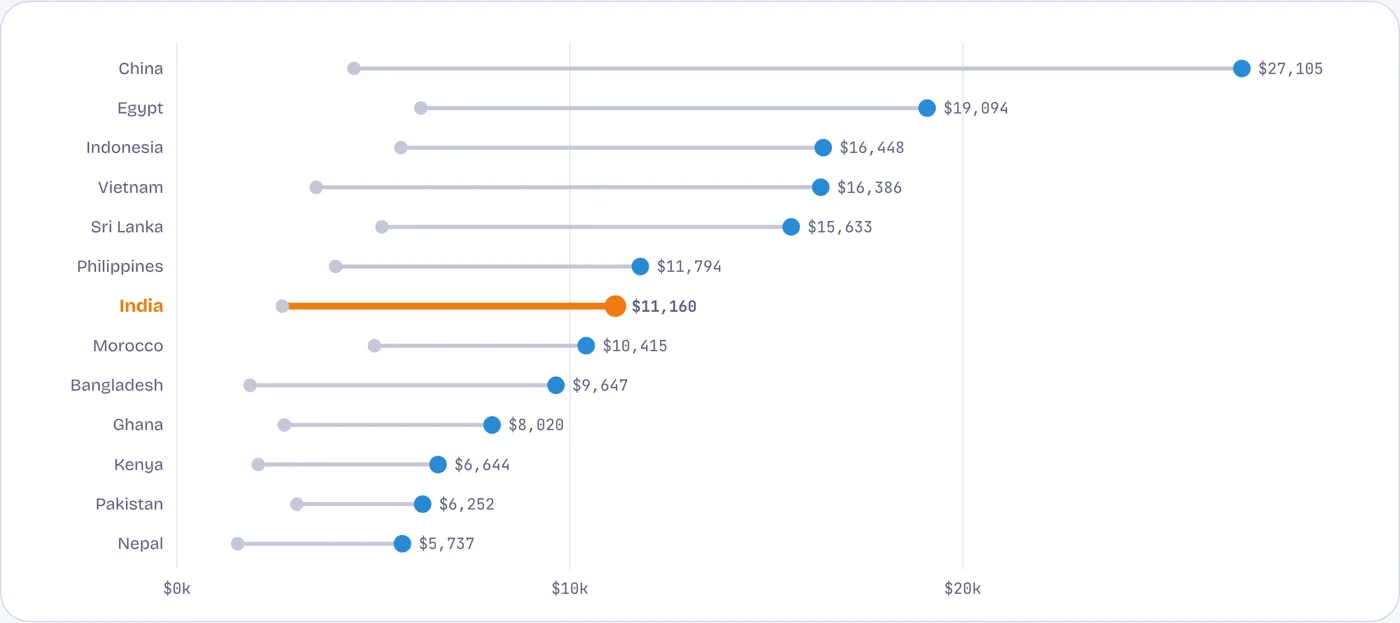
GDP per person at purchasing-power parity, current international $, 2004 → 2024
Adjusted for prices, the average Indian produces about $11,200 a year, close to the Philippines and Morocco and ahead of Bangladesh, Kenya and Pakistan, but about a third below Vietnam and Indonesia and less than half of China.
Source: World Bank WDI, GDP per capita, PPP (current international $).
Wellbeing
Countries poorer than India live better
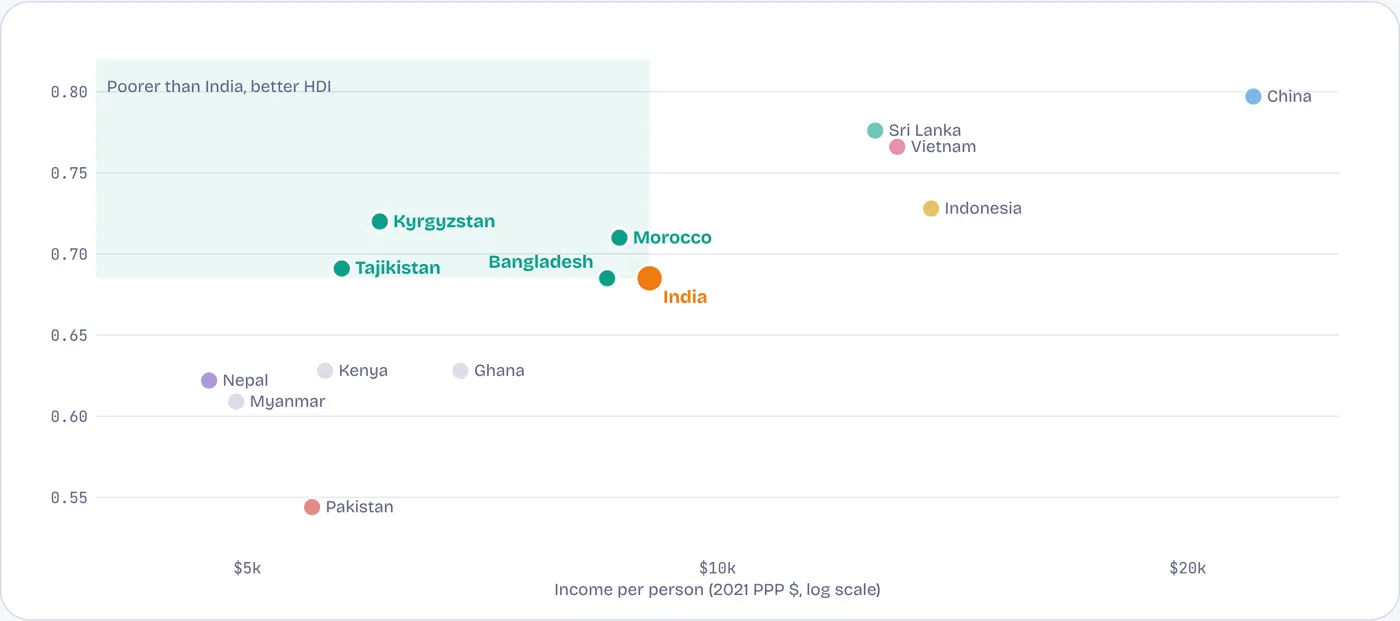
Human Development Index against income per person, 2023. Tap or hover a dot.
Kyrgyzstan and Tajikistan have two-thirds of India’s income per person and higher human development. Morocco and Bangladesh, at a similar income, match or beat it. Vietnam and Sri Lanka, with about 40% more income, score far higher, because their people live longer and stay in school longer.
Source: UNDP, Human Development Report 2025, Statistical Annex, Table 1 (GNI per capita in 2021 PPP $).
The conversion rate
India turns income into wellbeing worse than its income predicts
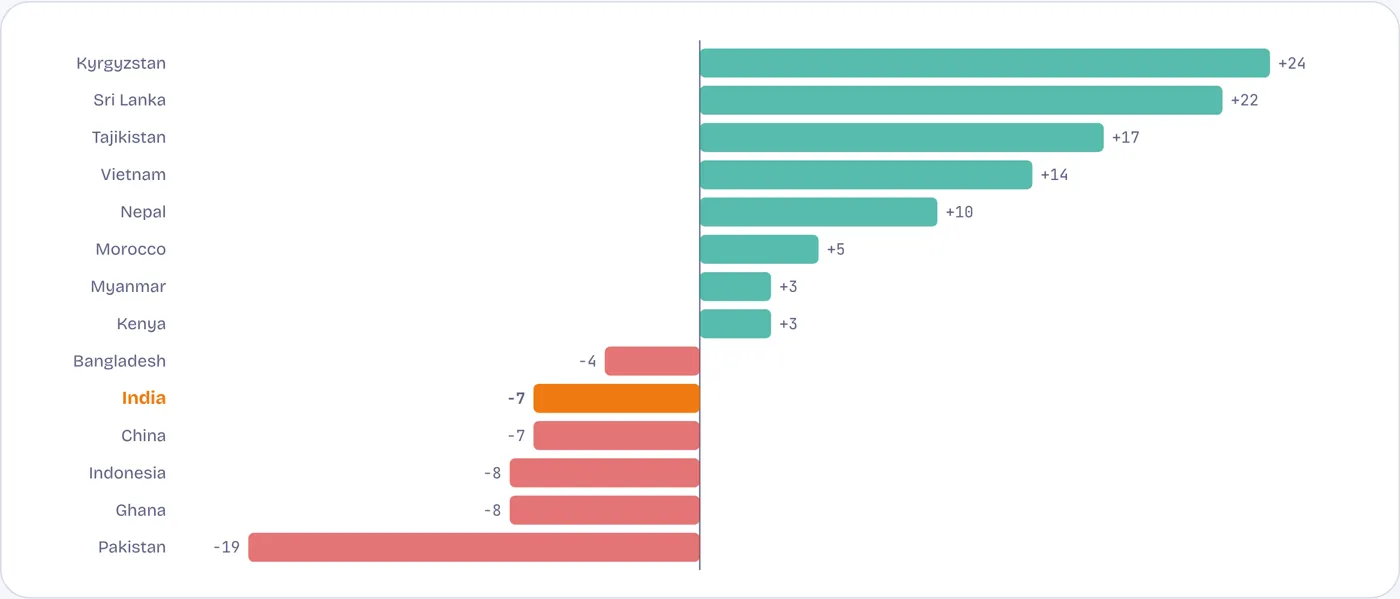
Rank by income per person minus rank by HDI, 2023. Positive: better wellbeing than income would suggest.
India ranks seven places lower on human development than on income. Sri Lanka ranks 22 places higher, Kyrgyzstan 24, Vietnam 14 and Nepal 10. These countries get more health and schooling out of each dollar of income.
Source: UNDP, Human Development Report 2025, Table 1.
Catching up, then caught
Bangladesh started lower and has drawn level
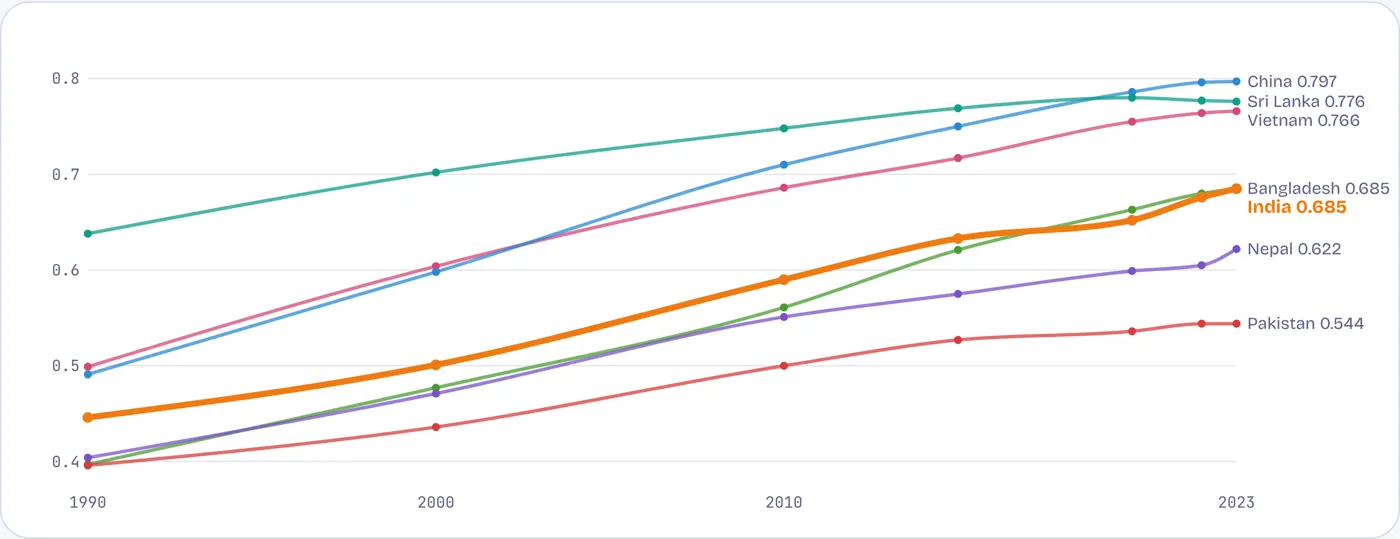
Human Development Index, 1990–2023
India’s HDI rose by more than half since 1990, from 0.446 to 0.685. Bangladesh rose faster and is now level. China and Vietnam, close to India in 1990, are now far ahead.
Source: UNDP, Human Development Report 2025, HDI trends table.
Who gets the income
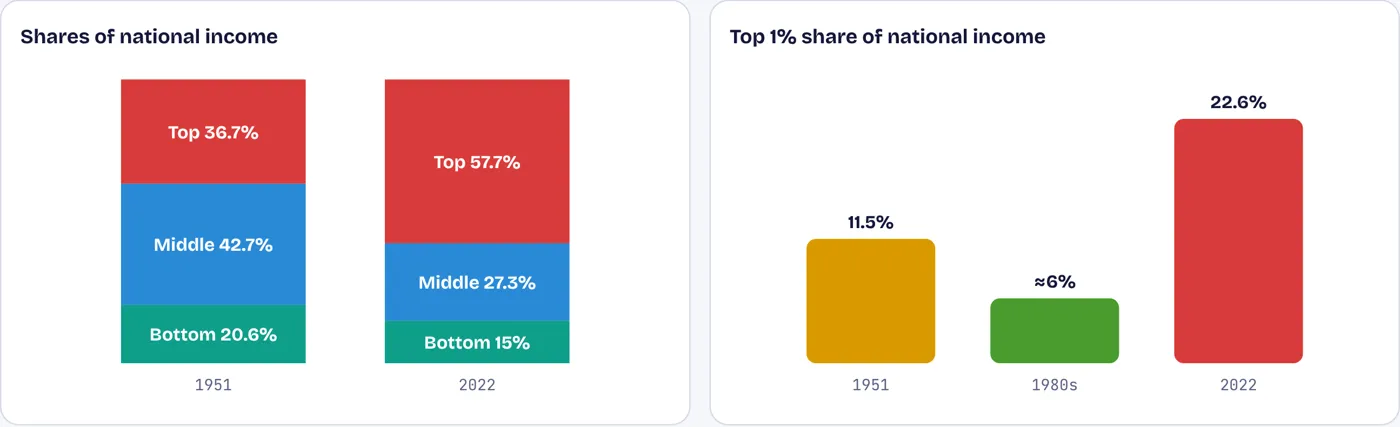
The top tenth takes almost three-fifths of national income
Shares of national income, 1951 and 2022, and the top 1% share
In 1951 the bottom half of Indians earned 20.6% of national income; by 2022, 15%. The top 1% took 22.6% of income and 40.1% of wealth in 2022–23, the highest shares in the record that begins in 1922.
Source: World Inequality Lab (Bharti, Chancel, Piketty and Somanchi, 2024), via Civilsdaily.
The inequality discount
Inequality cuts India’s human development by almost a third
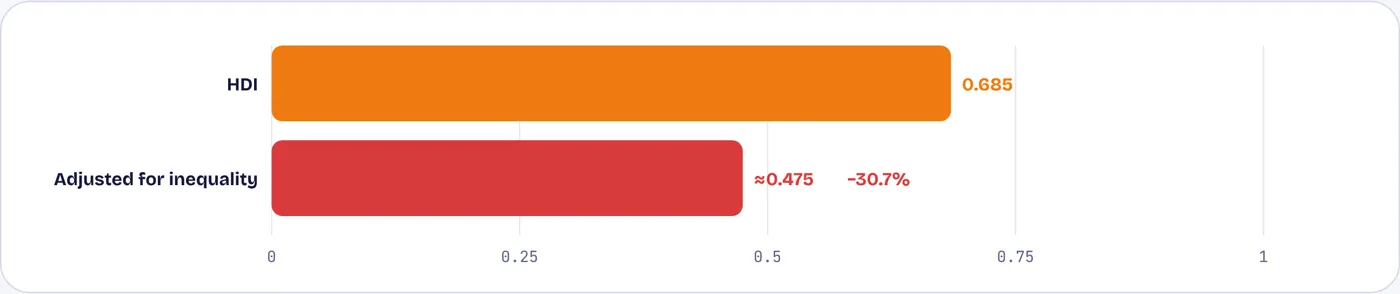
HDI and HDI adjusted for inequality in health, education and income, 2023
Averages hide how unevenly health, schooling and income are shared. Adjusted for that, India’s HDI falls by 30.7%, one of the largest losses in the region.
Source: UNDP, Human Development Report 2025, via UNDP India press release (May 2025).
Contested numbers
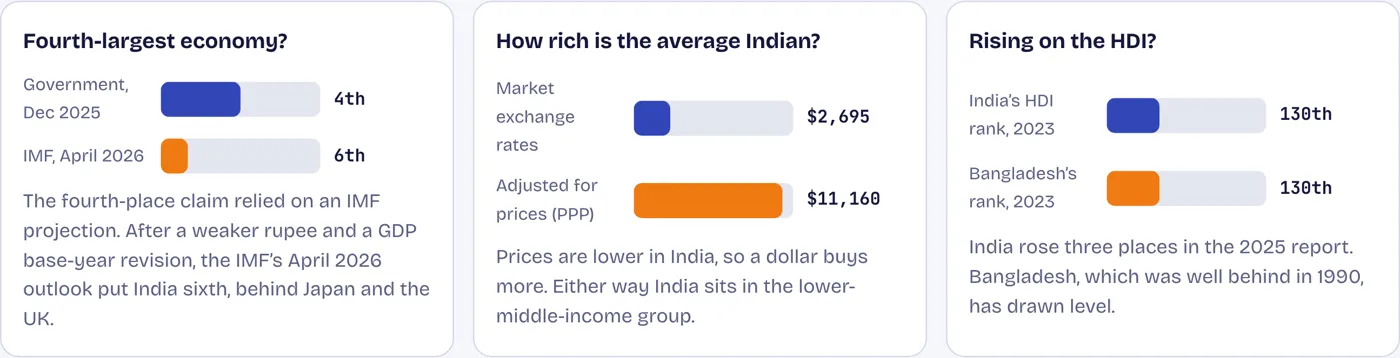
Three numbers that need a second look
Source: Government of India (December 2025); IMF World Economic Outlook (April 2026) via Basis Point Insight; World Bank WDI; UNDP.