India grows record harvests and gives free grain to 81 crore people. One in three of its young children is still too short for their age, and more than half its women are anaemic.
The ranking
Behind every South Asian neighbour except Pakistan and Afghanistan
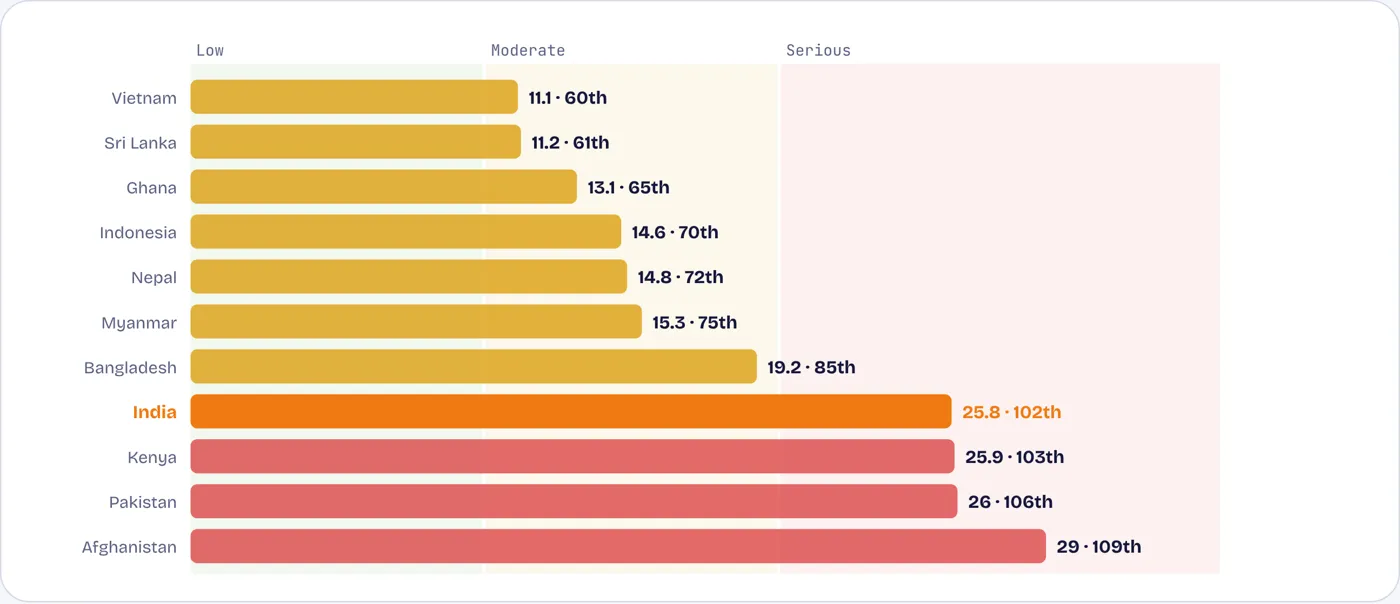
Global Hunger Index 2025 score (lower is better) and rank of 123 countries
India’s score of 25.8 puts it in the “serious” band, level with Kenya and Pakistan. Sri Lanka, Nepal and Bangladesh are 17 to 41 places ahead. The main drag is child wasting, at 18.7% the second-highest of any country in the report.
Source: Global Hunger Index 2025 (Welthungerhilfe and Concern Worldwide). China is ranked jointly in the top group with a score below 5.
The paradox
More food, fewer hungry, but children still short
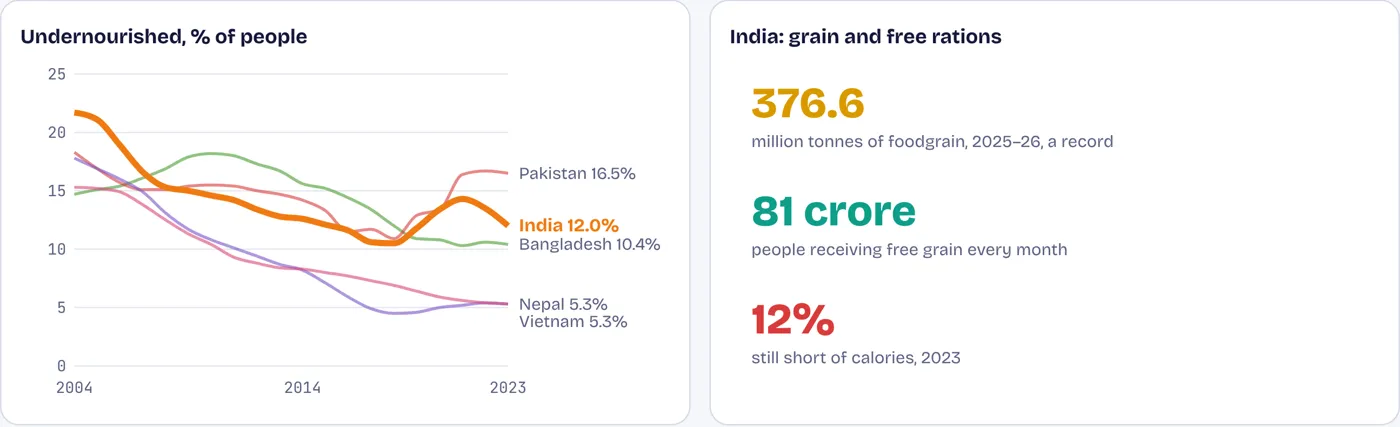
Share of people without enough calories, and foodgrain output
Undernourishment, a measure of calories, fell from 22% in 2004 to 12% in 2023. Grain output reached a record 377 million tonnes in 2025–26, and 81 crore people receive free grain each month. Calories are not the same as nutrition: diets heavy in cereals and light in protein, vegetables and fat leave children small even when they are not hungry.
Source: FAO via World Bank WDI; Ministry of Agriculture via Agro & Food Processing (2026); PRS India, demand for grants 2026–27.
Stunting
Bangladesh and Nepal started worse and are now better
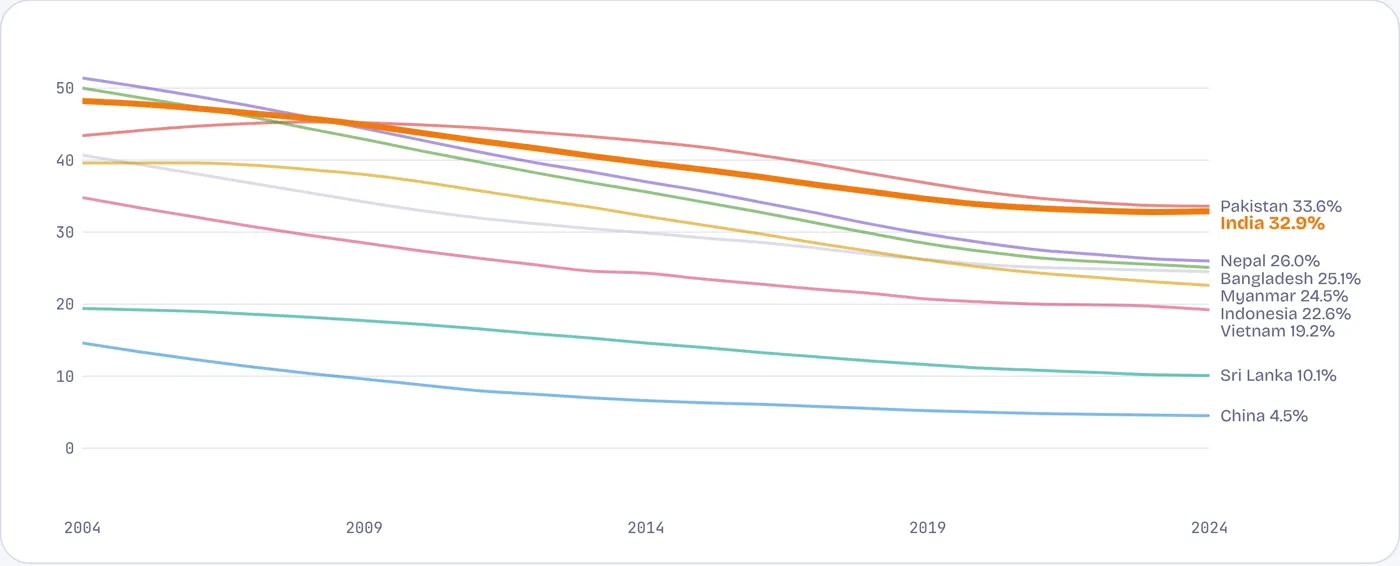
Share of children under five too short for their age (stunted), modelled estimates. Tap or hover a line.
In 2004 about half of children in India, Bangladesh and Nepal were stunted. By 2024 India had brought it to 33%, Nepal to 26% and Bangladesh to 25%. Progress in India slowed sharply after 2020. Vietnam is at 19%, Sri Lanka at 10% and China at under 5%.
Source: UNICEF/WHO/World Bank Joint Malnutrition Estimates, via WDI.
What surveys found
Stunting fell; wasting barely moved
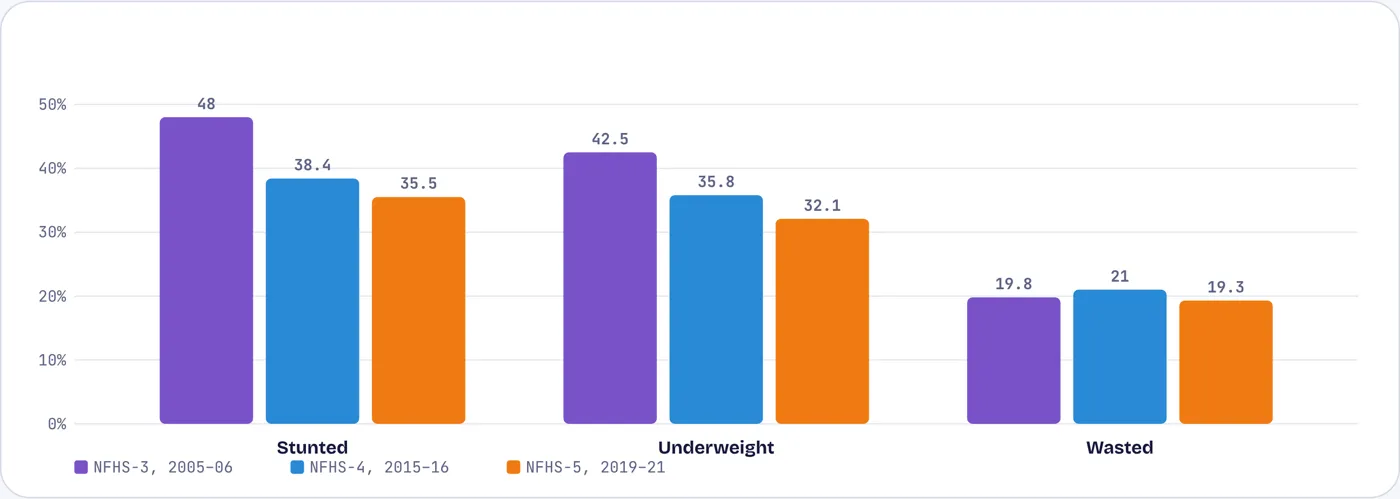
Children under five, National Family Health Survey rounds
Stunting, the long-run marker of poor nutrition, fell from 48% to 35.5% over fifteen years. Underweight fell too. But wasting, the sign of acute hunger or illness, was 19.8% in 2005–06 and 19.3% in 2019–21: one child in five, unchanged.
Source: NFHS-3 (2005–06), NFHS-4 (2015–16) and NFHS-5 (2019–21), Ministry of Health and Family Welfare.
Thin children
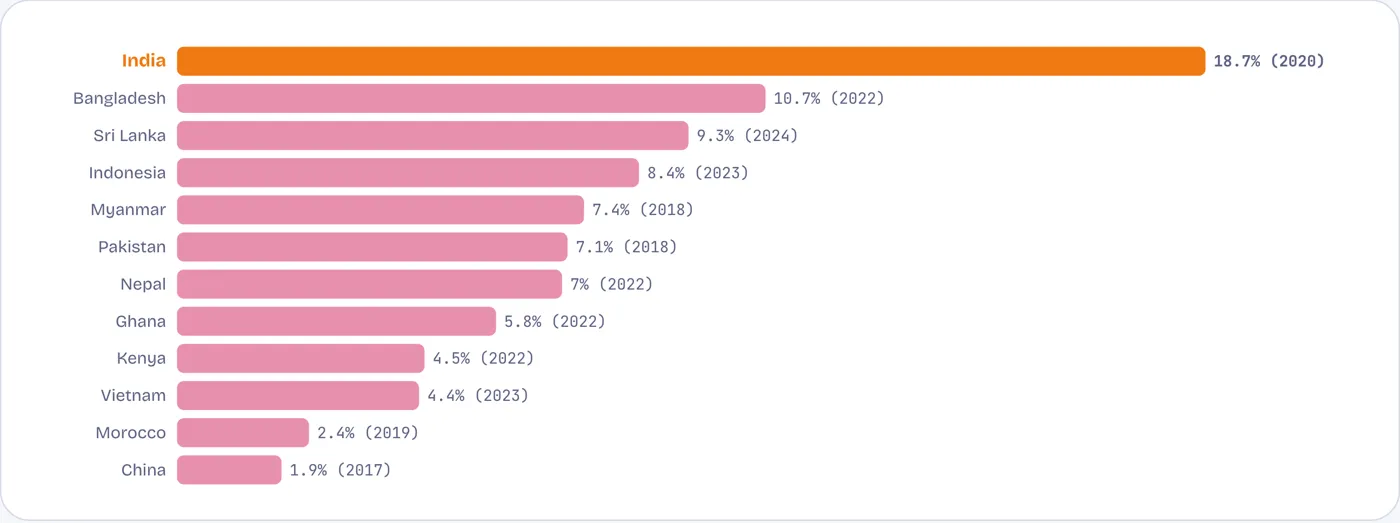
The highest child wasting in the peer panel
Children under five who are wasted (low weight for height), latest survey year
About one Indian child in five is wasted, roughly twice the share in Bangladesh or Sri Lanka and four times Vietnam’s. Only one country among the 123 in the 2025 Global Hunger Index had a higher rate.
Source: UNICEF/WHO/World Bank Joint Malnutrition Estimates via WDI; Global Hunger Index 2025.
Anaemia
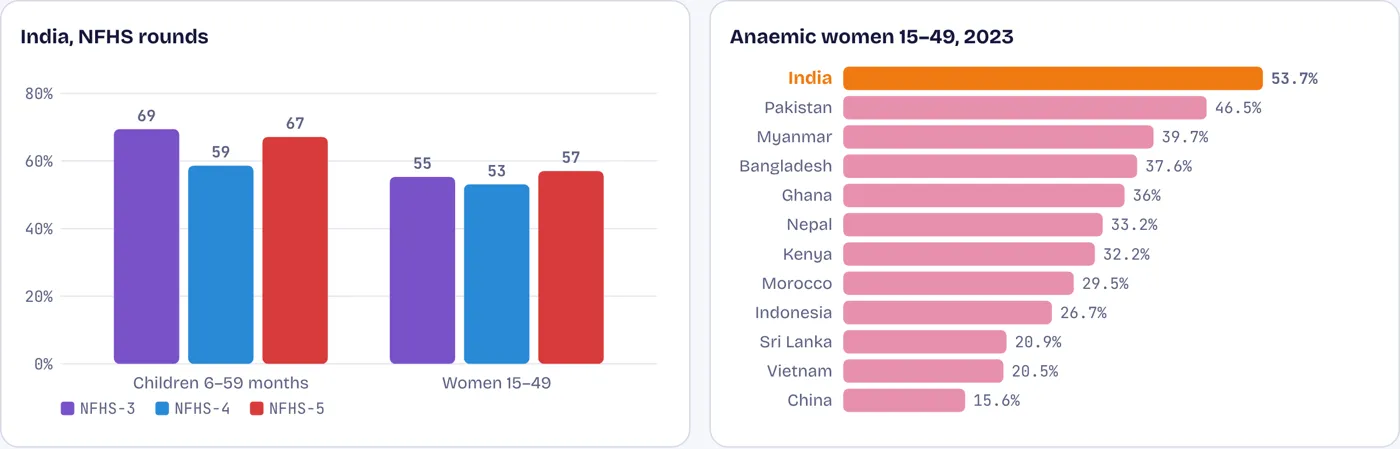
Anaemia is rising, not falling
Anaemia among children aged 6–59 months and women aged 15–49, NFHS rounds; and women’s anaemia across the peer panel, 2023
Two in three young children and more than half of women were anaemic in 2019–21, up from five years earlier. India’s rate for women, 54% by the WHO’s estimate, is the highest in the peer panel and rising, while Sri Lanka, Indonesia and China have brought theirs down.
Source: NFHS-3, 4 and 5, via Down To Earth; WHO via World Bank WDI (women 15–49, 2023).
Contested numbers
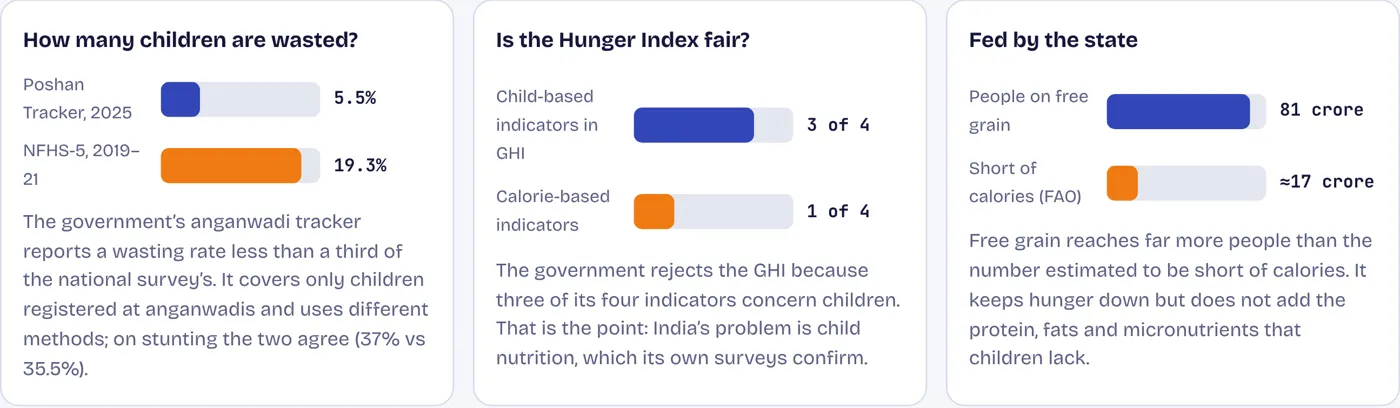
Three numbers that need a second look
Source: Ministry of Women and Child Development (Poshan Tracker) via The Week (July 2025); NFHS-5; Global Hunger Index 2025.