The economy grew fivefold; the share of it spent on health shrank. Indians live longer than in 2004, but less long than Bangladeshis, and still pay for much of their care from their own pockets.
Spending and living
Less spent on health than most peers, and shorter lives than several
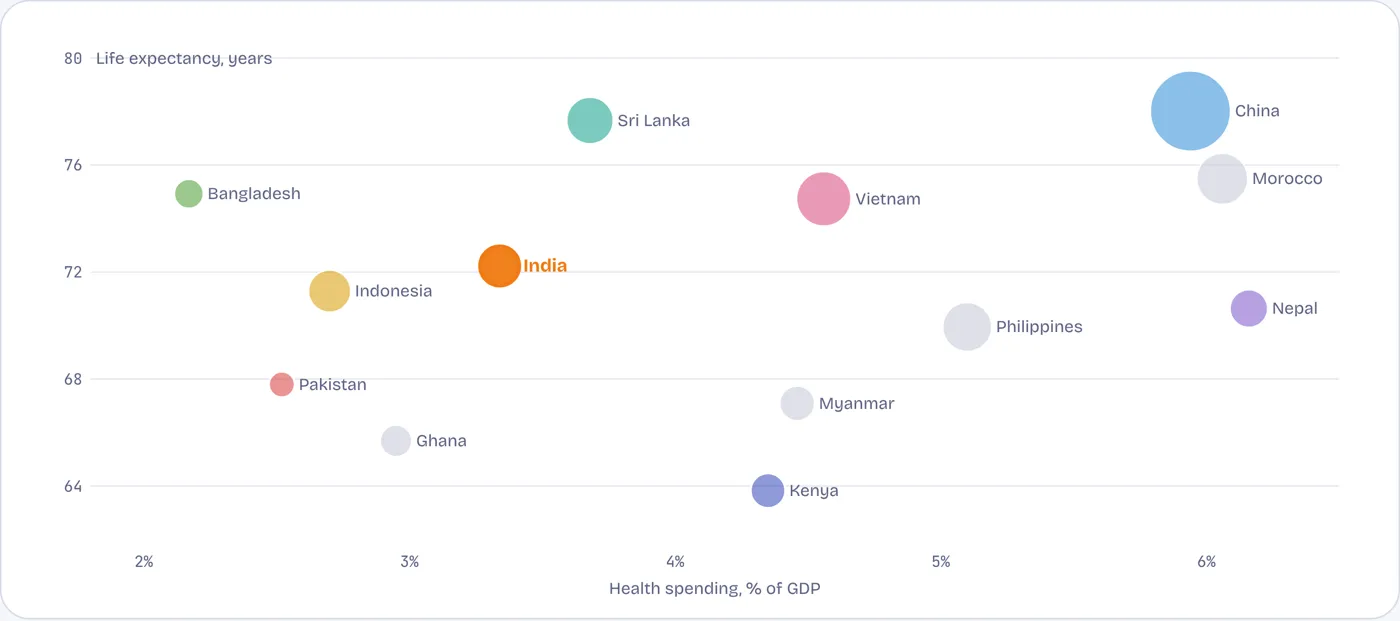
Health spending as a share of GDP (2023) against life expectancy (2024). Circle size: spending per person. Tap or hover a circle.
India spends 3.3% of its economy on health, less than Nepal, Vietnam, Kenya, the Philippines or Morocco. Sri Lanka spends about the same share and its people live more than five years longer. Bangladesh spends even less, relies heavily on community health workers, and outlives India by 2.7 years.
Source: World Bank WDI (WHO Global Health Expenditure Database; UN population estimates).
The shrinking share
India’s health share fell as China’s, Nepal’s and Morocco’s rose
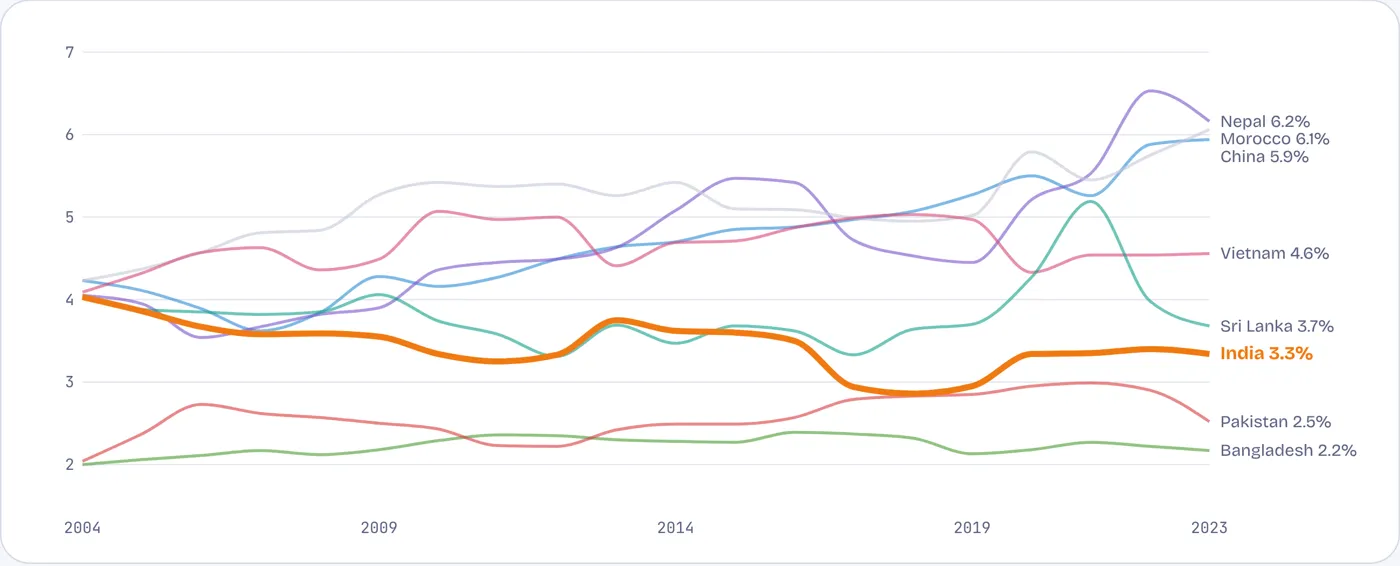
Current health expenditure, % of GDP, 2004–2023. Tap or hover a line.
Total health spending fell from 4.0% of GDP in 2004 to under 3% before the pandemic and 3.3% in 2023. India’s world rank on this measure fell from 145th to 170th of about 190 countries. China went from about the same share as India to almost 6%.
Source: World Bank WDI (WHO).
What the state spends
The government still spends just 1.3% of GDP on health
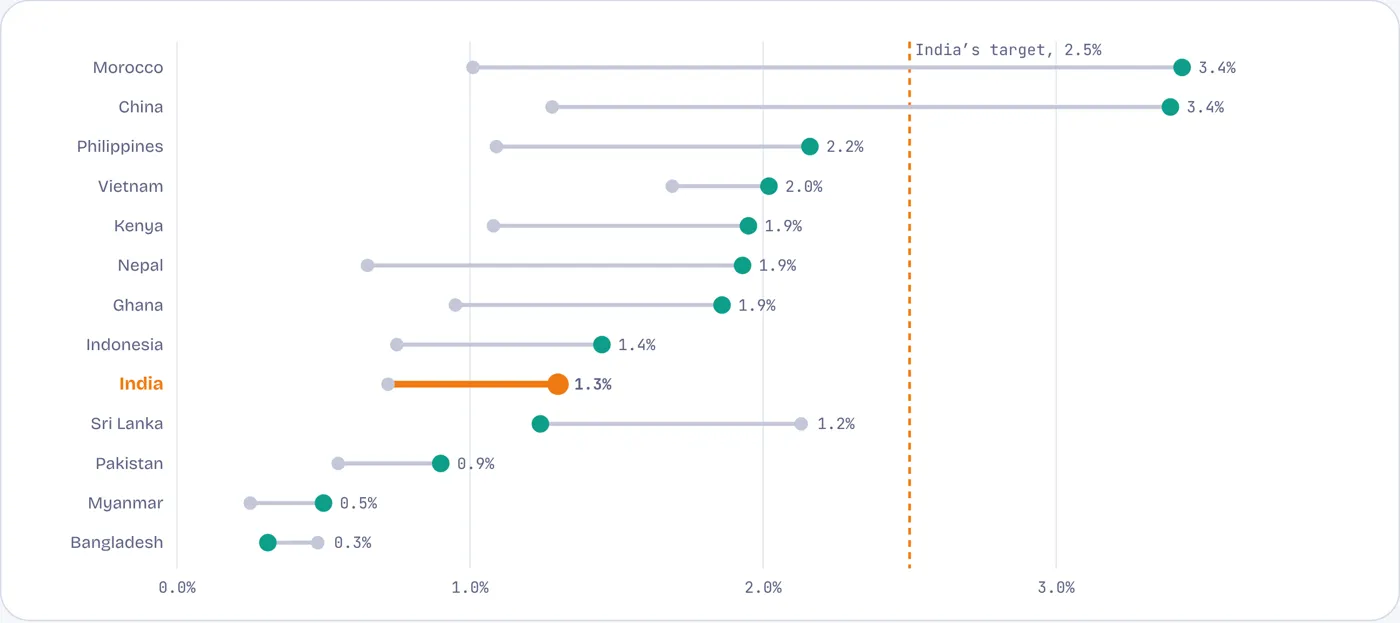
Government health spending, % of GDP, 2004 → 2023
Public spending nearly doubled as a share of GDP but remains half the 2.5% target set by the National Health Policy of 2017 for 2025. China’s government spends 3.4%, Morocco’s 3.4% and Vietnam’s 2%. India ranks 153rd of 192 countries.
Source: World Bank WDI (WHO). India’s own National Health Accounts put it higher; see the contested numbers below.
Who pays
Out-of-pocket payments fell, but still cover over two-fifths of the bill
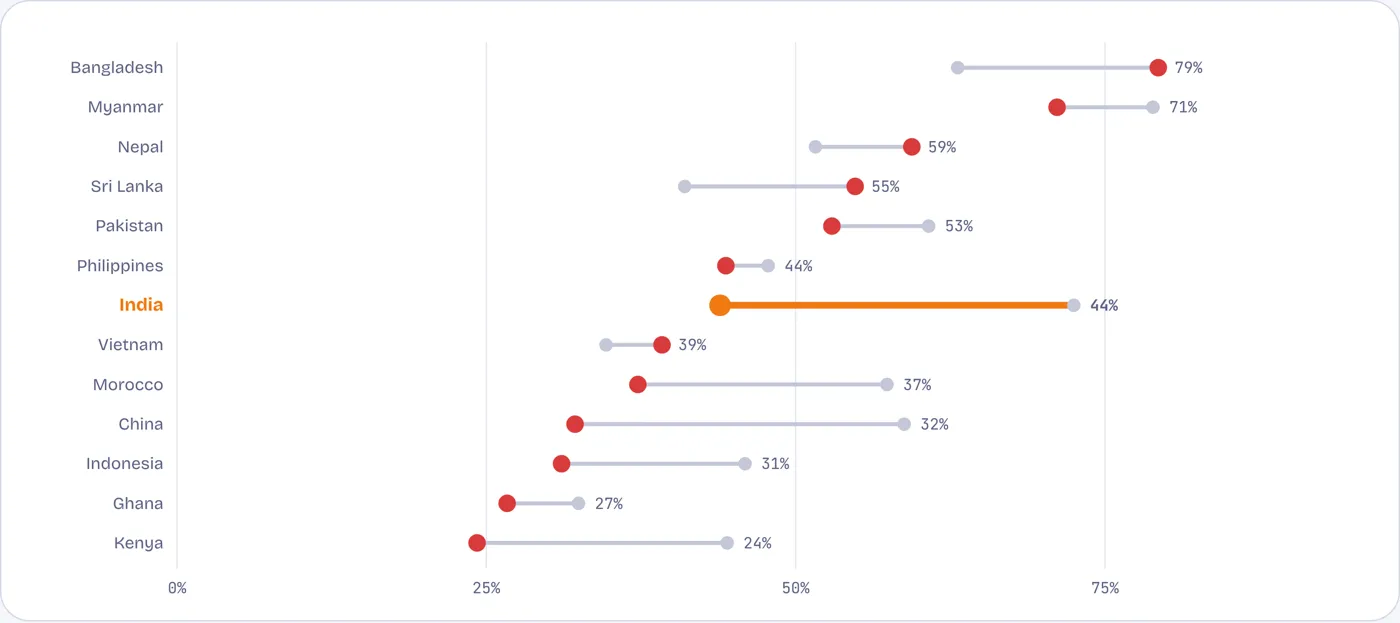
Share of health spending paid directly by patients, 2004 → 2023
In 2004 Indians paid 72% of their health costs themselves; by 2023, 44%. That is real progress, helped by insurance schemes and free medicines. But it remains above China, Vietnam, Indonesia and Kenya, where patients pay a quarter to two-fifths. Bangladesh, at 79%, has moved the other way.
Source: World Bank WDI (WHO).
Per person
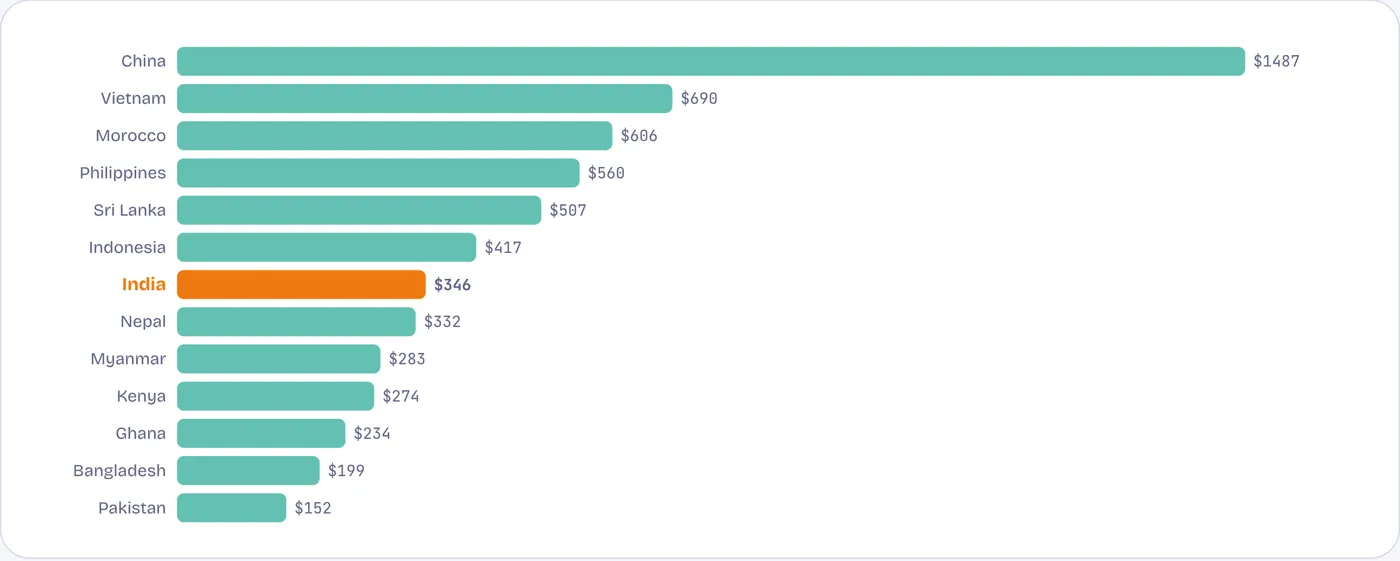
About $350 a year per person on health
Health spending per person, international $ at purchasing-power parity, 2023
Adjusted for prices, India spends about half what Vietnam spends per person and less than a quarter of China. It spends more than poorer Nepal, Bangladesh, Pakistan, Kenya and Myanmar, and less than Indonesia, Sri Lanka, the Philippines and Morocco.
Source: World Bank WDI (WHO).
Lifespans
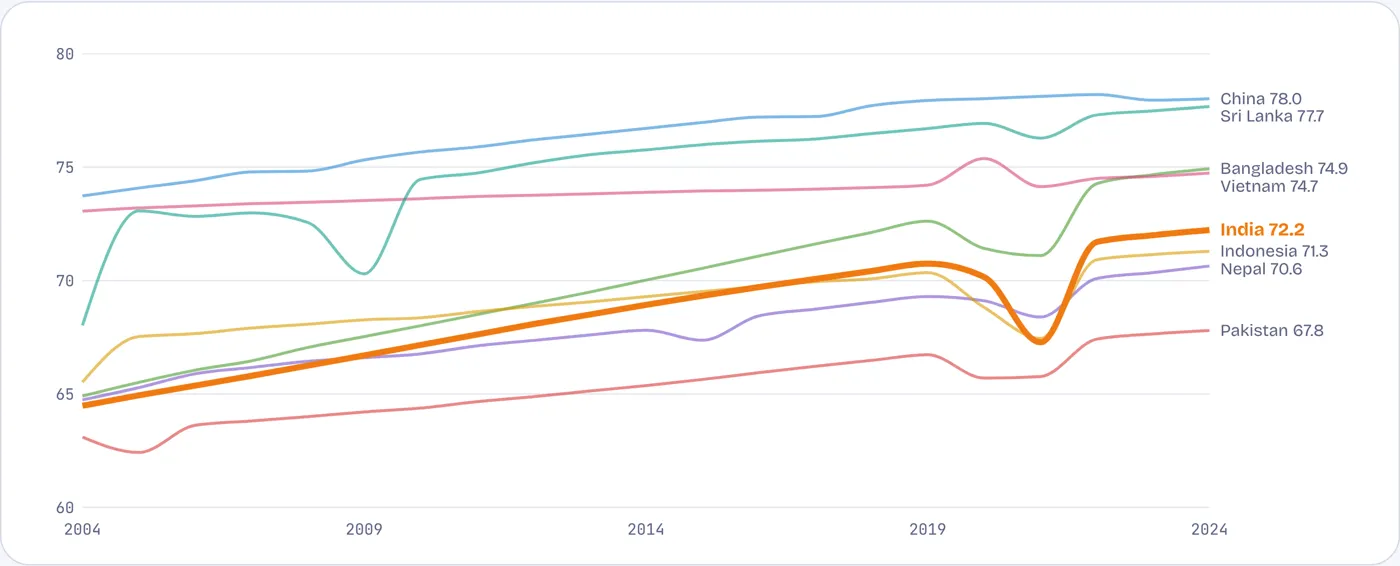
Bangladeshis now live 2.7 years longer than Indians
Life expectancy at birth, years, 2004–2024. Tap or hover a line.
India and Bangladesh had the same life expectancy in 2004, about 64.5 years. Bangladesh pulled ahead and the pandemic widened the gap: India lost about three years of life expectancy in 2021. Sri Lanka and China are more than five years ahead.
Source: World Bank WDI (UN World Population Prospects).
Beds and coverage
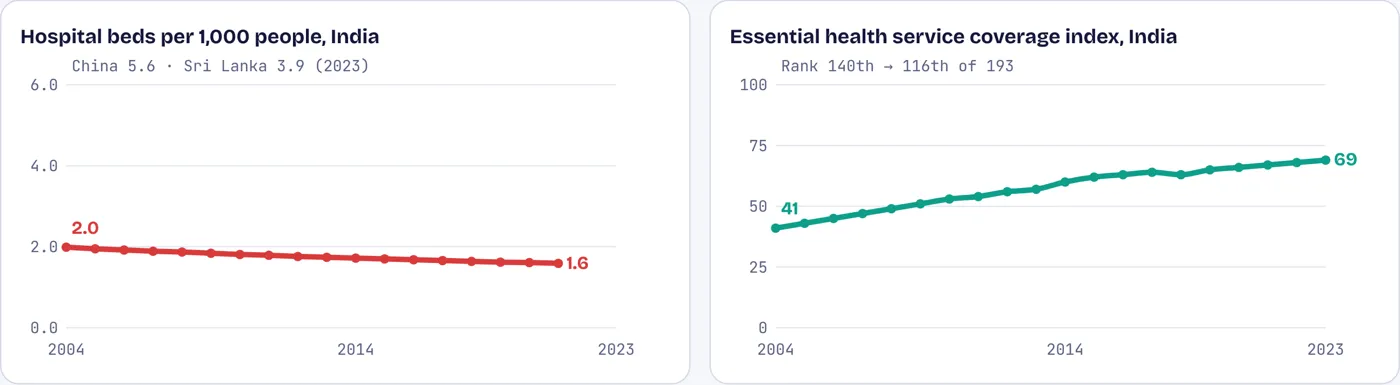
Fewer hospital beds per person than in 2004; wider coverage of basic services
Hospital beds per 1,000 people, and the WHO index of essential health service coverage (0–100)
Hospital beds did not keep up with population: 2.0 per 1,000 people in 2004, 1.6 in 2021, against 5.6 in China and 3.9 in Sri Lanka. Coverage of essential services, such as vaccination, antenatal care and TB treatment, rose from 41 to 69 out of 100, lifting India from 140th to 116th of 193 countries.
Source: World Bank WDI (WHO).
Insurance
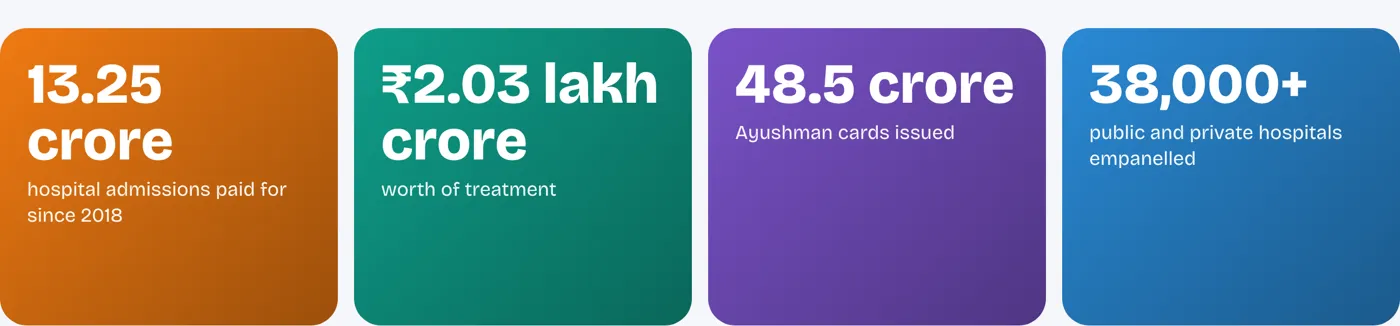
One of the world’s largest public health insurance schemes
Ayushman Bharat pays for hospital care for poorer families. In eight years it funded 13.25 crore admissions worth ₹2.03 lakh crore. It covers hospital stays, not the doctor visits and medicines that make up most out-of-pocket spending.
Source: National Health Authority via Digital Health News (September 2026).
Contested numbers
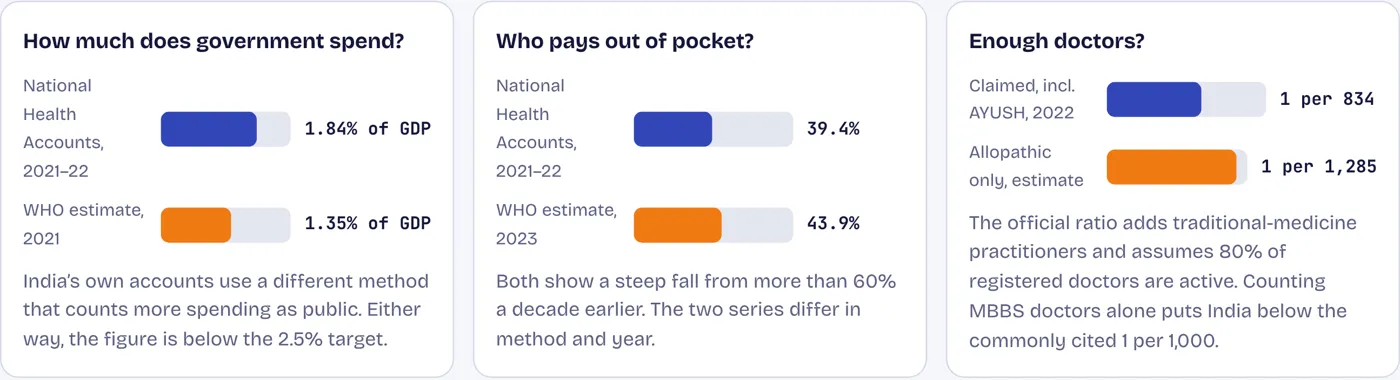
Three numbers that need a second look
Source: National Health Accounts 2021–22 via IAS Gyan; WHO via WDI; Ministry of Health in Parliament and FactChecker (2022).