Nearly every Indian child now goes to school. Fewer than one in four Class 3 children in government schools can read a simple Class 2 story.
Reading
Fewer than one in four can read a Class 2 story
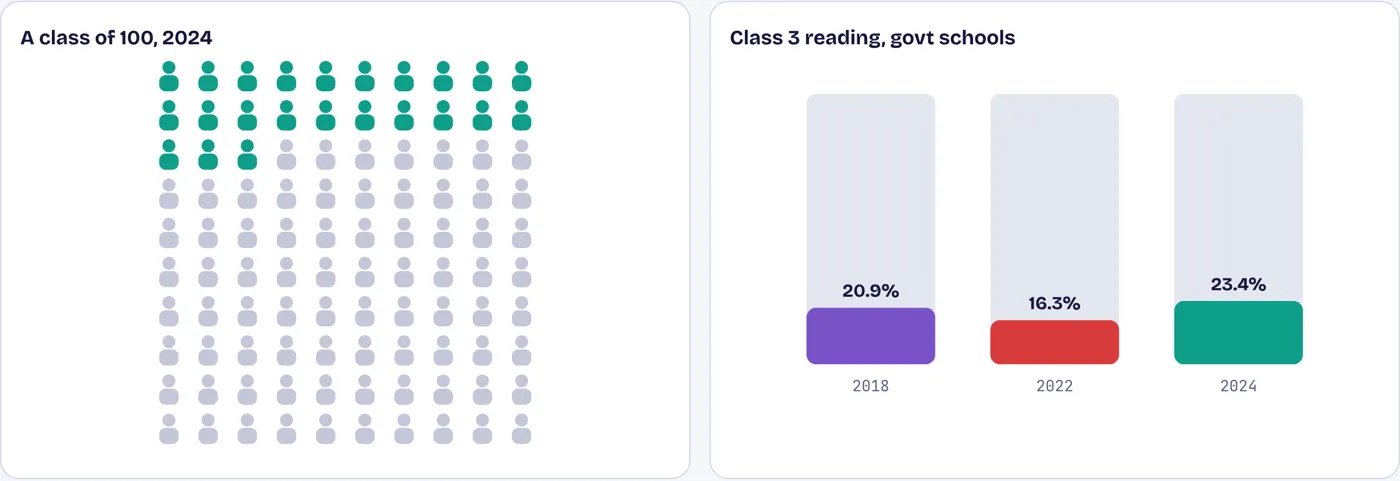
Class 3 children in rural government schools who can read a Class 2 text. One figure = one child in a class of 100.
The share fell during the school closures of 2020–22 and recovered to 23.4% in 2024, above its level before the pandemic. Even so, three in four children reach Class 3 unable to read a text meant for Class 2.
Source: ASER Centre, Annual Status of Education Report (Rural) 2018, 2022, 2024, via Careers360.
Up the grades
By Class 8, a third still cannot read a Class 2 text
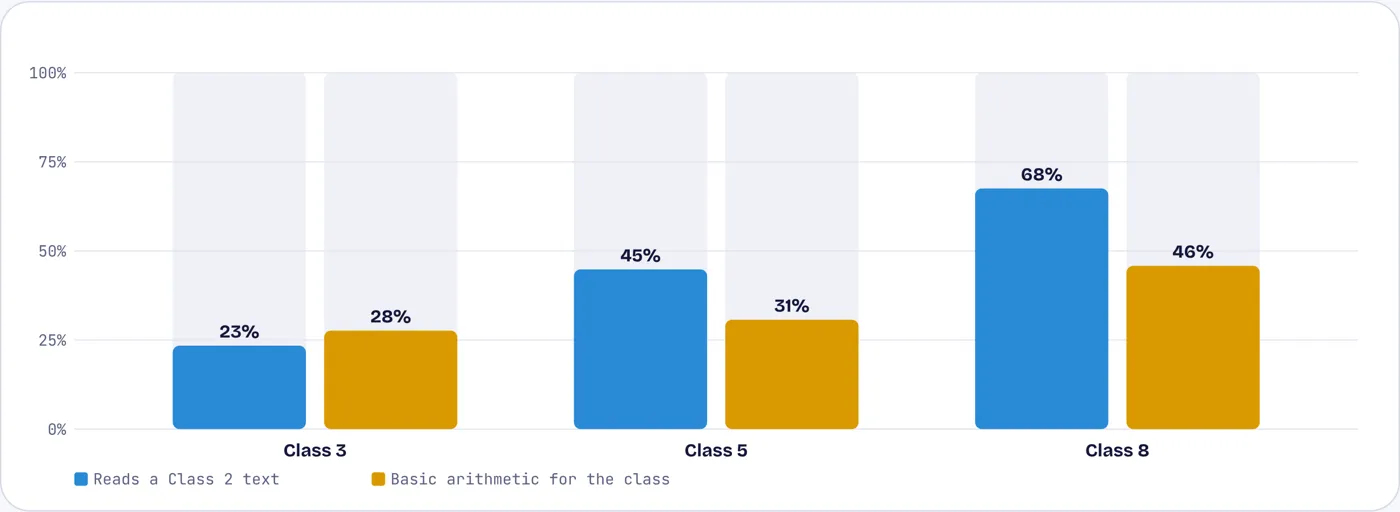
Rural children who can do Class 2-level reading or basic arithmetic, by class, 2024
Children improve as they move up, but slowly. Fewer than half of Class 5 children in government schools read at Class 2 level, and fewer than one in three can do a simple division. In Class 8, 54% cannot do basic arithmetic.
Source: ASER 2024 via Careers360. Reading for Classes 3, 5 and 8 and Class 3 subtraction refer to government schools; Class 5 division and Class 8 arithmetic to all rural schools.
In school
Enrolment rose fast, but some poorer neighbours enrol more
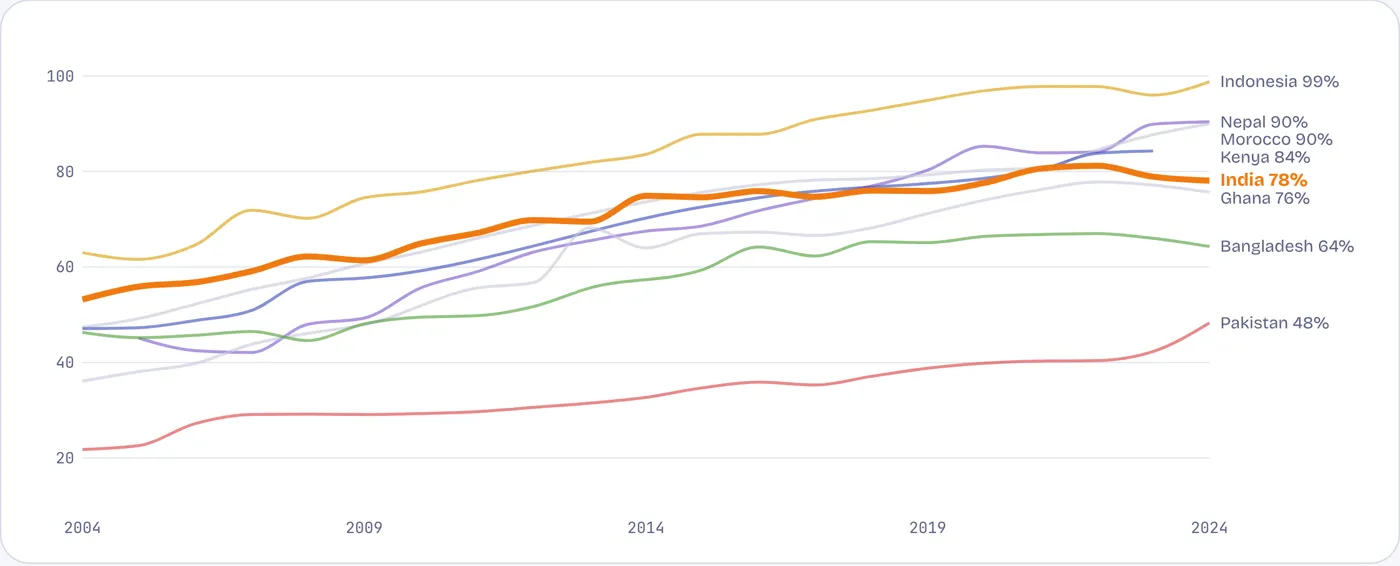
Gross secondary enrolment ratio, %, 2004–2024. Tap or hover a line.
India’s secondary enrolment rose from 53% to 78%. Nepal, Kenya and Morocco, all poorer or similar per person, now enrol 84–90%. Youth literacy reached 97%, but literacy measures whether someone can read a sentence, not whether they learned in school.
Source: UNESCO Institute for Statistics, via World Bank WDI.
Learning poverty
More than half of 10-year-olds cannot read and understand a simple text
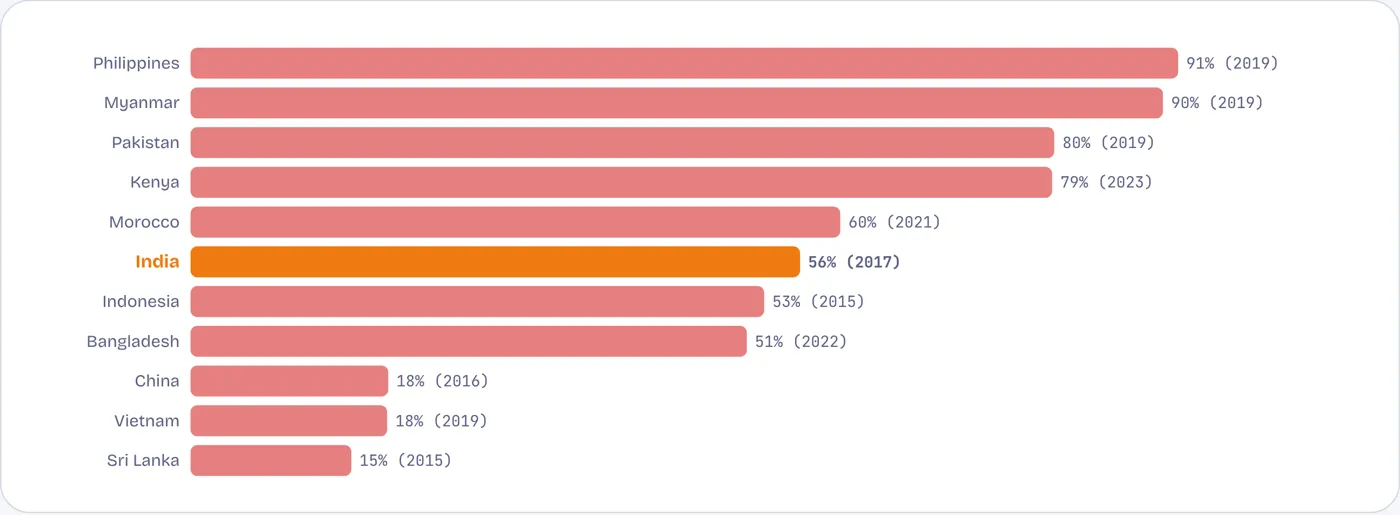
World Bank “learning poverty”: share of children who cannot read and understand an age-appropriate text by age 10, latest year
India’s learning poverty, 56%, is three times Vietnam’s or China’s and almost four times Sri Lanka’s. It is level with Bangladesh and Indonesia and better than Pakistan, Kenya and the Philippines.
Source: World Bank and UNESCO Institute for Statistics, via WDI. Latest year per country.
The government’s own test
The national survey finds the same gaps
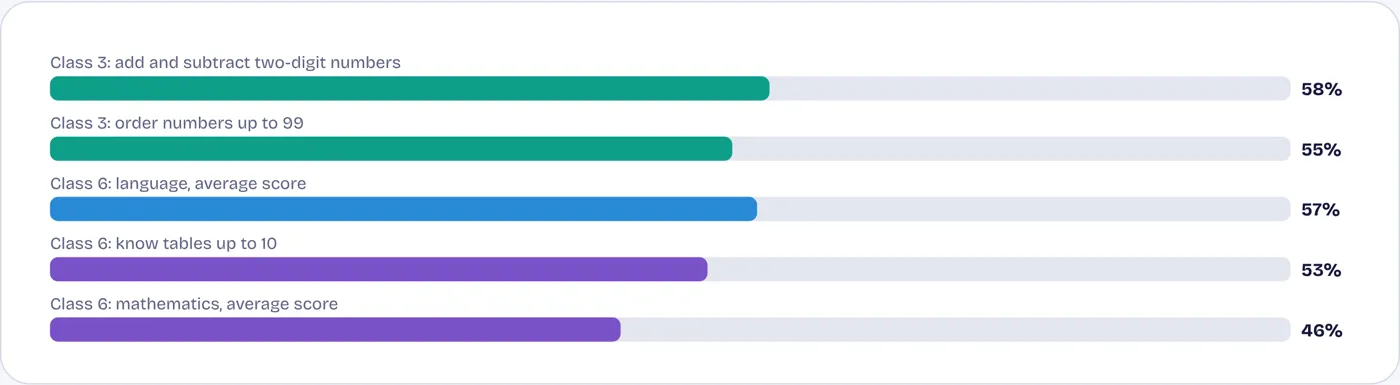
PARAKH Rashtriya Sarvekshan 2024, 21 lakh students in 74,000 schools
The Ministry of Education’s own survey found Class 6 students answered 46% of mathematics questions correctly, and only 53% knew their tables up to 10. In Class 3, 58% could add and subtract two-digit numbers.
Source: Ministry of Education, PARAKH Rashtriya Sarvekshan 2024, via The Week (PTI, July 2025).
Money
India spends more on schooling than most peers
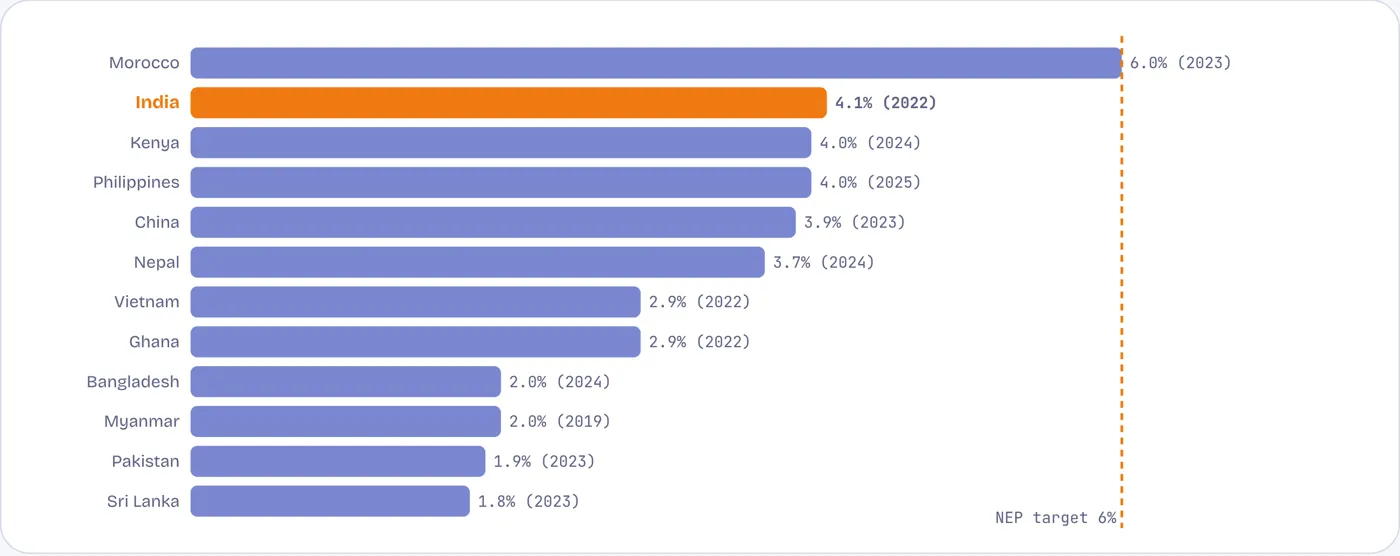
Public spending on education, % of GDP, latest year
India spends about 4% of GDP on education, more than Vietnam, Bangladesh, Sri Lanka or China’s reported share, though below the 6% target in the National Education Policy. Money is not the main gap: Vietnam spends less and its children learn far more.
Source: UNESCO Institute for Statistics, via WDI. Latest year per country.
College
One in three young people in higher education
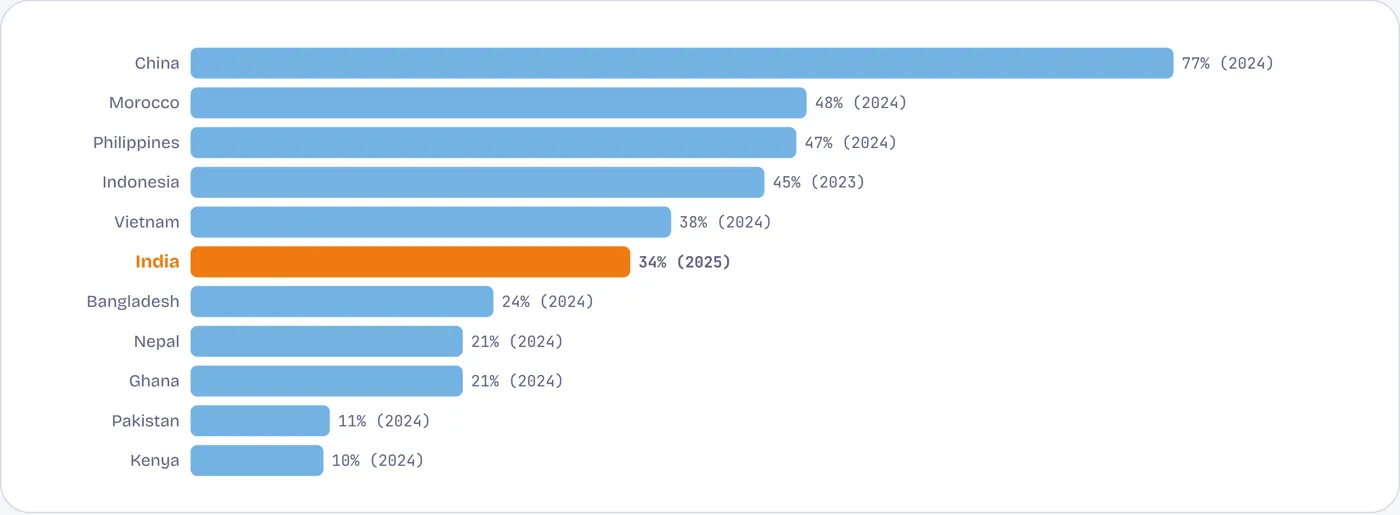
Gross tertiary enrolment ratio, %, latest year
Higher-education enrolment tripled from 11% in 2004 to 34%. China went from 17% to 77% over the same years; Morocco, the Philippines and Indonesia are all above 44%.
Source: UNESCO Institute for Statistics, via WDI.
Contested numbers
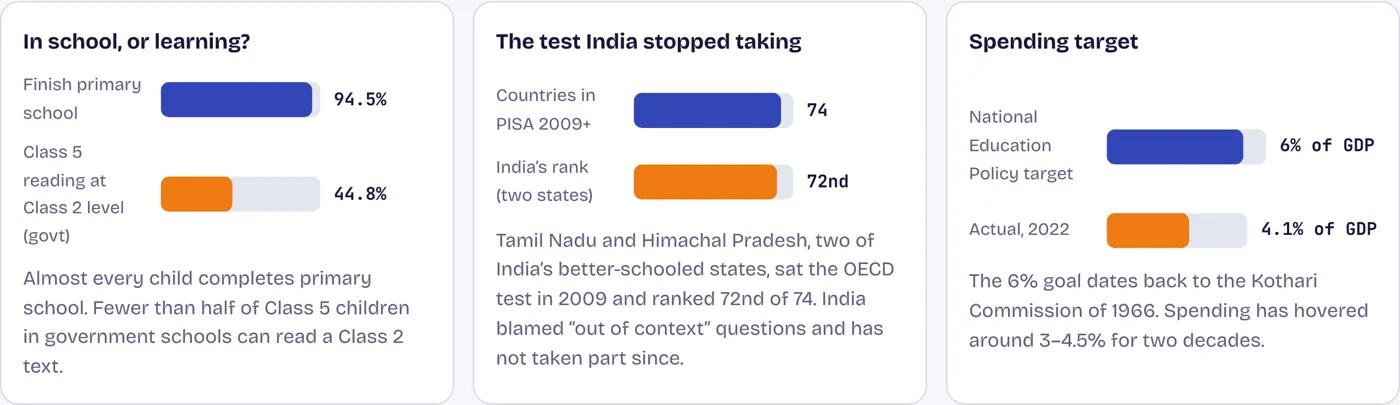
Three numbers that need a second look
Source: World Bank WDI; ASER 2024; The Better India (PISA 2009); National Education Policy 2020.