Bank accounts, phones and cash transfers reached India’s women. Paid work did not. A smaller share of women are in the labour force than in 2004, and only twenty countries have fewer.
Two lines that parted
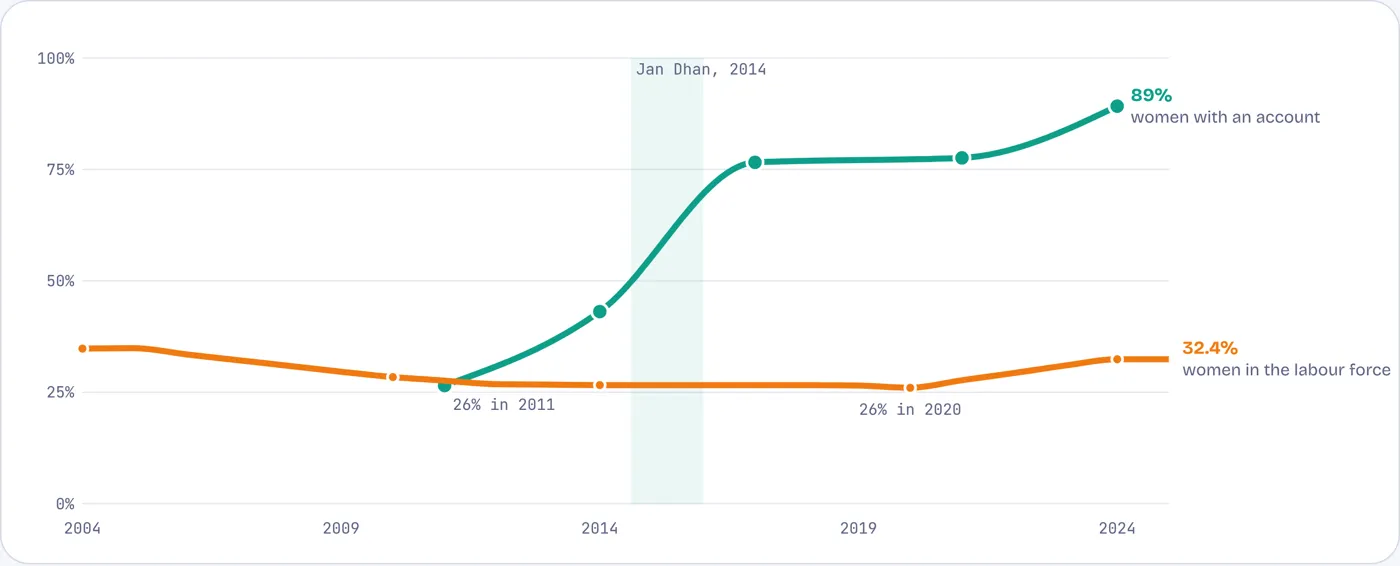
Almost every woman got a bank account; most still have no job
Indian women aged 15+: share with an account at a bank or mobile-money provider, and share in the labour force. Tap or hover a point.
Jan Dhan accounts and direct benefit transfers took women’s account ownership from about a quarter to nine in ten, level with China. Over the same years the share of women working or looking for work fell from 35% to a low of 26% in 2020, and has only partly recovered. An account is useful when there is income to put in it.
Source: World Bank Global Findex, via WDI (accounts); International Labour Organization modelled estimates, via WDI (labour force).
Against the neighbours
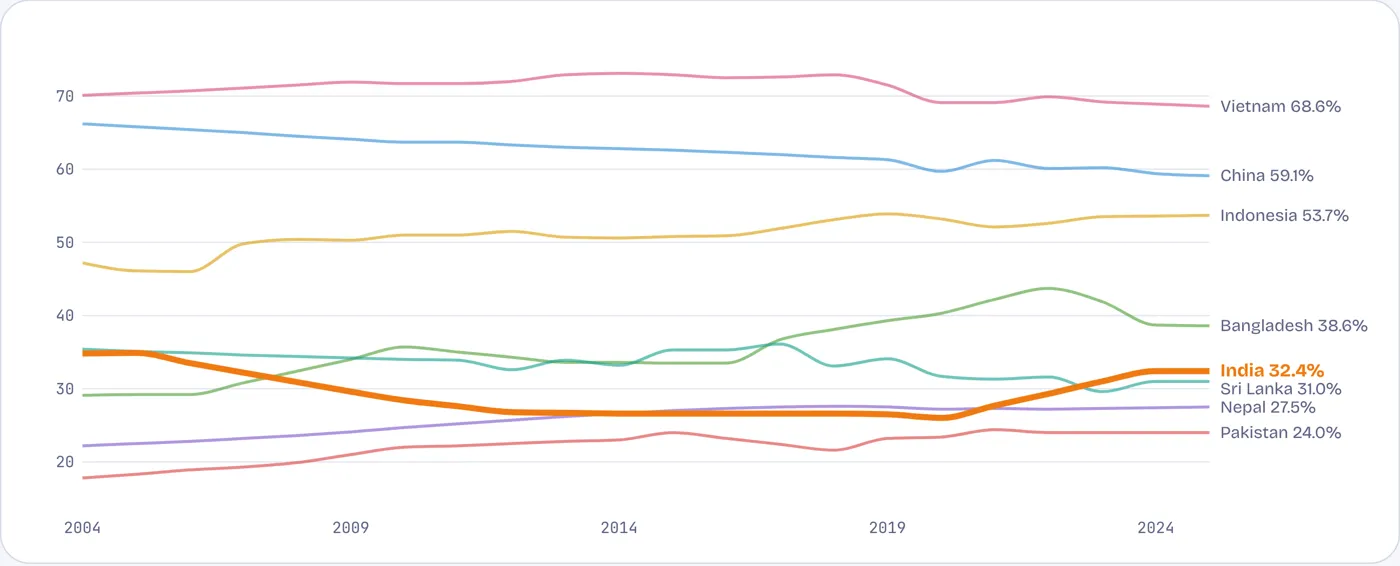
Bangladesh’s women went to work; India’s went home, then partly came back
Women’s labour-force participation, % of women aged 15+, 2004–2025. Tap or hover a line.
In 2004 India was ahead of Bangladesh. Garment factories then drew millions of Bangladeshi women into paid work, and Bangladesh moved ahead by 2008. India’s rate slid for fifteen years, through a period of fast growth, before rising after 2020. Vietnam and China, where factory jobs came early, are near 60–70%.
Source: International Labour Organization modelled estimates, via World Bank WDI.
Where India stands
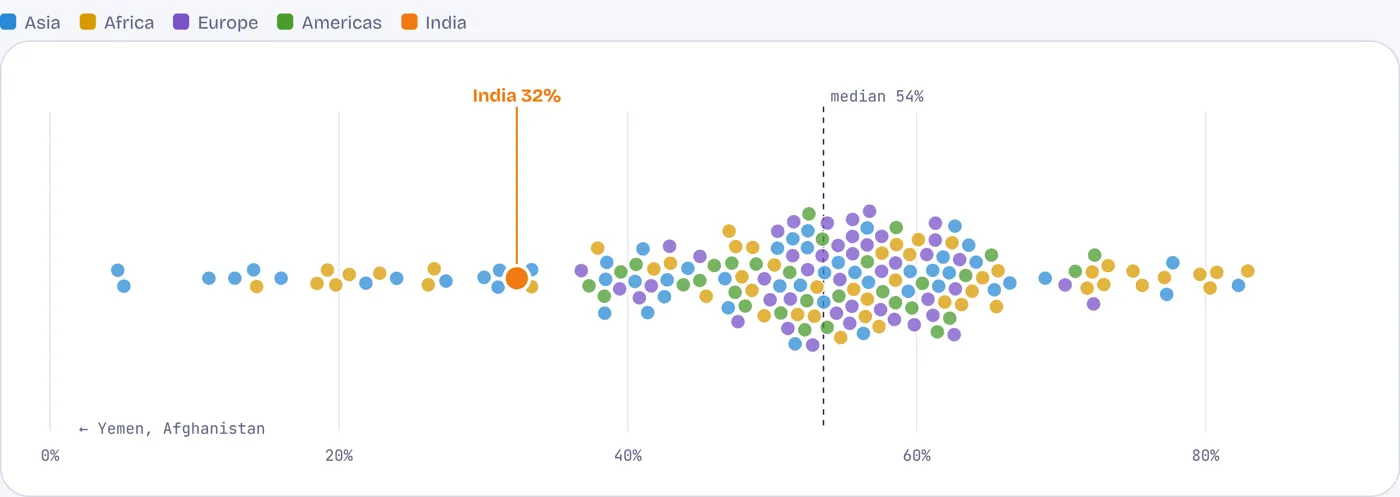
Only twenty countries have a smaller share of women in the labour force
Women’s labour-force participation, 2024, 180 countries. Each dot is a country; colour shows region. Tap or hover a dot.
The typical country has 54% of its women in the labour force. Most of the countries below India are in the Middle East and North Africa, or are at war: Yemen, Afghanistan, Iraq, Syria, Iran, Egypt. Pakistan and Nepal are lower; Sri Lanka has slipped just below India since its 2022 crisis.
Source: International Labour Organization modelled estimates, via World Bank WDI. Countries with data for 2024.
The gap between men and women
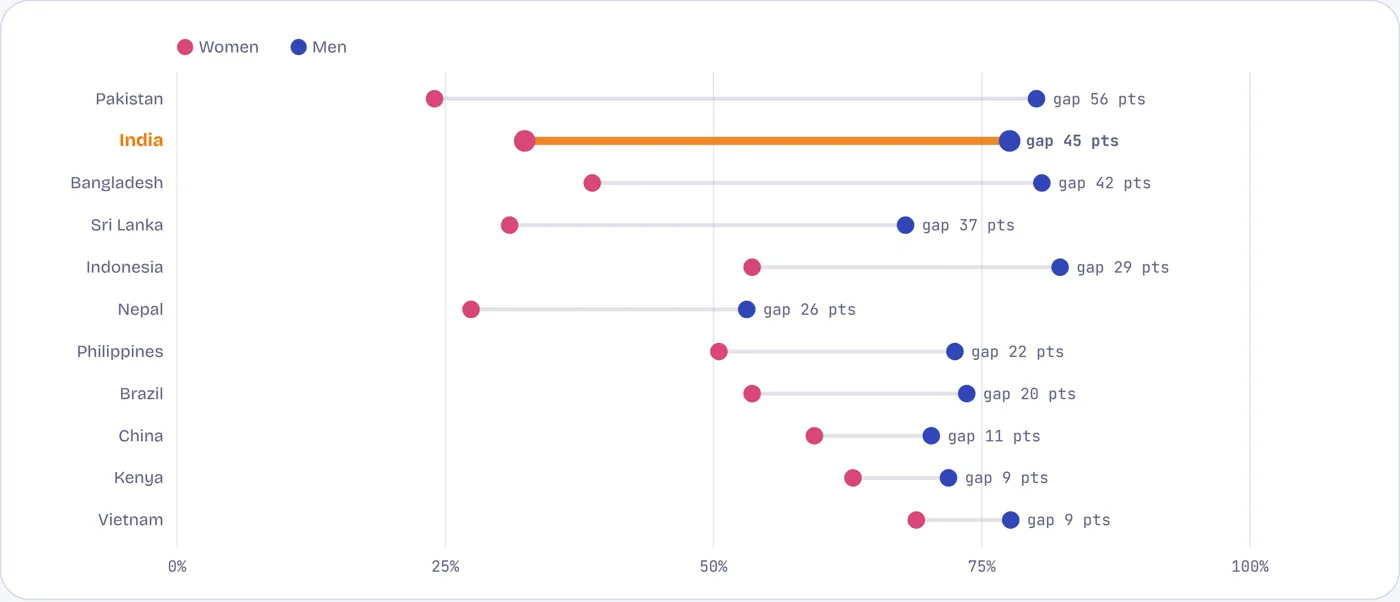
Men work at about the same rate everywhere; women make the difference
Labour-force participation, 2024: women and men aged 15+. Sorted by the gap. Tap or hover a row.
Indian men are in the labour force at much the same rate as men in Vietnam, Indonesia or Bangladesh. The difference between these countries is almost entirely about women. India’s gap of 45 percentage points is among the widest; only Pakistan’s is wider in this group.
Source: International Labour Organization modelled estimates, via World Bank WDI.
What kind of work
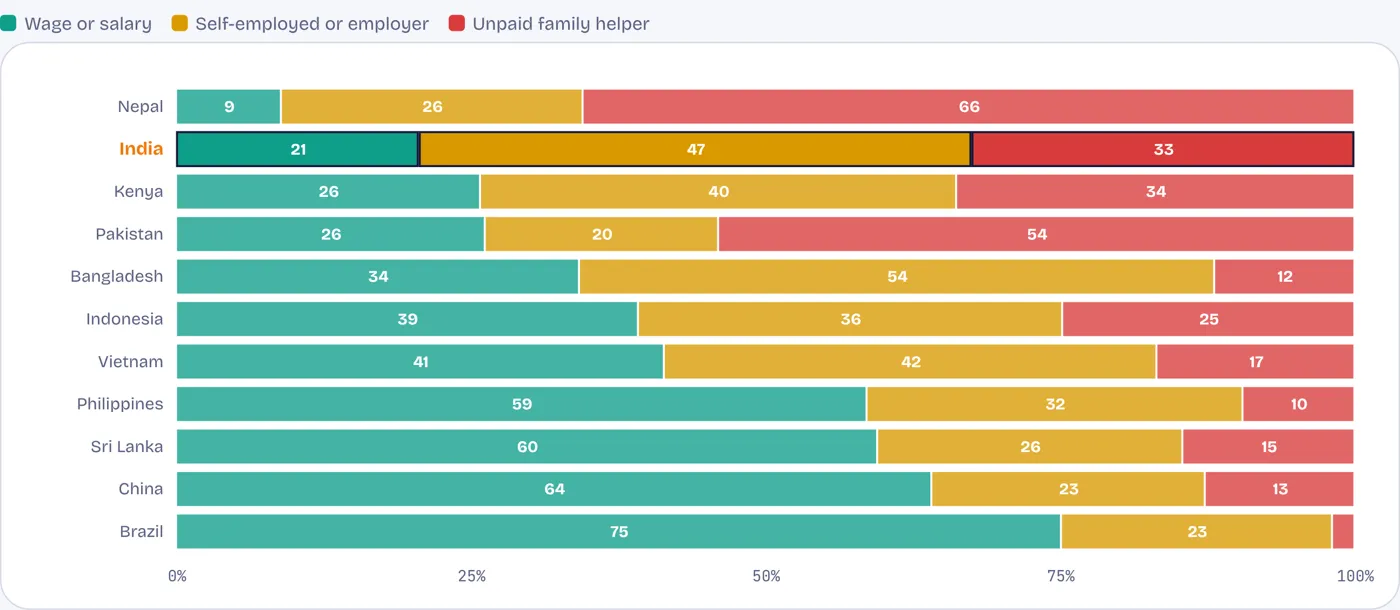
One in five working Indian women earns a wage; one in three is an unpaid family helper
Employed women by type of work, 2024, %
Of the women who do work, most in India work on their family’s farm or in a household business, often unpaid. In Bangladesh unpaid family work fell from 68% of working women to 12% in twenty years as factory jobs grew. In India the share barely moved.
Source: International Labour Organization modelled estimates, via World Bank WDI.
The recovery since 2017
Much of the recent rise is unpaid work on family farms
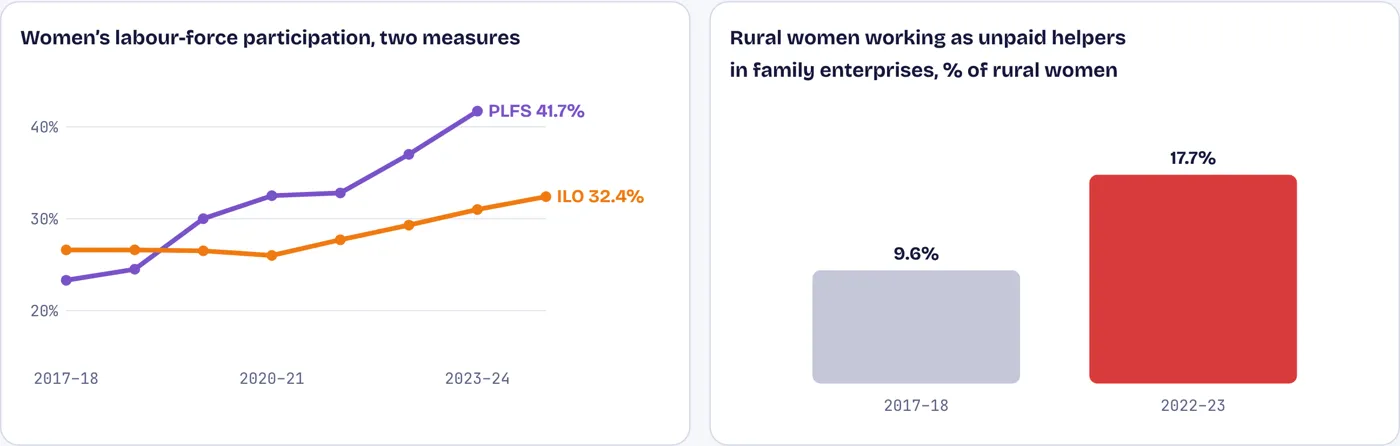
India’s official survey shows a much sharper rise than the international estimate
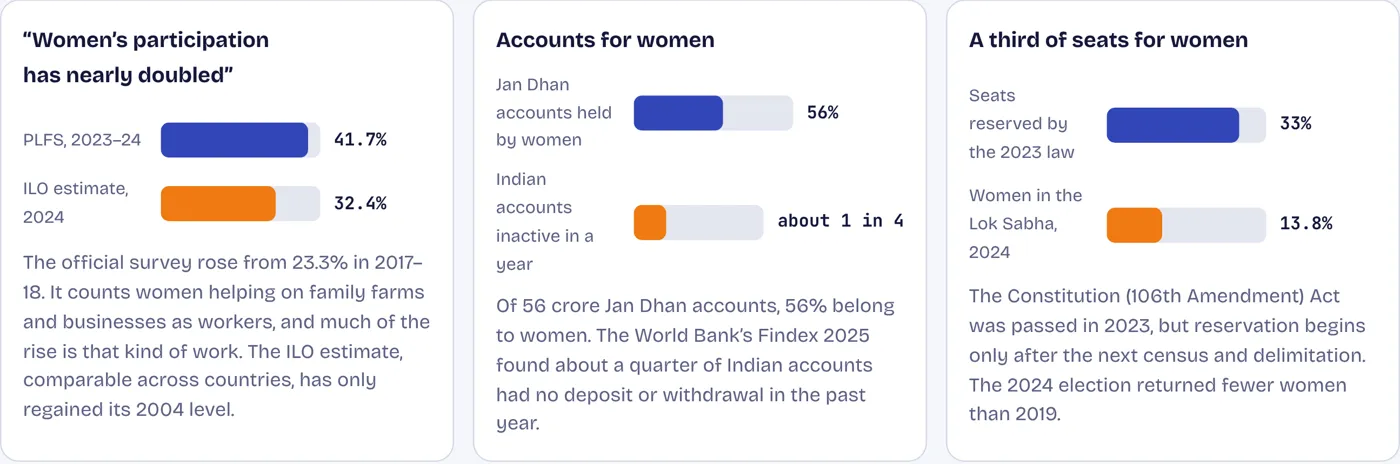
India’s Periodic Labour Force Survey shows women’s participation nearly doubling, to 41.7% in 2023–24. Most of the rise was in villages, and much of it was women counted as helpers in family enterprises, mostly farms. The share of working women in regular salaried jobs fell over the same years, from 21% to 16%.
Source: MoSPI, PLFS Annual Report 2023–24; Foundation for Agrarian Studies analysis of PLFS unit data (helpers); Business Standard analysis of PLFS (salaried share).
Educated, then idle
Four times as many women go to college; four in ten young women are not in work or study
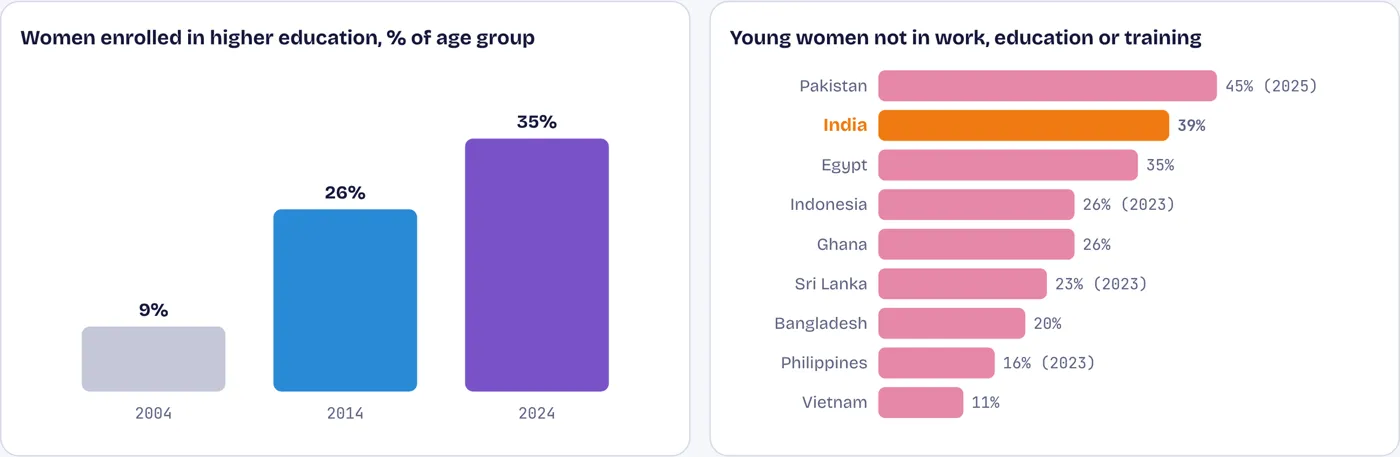
Women’s college enrolment in India, and young women (15–24) not in employment, education or training
Women’s enrolment in higher education rose from 9% to 35% of their age group, slightly above the rate for men. Yet 39% of young Indian women are neither working nor studying, against 20% in Bangladesh and 11% in Vietnam. Education has not turned into jobs.
Source: UNESCO and ILO, via World Bank WDI. Latest year shown in brackets.
Where the hours go
Women do more than three times the unpaid housework men do
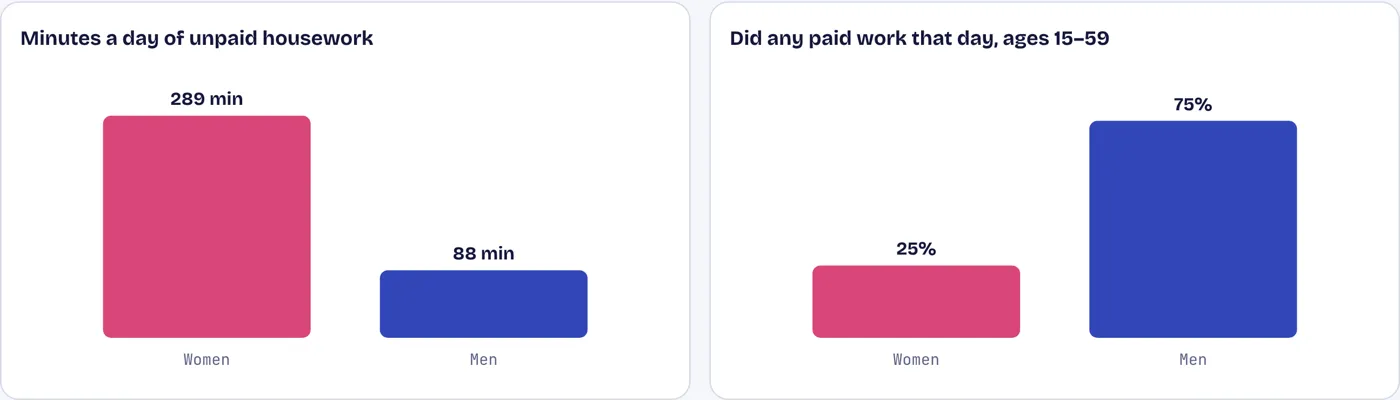
India’s Time Use Survey, 2024
The average Indian woman spends nearly five hours a day on cooking, cleaning and other unpaid housework; the average man spends an hour and a half. On a given day only a quarter of women aged 15–59 did any paid work, against three-quarters of men. Childcare, safe transport and work close to home decide whether women can take a job.
Source: MoSPI, Time Use Survey 2024, via Business Today. Minutes are averages per person aged 6 and above; participation is for ages 15–59.
Missing at birth
Fewer girls are being lost before birth, but the gap has not closed
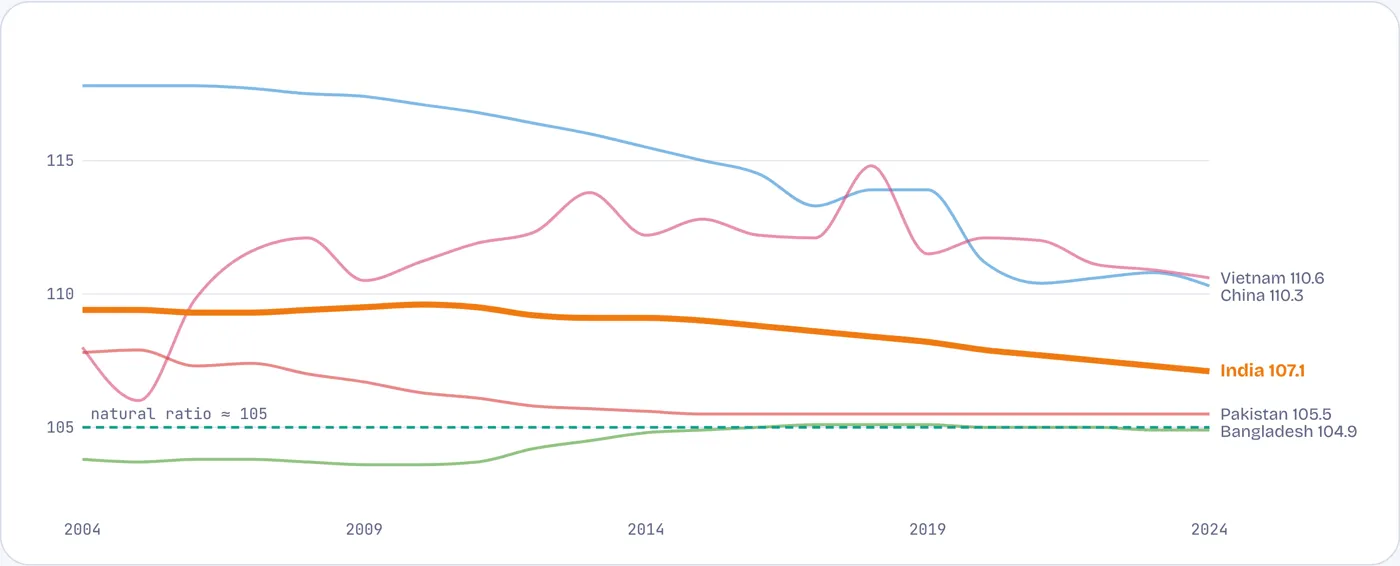
Boys born per 100 girls, 2004–2024. Without sex selection the ratio is about 105. Tap or hover a line.
India’s sex ratio at birth has improved from 109 boys per 100 girls to 107, as the ban on sex-selective scans was enforced more strictly and the Beti Bachao campaign began in 2015. China has improved faster from a worse start; Vietnam has got worse. The UN estimated in 2020 that 45.8 million females were “missing” from India’s population, through sex selection before birth and neglect after it.
Source: UN World Population Prospects, via World Bank WDI; UNFPA, State of World Population 2020.
Where decisions are made
Fewer than one MP in seven is a woman
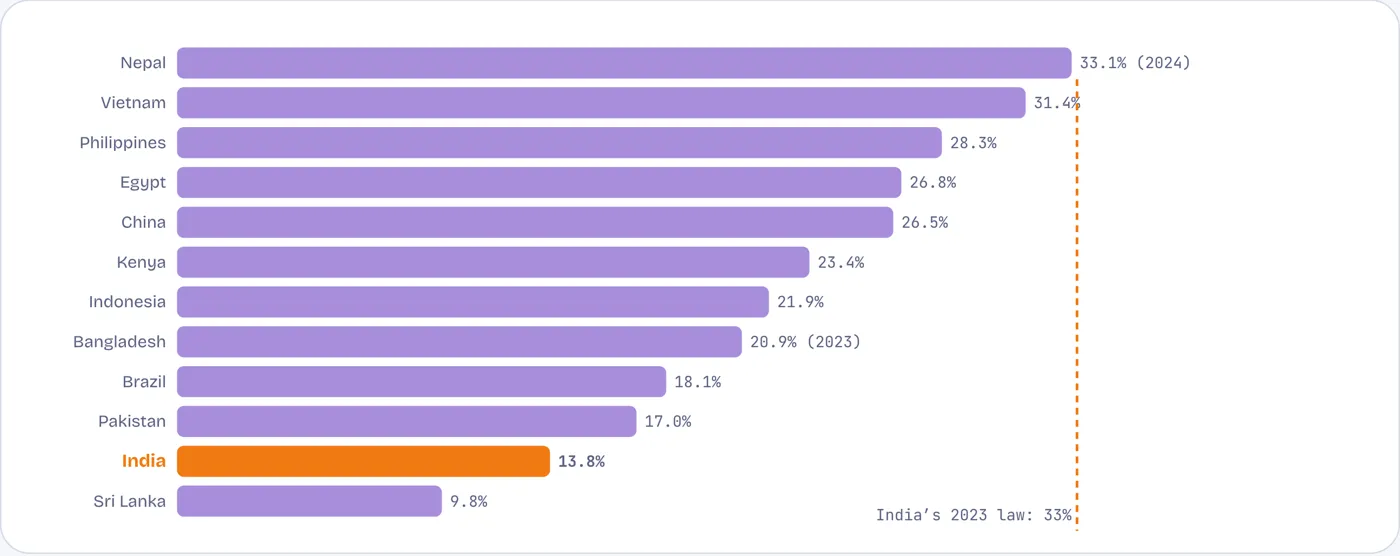
Women’s share of seats in the lower or single house of parliament, latest year
Women hold 13.8% of seats in the Lok Sabha, up from 8.3% in 2004 but behind Nepal, Bangladesh and Pakistan, which reserve seats for women, and Vietnam, which sets a quota for women candidates. India passed a law in 2023 to reserve a third of seats, but it takes effect only after the next census and a redrawing of constituencies.
Source: Inter-Parliamentary Union, via World Bank WDI.
Contested numbers
Three numbers that need a second look
Source: MoSPI PLFS 2023–24; ILO via WDI; Ministry of Finance (Jan Dhan, August 2025); World Bank Global Findex 2025, via Moneylife; Constitution (106th Amendment) Act, 2023.