India built toilets for hundreds of millions of people. Building the sewers and treatment plants behind them came far slower: most urban sewage still reaches rivers untreated, and the Yamuna leaves Delhi thousands of times dirtier than it enters.
Where the sewage goes
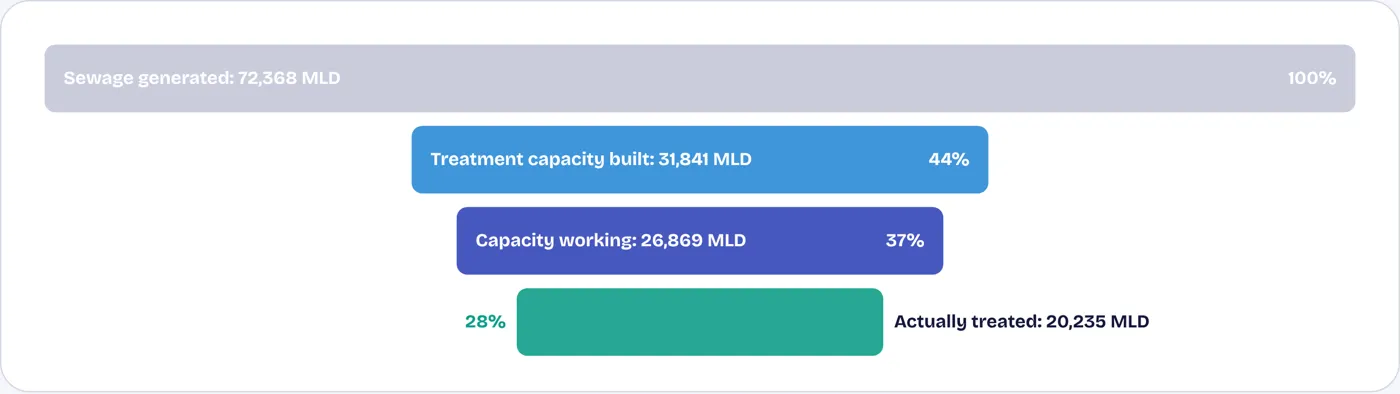
Of every 100 litres of urban sewage, 28 are treated
India’s urban sewage, million litres a day (MLD): generated, treatment capacity built, capacity working, and sewage actually treated. Tap or hover a bar.
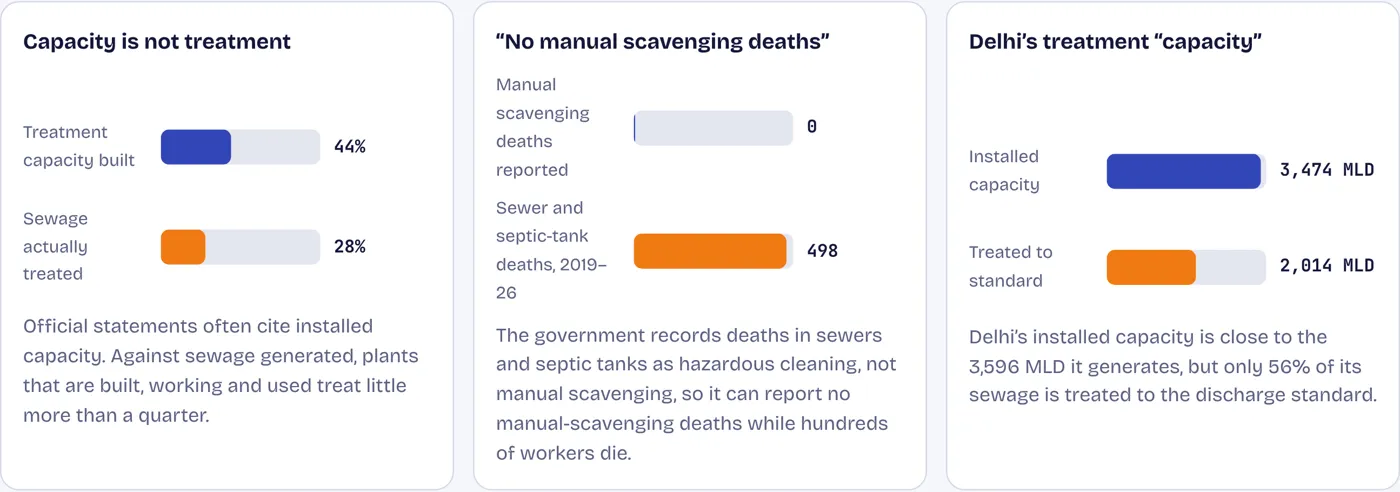
Indian cities produce about 72,000 million litres of sewage a day. Plants exist to treat 44% of it; some of those plants are not working, and the rest run below capacity, so about 28% is treated. The other 52,000 million litres a day flow into drains, rivers, lakes and the ground.
Source: Central Pollution Control Board (CPCB), national inventory of sewage treatment plants, 2021, via Down To Earth. The latest national count.
One river, one city
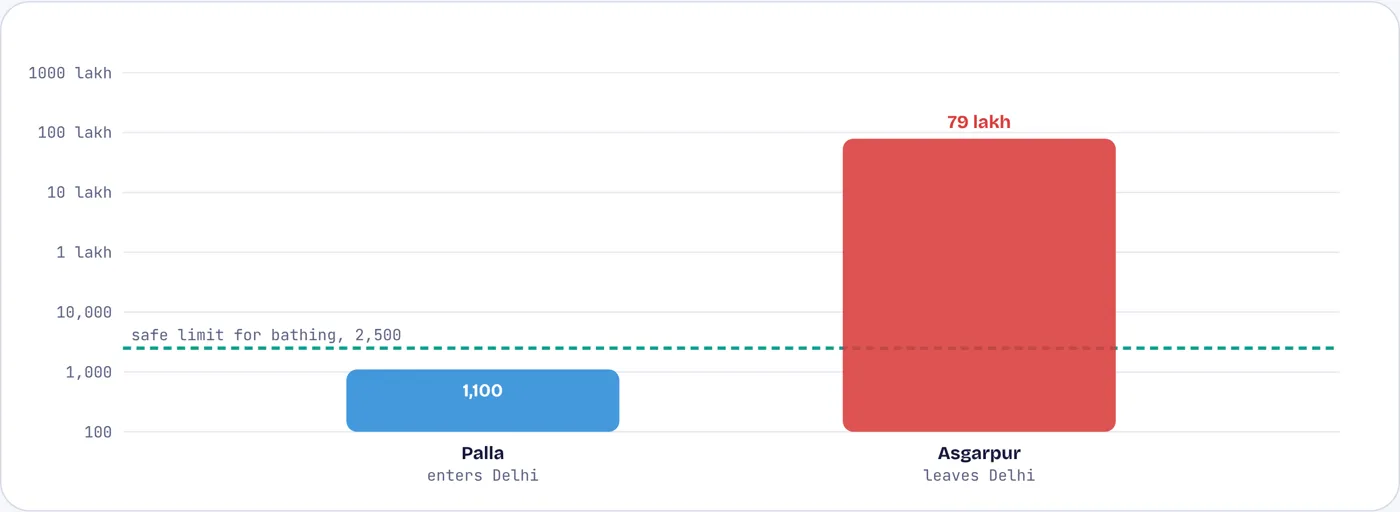
The Yamuna enters Delhi within the safe limit and leaves it 3,160 times over
Faecal coliform bacteria in the Yamuna, November 2024, MPN per 100 ml. Logarithmic scale: each step is ten times the last.
At Palla, where it enters Delhi, the river carried 1,100 faecal bacteria per 100 ml, under the bathing limit of 2,500. By Asgarpur, about 50 km downstream, after more than 20 large drains have emptied into it, the count was 79 lakh. Six of eight sampling points had no dissolved oxygen at all in May 2025.
Source: Delhi Pollution Control Committee (DPCC) monitoring, via The Week / PTI (December 2024) and ETV Bharat (May 2025). Limit: CPCB maximum permissible for bathing, 2,500 MPN/100 ml.
The capital’s sewage
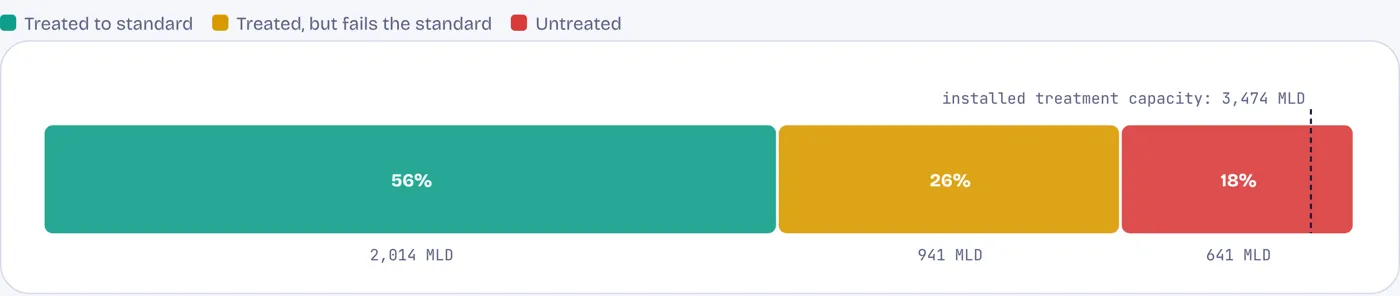
Delhi has the plants but not the results
Delhi’s sewage, million litres a day, 2025: what meets the discharge standard, what is treated badly, and what is not treated
Delhi’s 37 plants could in theory treat almost all of the 3,596 million litres a day the city produces. In practice, 14 of the plants fail the discharge standard and 641 million litres a day bypass treatment altogether. Nine completed Namami Gange projects in Delhi cost ₹1,951 crore.
Source: Ministry of Jal Shakti reply in Lok Sabha, July 2025, via The Week / PTI. “Fails the standard” is the remainder after the treated-to-standard and untreated volumes.
Rivers across India
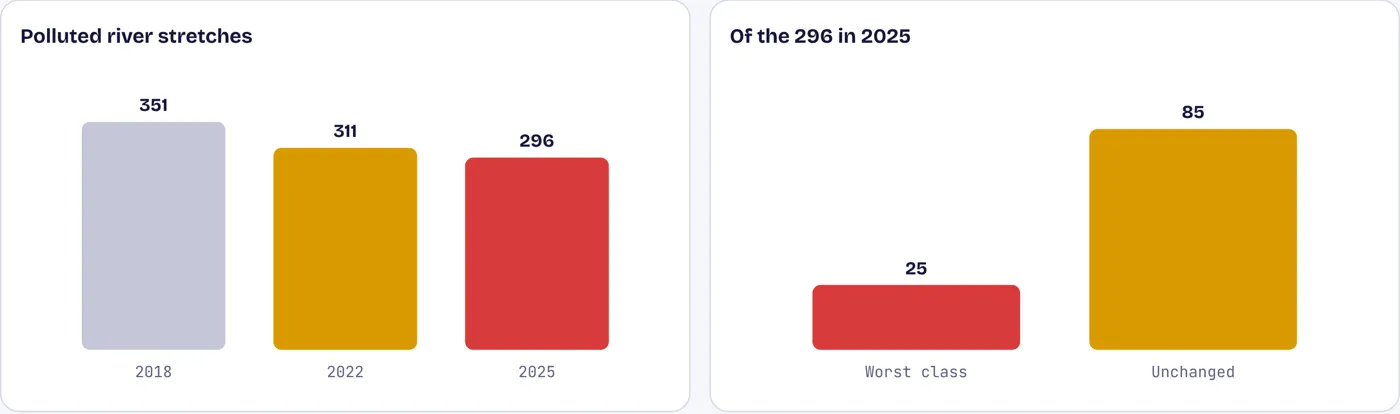
Fewer polluted stretches, but nearly 300 remain
River stretches classed as polluted by CPCB (BOD above 3 mg/l), by assessment year
The count of polluted river stretches fell from 351 in 2018 to 296 in 2025, on 271 rivers. Twenty-five are in the worst class, with oxygen demand more than ten times the bathing limit, and 85 were unchanged.
Source: CPCB, Polluted River Stretches for Restoration of Water Quality (2018, 2022, 2025), via The Policy Edge.
The honest comparison
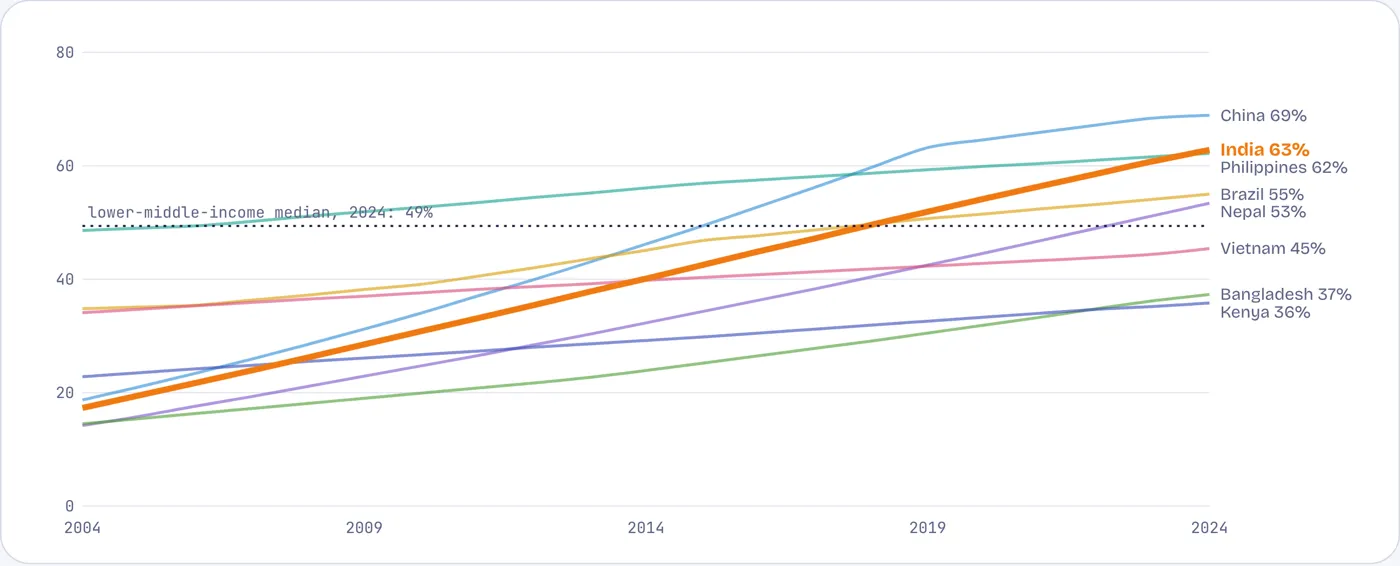
On safely managed sanitation, India is above the average for its income
Share of people using a toilet whose waste is safely disposed of or treated, %, 2004–2024. Tap or hover a line.
The international measure counts a household as safely served when its waste is treated, either at a plant or in a well-built septic tank or pit. On that measure India rose from 17% to 63%, ahead of the 49% typical for lower-middle-income countries and of Bangladesh and Kenya. Most Indian toilets drain to tanks and pits, which is why the rivers can stay foul while the sanitation figure improves.
Source: WHO/UNICEF Joint Monitoring Programme, via World Bank WDI.
The cost in lives
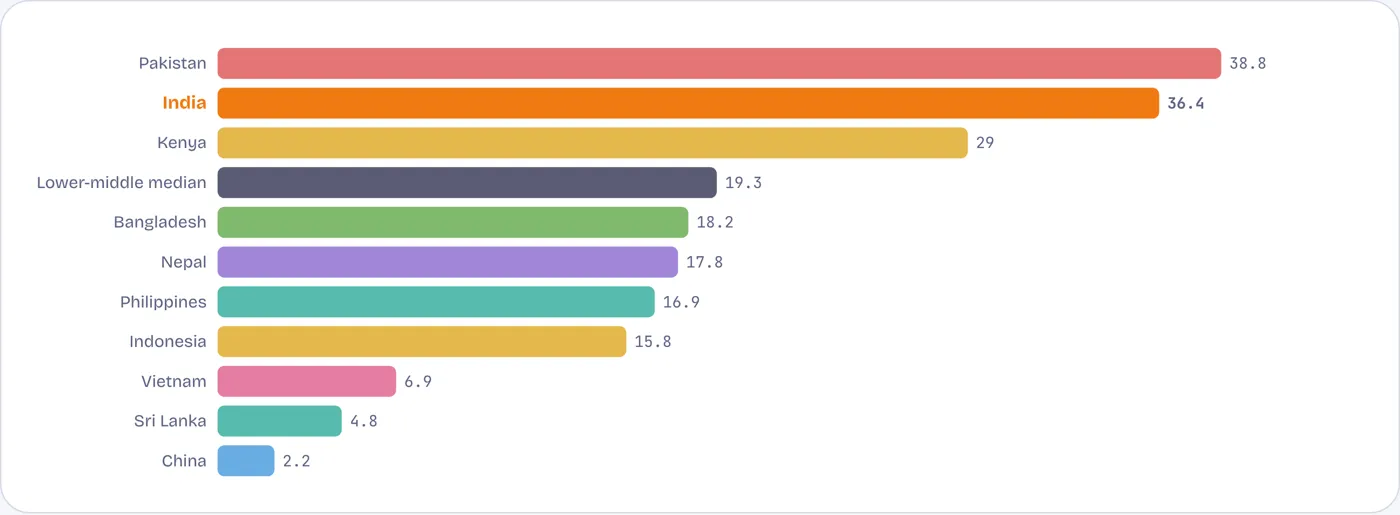
Dirty water still kills Indians at twice the rate of their neighbours
Deaths from unsafe water, sanitation and hygiene, per lakh people, 2019 (WHO)
India ranked 30th worst of 183 countries. Every country with a higher rate is in Africa, except Pakistan and Kiribati. India’s rate is twice Bangladesh’s and Nepal’s, and about 16 times China’s. Toilets reduce exposure only if the waste does not come back through drinking water, food and floods.
Source: WHO, via World Bank WDI.
Who cleans the sewers
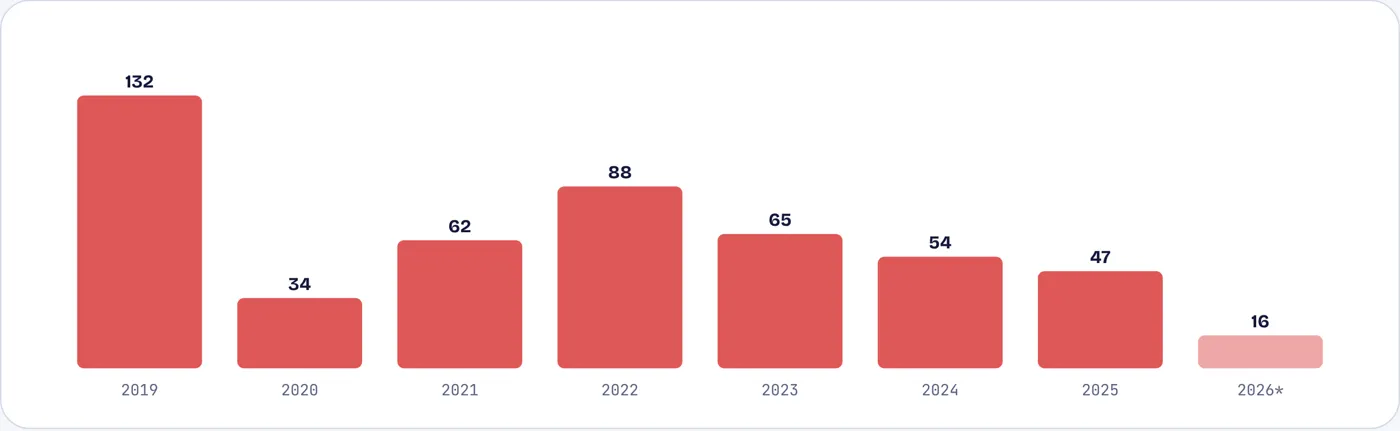
Nearly 500 workers have died in sewers and septic tanks since 2019
Deaths while cleaning sewers and septic tanks, by year (2026: January to June)
Workers, mostly from Dalit communities, are still sent into tanks and drains without protective gear, despite a 2013 law banning manual scavenging and court orders for mechanised cleaning. The government counts these as sewer deaths, not manual scavenging, and reports no deaths from manual scavenging.
Source: Ministry of Social Justice reply in Lok Sabha, August 2026, citing the National Commission for Safai Karamcharis, via Business Standard.
The tap and the drain
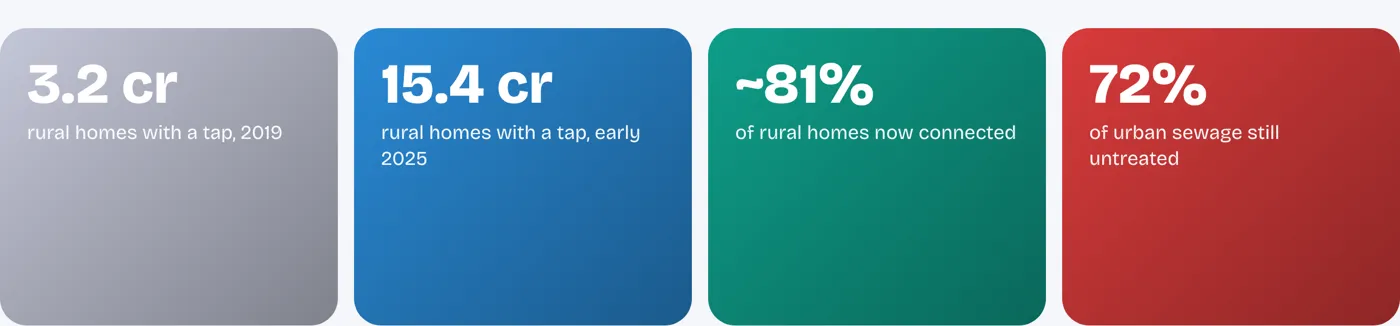
Taps reached four rural homes in five; the waste water from them has nowhere to go
Jal Jeevan Mission raised rural tap connections from 3.2 crore homes in 2019 to more than 15.4 crore by early 2025. More piped water means more waste water. Without drains and treatment in villages and small towns, it collects in streets and ponds or seeps into the groundwater that many still drink.
Source: Ministry of Jal Shakti via All India Radio News (February 2025); CPCB 2021.
Contested numbers
Three numbers that need a second look
Source: CPCB (2021); Lok Sabha replies (July 2025, August 2026); CPCB Polluted River Stretches (2025).