Income per head, Karnataka vs Bihar
5.6×
up from 4.9× in 2015–16
Scheduled Tribes in multidimensional poverty
50%
against 15% of upper castes, 2015–16
Muslim share of Lok Sabha
4.4%
about 14% of the population
Growth has reached India’s states, castes, tribes and faiths at very different speeds. Where the gaps follow the lines of identity, the easiest politics is to mobilise those identities and hand out cash rather than close the gaps.
Where you are born
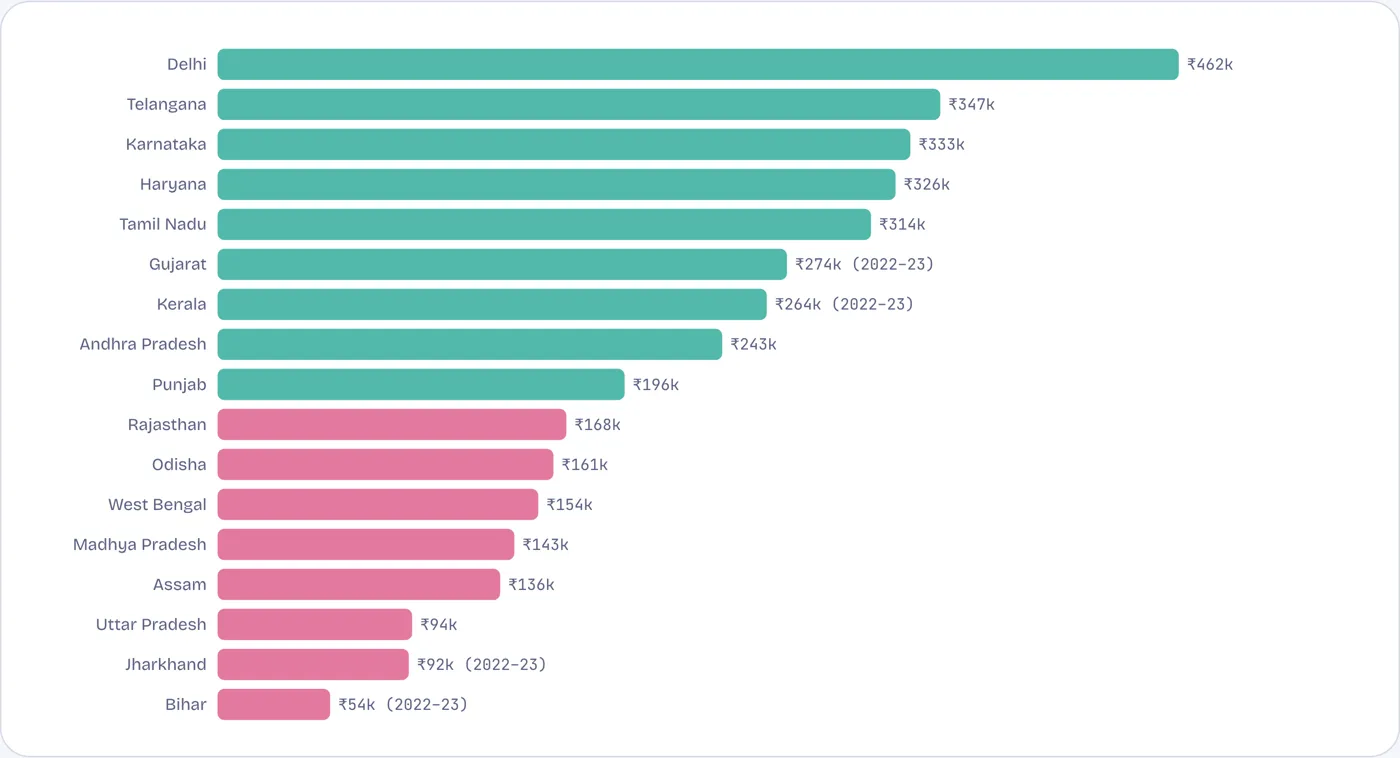
An average person in Delhi earns eight times as much as one in Bihar
Net state domestic product per person, ₹ thousand, current prices, 2023–24 (2022–23 where marked). Tap or hover a bar.
The southern and western states and Delhi earn three to eight times as much per person as Bihar, Uttar Pradesh and Jharkhand. These three poorest states hold over a quarter of India’s people and send the most migrants to the richer ones.
Source: Economic Survey 2023–24, Statistical Appendix Table 1.11A (state statistical offices).
Pulling apart
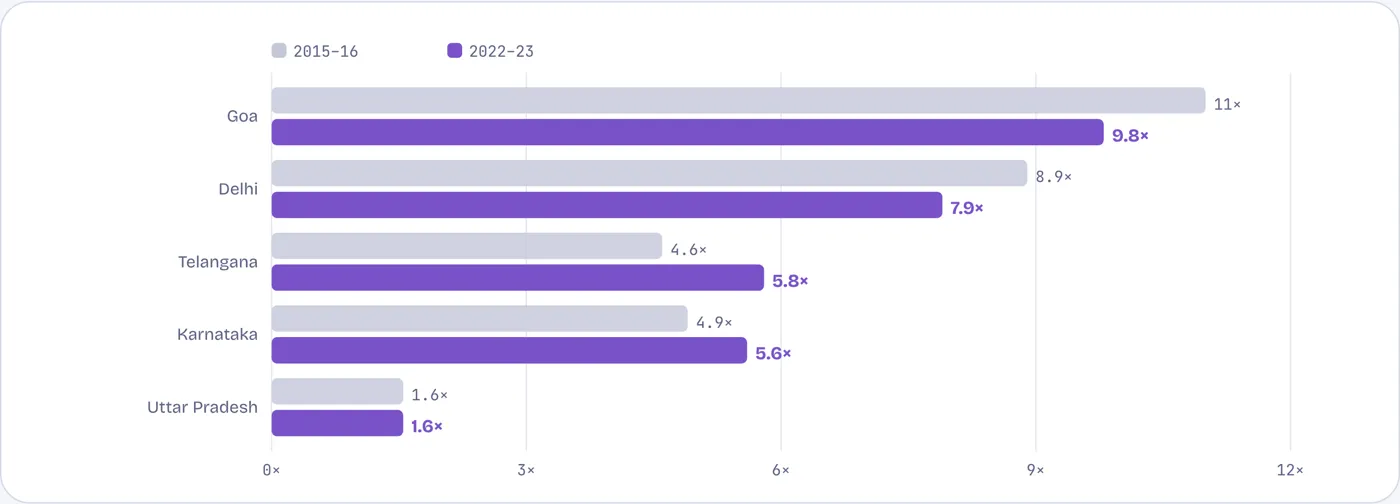
The big southern states are pulling further ahead of Bihar
Income per head as a multiple of Bihar’s, 2015–16 and 2022–23, current prices
Telangana went from 4.6 to 5.8 times Bihar’s income per head in seven years, and Karnataka from 4.9 to 5.6. Uttar Pradesh stood still relative to Bihar. Small, rich Goa and Delhi converged a little, but the large states that hold most people are diverging.
Source: Economic Survey 2023–24, Table 1.11A; multiples computed from rupee values.
Who is poor
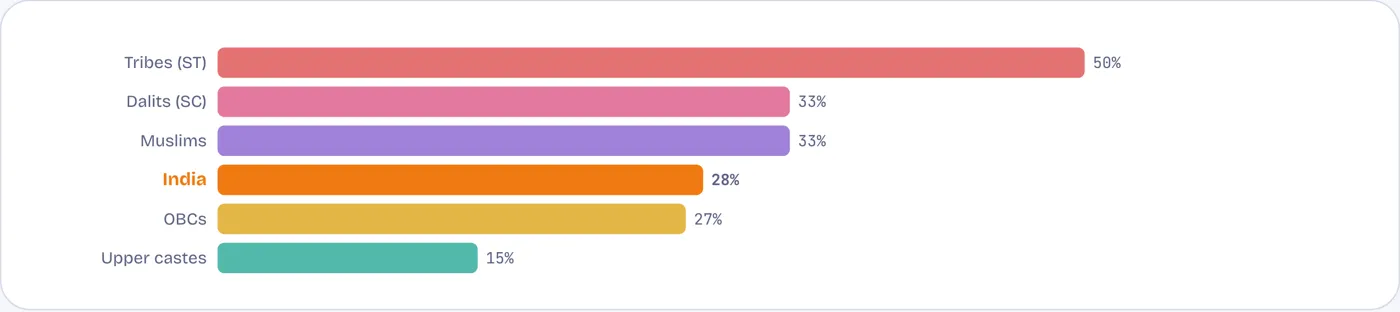
Half of tribal Indians and a third of Dalits and Muslims are multidimensionally poor
Share of each group deprived in health, schooling and living standards, %, 2015–16 (NFHS-4)
Deprivation tracks caste and faith closely. Tribal poverty fell fast, from about 80% in 2005–06, yet in 2015–16 a tribal Indian was still more than three times as likely to be poor as an upper-caste one. Five in six of India’s multidimensionally poor came from Scheduled Tribes, Scheduled Castes or Other Backward Classes.
Source: UNDP–OPHI Global MPI 2018 and 2021, via ThePrint and ForumIAS.
Who owns
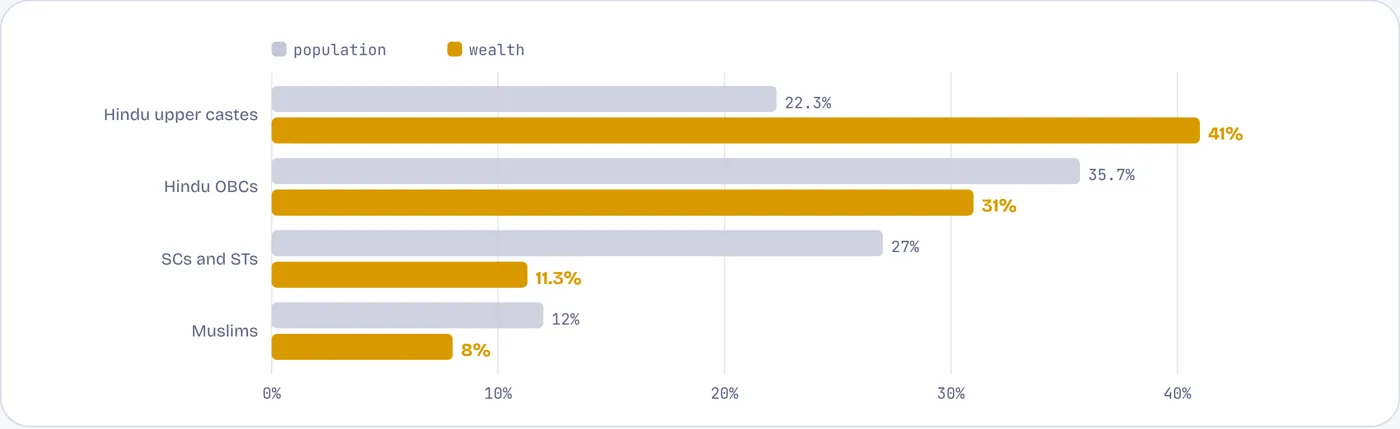
Upper-caste Hindus own 41% of household wealth with 22% of the people
Share of national household wealth vs share of population, %, by group
Wealth is more unequal than income because it is inherited: land, houses and businesses pass down family lines. Scheduled Castes and Tribes, over a quarter of the people, hold about a ninth of the wealth; Muslims, about an eighth of households, hold 8%.
Source: SPPU, JNU and Indian Institute of Dalit Studies, “Wealth Ownership and Inequality in India” (NSSO data), via Business Today.
The perverse incentive
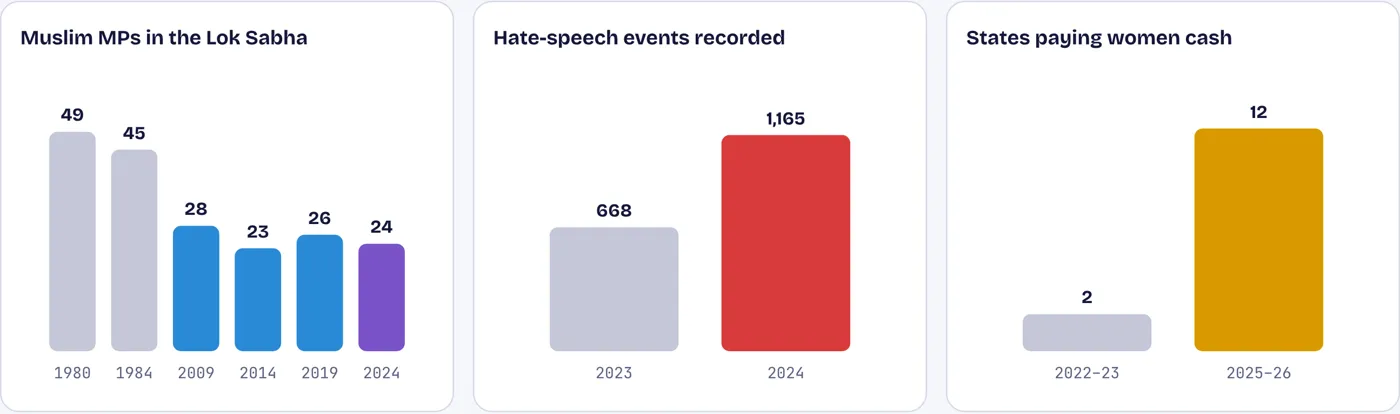
Gaps that follow identity reward identity politics and cash handouts
Three signals of how parties respond to uneven growth
When a group is visibly behind, a party can win its vote by promising quotas, grievance or a monthly cash transfer, all faster than building schools and jobs. The number of states paying women unconditionally rose from 2 to 12 in three years; hate-speech events recorded by one monitoring group rose 74% in 2024, a third of them during the election campaign; and the share of Muslim MPs is at a historic low. Each response is rational for a party and costly for the country.
Source: Factly (Lok Sabha); India Hate Lab, Hate Speech Events in India 2024; PRS Legislative Research via Deccan Herald.
When it breaks
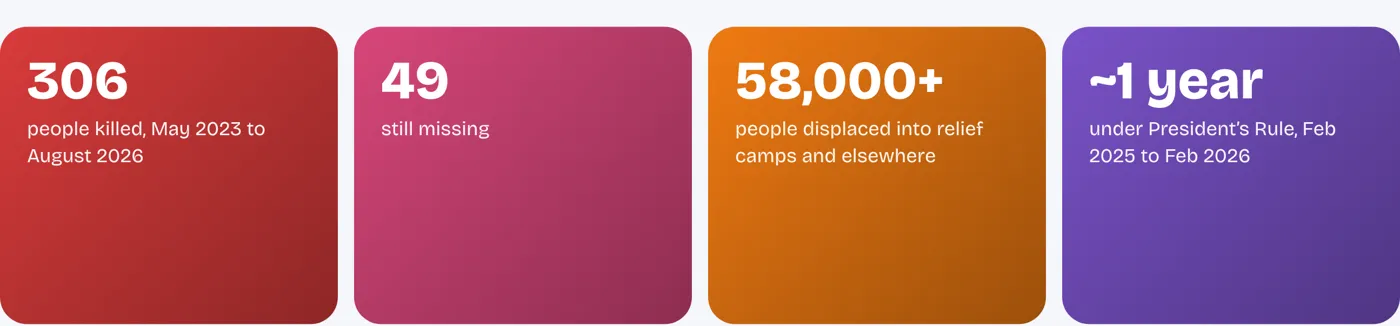
Manipur: a fight over quotas and land turned into three years of killing
Ethnic violence between Meitei and Kuki-Zo communities, since 3 May 2023
The violence began after a court order on granting the Meitei majority tribal status, which Kuki-Zo groups saw as a threat to their land and job reservations. A dispute over shares of a slow-growing state economy became a conflict that emptied whole districts of one community or the other.
Source: Manipur Home Minister to the Assembly, via The Pioneer (deaths, missing); state home department, via Amar Ujala (displaced).
Contested numbers
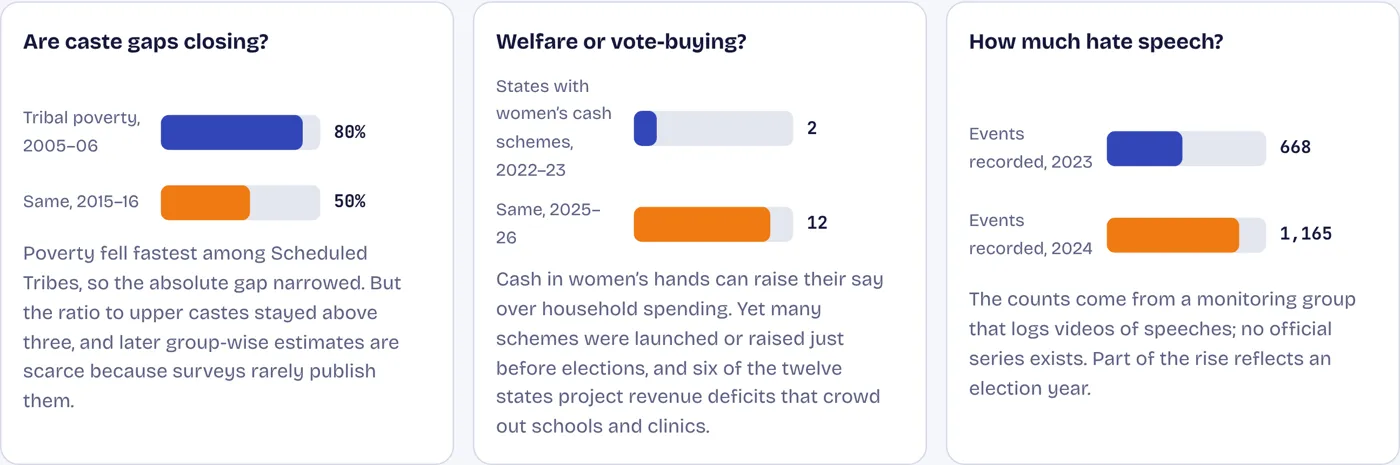
Three numbers that need a second look
Source: UNDP–OPHI Global MPI; PRS; India Hate Lab.