Income-tax filers who owed no tax
66%
5.6 crore of 8.4 crore returns, 2023–24
Corporate tax share of direct taxes
67%→46%
2010–11 to 2024–25
Tax on wealth or inheritance
None
wealth tax abolished 2015; estate duty 1985
Every Indian pays tax each time they buy soap, a phone recharge or a bus ticket. Only 2.8 crore pay any income tax at all. Companies now pay less income tax than individuals do, wealth and inheritance go untaxed, and economists disagree sharply on whether the GST falls harder on the poor or the rich.
The GST question
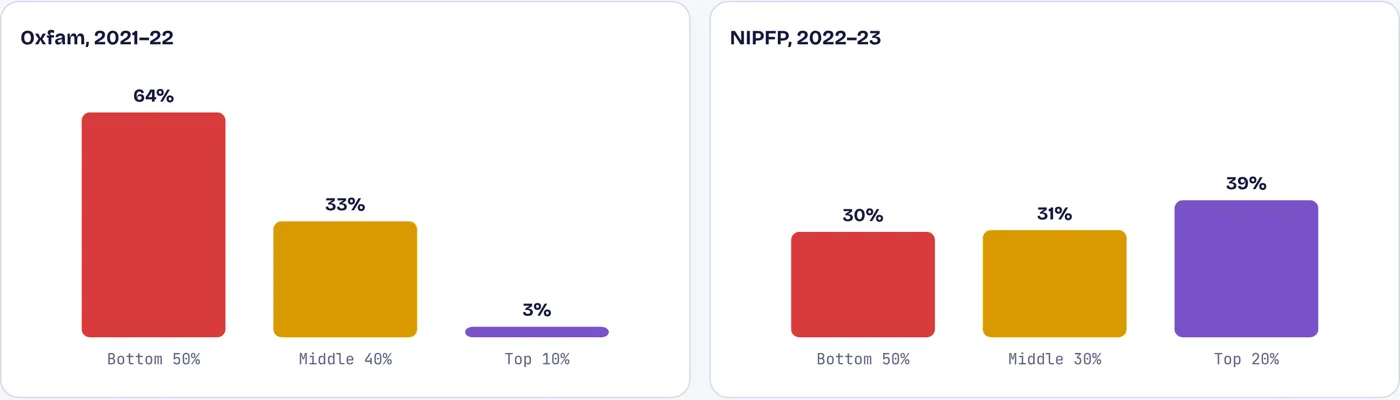
Two studies, opposite answers: who carries the GST?
Share of total GST paid by each group, %
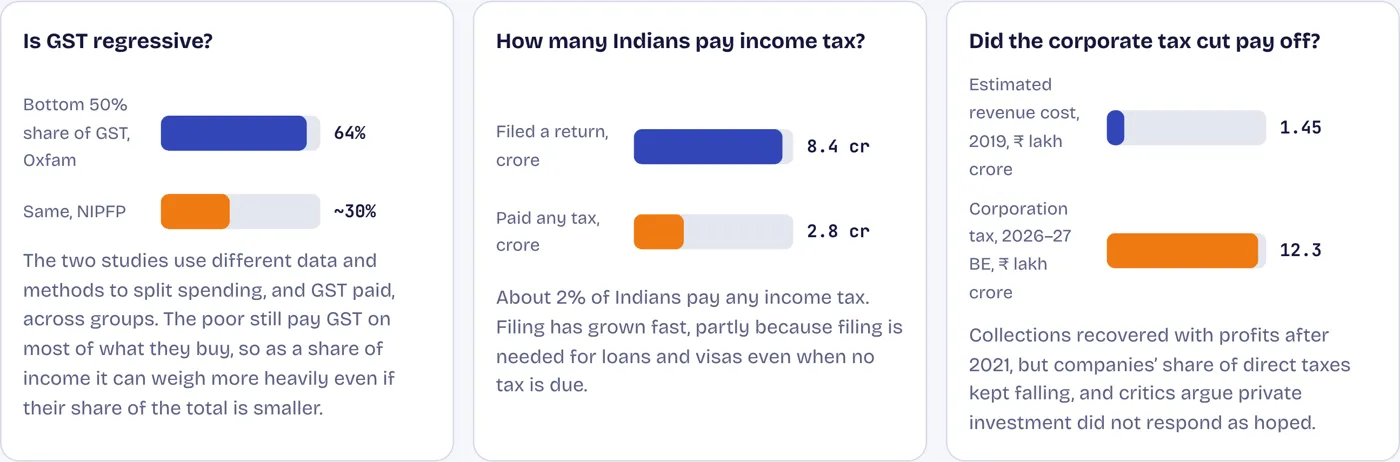
Oxfam estimated in 2023 that the poorest half of Indians paid 64% of GST and the richest tenth just 3%, which would make the tax sharply regressive. A 2025 study by the National Institute of Public Finance and Policy, using the government’s 2022–23 consumption survey, found the bottom half paying about 30% and the top fifth about 40%, and called GST mildly progressive. The difference lies in method: how spending is split across groups and which goods are taxed at which rate. What both agree on is that GST reaches every household, however poor.
Source: Oxfam India, Survival of the Richest (2023), via Outlook; Sacchidananda Mukherjee, NIPFP Working Paper 430 (July 2025), via Next IAS. Groups differ: Oxfam uses top 10% and middle 40%, NIPFP top 20% and middle 30%; NIPFP figures are the average of rural and urban.
Income tax
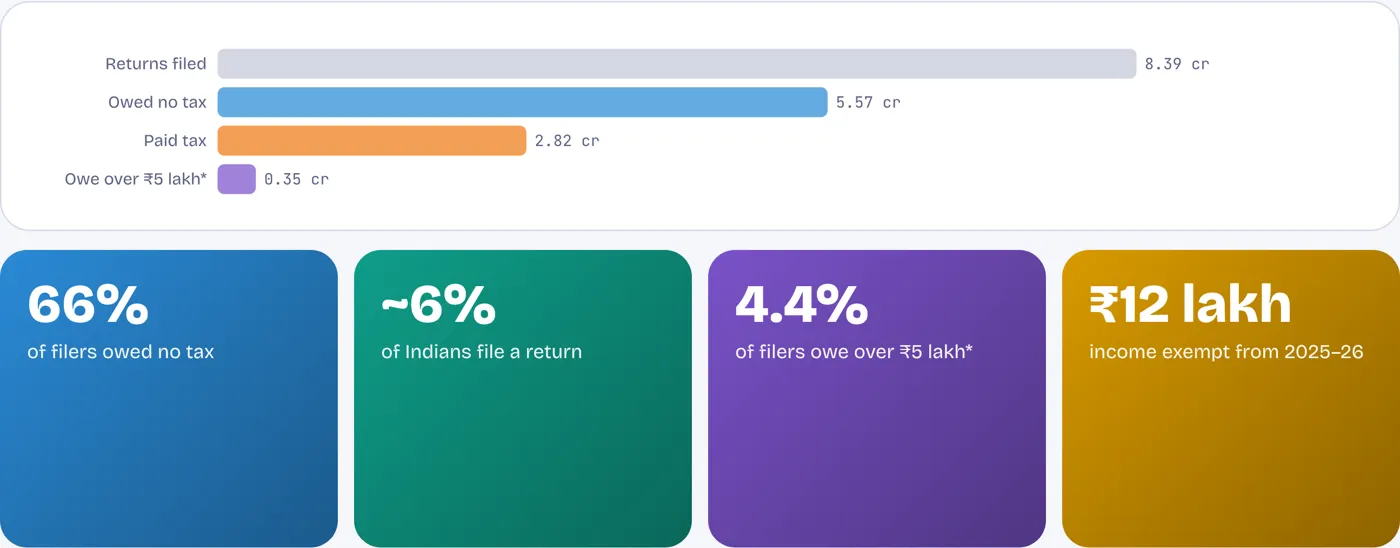
Two of every three people who file a return pay no income tax
Individual income-tax returns, crore, financial year 2023–24 (filed by December 2024). *2024–25 returns filed by December 2025
Of 8.4 crore returns, 5.6 crore showed no tax due; 2.8 crore people paid. Only about 35 lakh filers owe more than ₹5 lakh a year in tax, under one in twenty. From 2025–26, incomes up to ₹12 lakh are exempt under the new regime, and at least four in five filers are expected to owe nothing. Income tax is paid by a narrow salaried and professional slice.
Source: Income Tax Department data via A2Z Taxcorp; PRS Legislative Research, Vital Stats: Direct Taxes in India (2025).
People vs companies
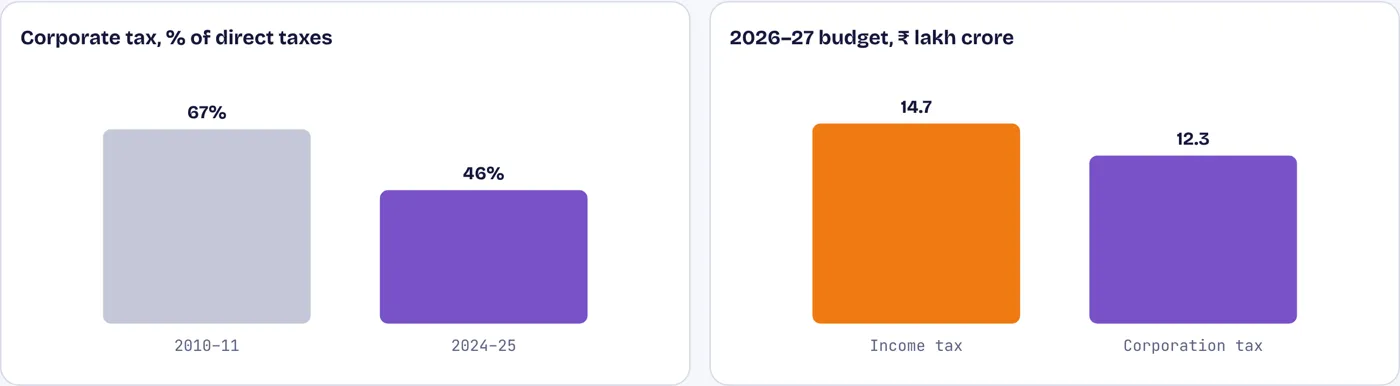
Individuals now pay more income tax than companies do
Corporate tax as % of direct tax collections; budgeted collections 2026–27, ₹ lakh crore
In 2010–11 companies paid two-thirds of India’s direct taxes. By 2024–25 they paid under half. The 2019 cut in the base corporate rate, to 22% for firms giving up exemptions, cost an estimated ₹1.45 lakh crore a year, while personal income tax kept rising with salaries. The 2026–27 budget expects ₹14.7 lakh crore from income tax and ₹12.3 lakh crore from companies. Even among companies tax is concentrated: 743 firms, 0.1% of the total, paid 53% of corporate tax in 2022–23.
Source: Factly (Union Budget data); The Wire (Budget at a Glance 2026–27); PRS Vital Stats.
The untaxed
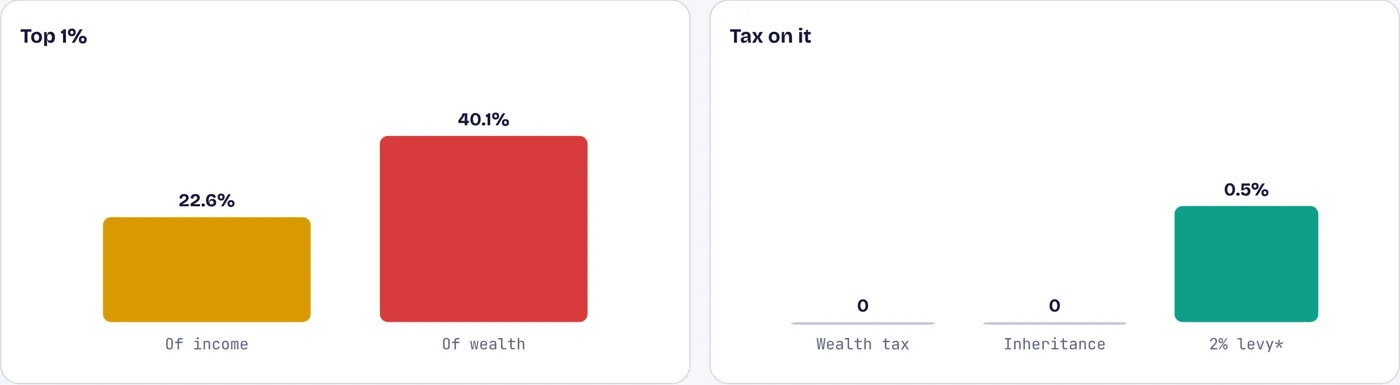
The richest 1% own 40% of the wealth, and wealth itself is not taxed
Share of national income and wealth held by the top 1%, %, 2022–23. *Revenue from a 2% tax on the 167 richest families, % of national income
India abolished its wealth tax in 2015 and its estate duty in 1985. Gains on assets are taxed only when sold, at rates below those on salaries. The World Inequality Lab estimates a 2% annual tax on the net wealth of India’s 167 richest families would raise 0.5% of national income.
Source: World Inequality Lab (Chancel, Bharti, Kumar, Piketty, 2024); Oxfam India.
The 2025 reset
GST 2.0 cut taxes on everyday goods and added a 40% rate for luxuries
Revenue effect of the September 2025 GST rate rationalisation, ₹ thousand crore a year (estimates)
From 22 September 2025, milk, bread and fresh produce were exempted, soaps, toothpaste and farm equipment moved to 5%, and small cars and air conditioners fell from 28% to 18%. Luxury and sin goods moved to a new 40% slab. The net revenue cost was estimated at ₹48,000 crore. Lower rates on essentials help poorer households most as a share of their spending; cheaper cars and air conditioners help the better-off.
Source: GST Council decisions and estimates, via Wikipedia (Goods and Services Tax 2.0).
Contested numbers
Three numbers that need a second look
Source: Oxfam India; NIPFP; Income Tax Department; PRS.
The takeaway
India taxes spending broadly, salaries narrowly, profits less than before and wealth not at all. The burden rests on consumers and the salaried middle, while the largest fortunes face the lightest touch.