Corruption Perceptions Index
36→39
out of 100, 2012 to 2025; 91st of 182
Public-service users who paid a bribe
39%
highest of 17 Asian countries surveyed, 2020
Firms calling corruption a major obstacle
17%→39%
2014 to 2022
India digitised payments and pushed benefits straight into bank accounts, cutting some of the oldest leaks in the state. Yet its score on the world’s main corruption index has barely moved in a decade, more firms report bribe demands than ten years ago, and four in ten Indians who used a public service paid a bribe.
A decade standing still
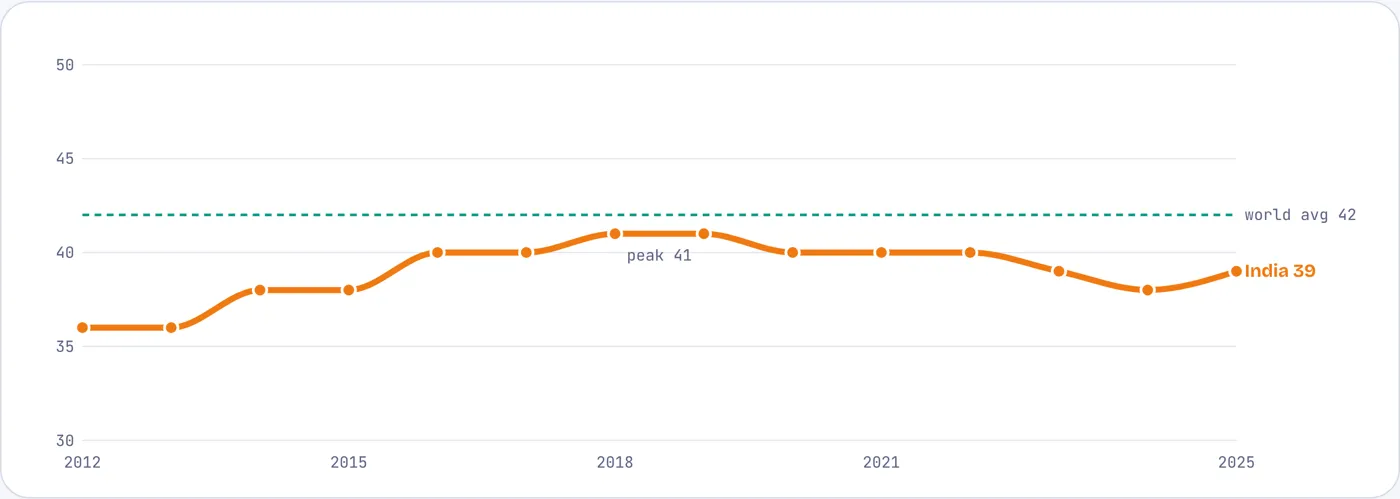
India’s corruption score has hovered around 40 for a decade, below the world average
Transparency International Corruption Perceptions Index, India, 2012–2025 (0 = highly corrupt, 100 = very clean). Tap or hover a point.
The index rose from 36 to a peak of 41 in 2018–19, then slipped back to 38 in 2024 and 39 in 2025. Over the same years the economy more than doubled. Rising incomes have not, on this measure, bought a cleaner state; the world average is 42.
Source: Transparency International, Corruption Perceptions Index 2012–2025; 2025 results via Drishti IAS.
The neighbourhood
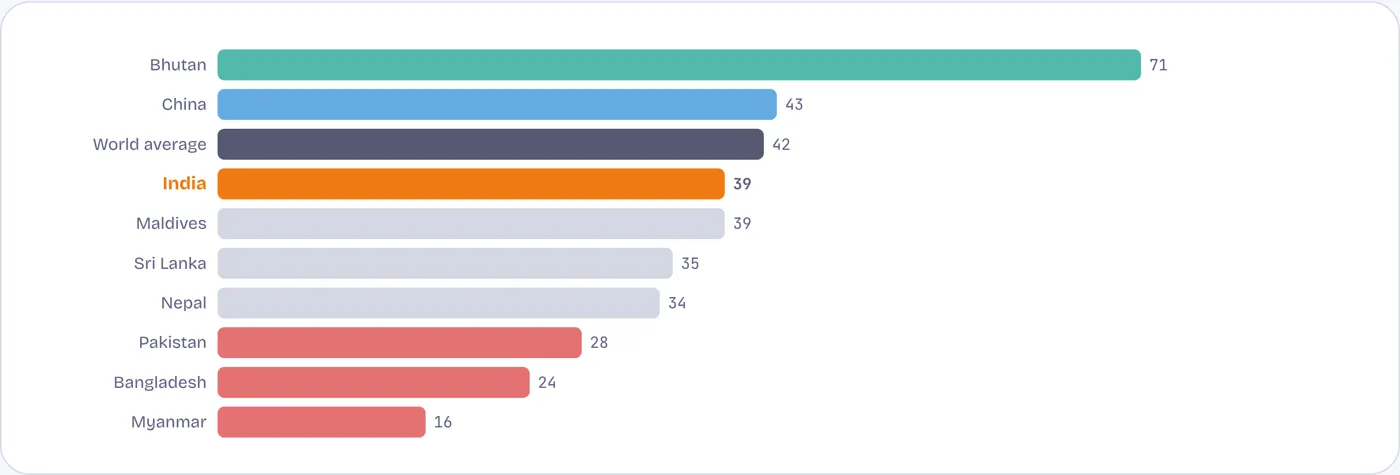
Cleaner than most of South Asia, well behind China and Bhutan
Corruption Perceptions Index score, 2025
India ranks 91st of 182 countries, level with the Maldives. Bhutan, a far poorer country, scores 71. Bangladesh, Pakistan and Myanmar score lower than India.
Source: Transparency International, CPI 2025, via Drishti IAS.
What citizens pay
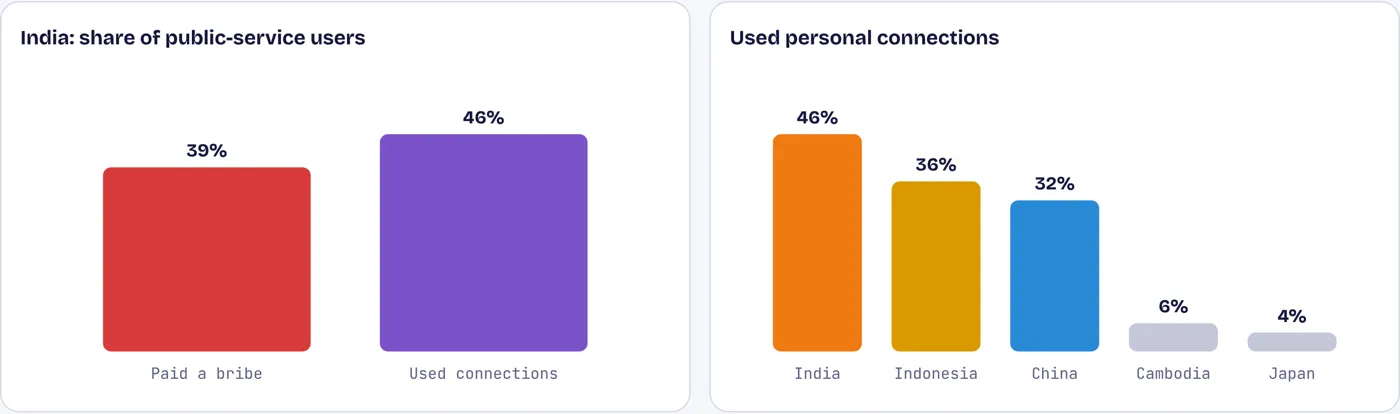
Four in ten Indians who used a public service paid a bribe; nearly half used connections
Share of people who used a public service in the previous year and paid a bribe, or used personal connections to get it, 2020
Transparency International’s Global Corruption Barometer for Asia found India’s bribery rate the highest of the 17 countries surveyed, and its use of personal connections the highest too. Across the region, the police were where bribes were most often paid; courts and identity offices where connections mattered most.
Source: Transparency International, Global Corruption Barometer Asia 2020.
What business pays
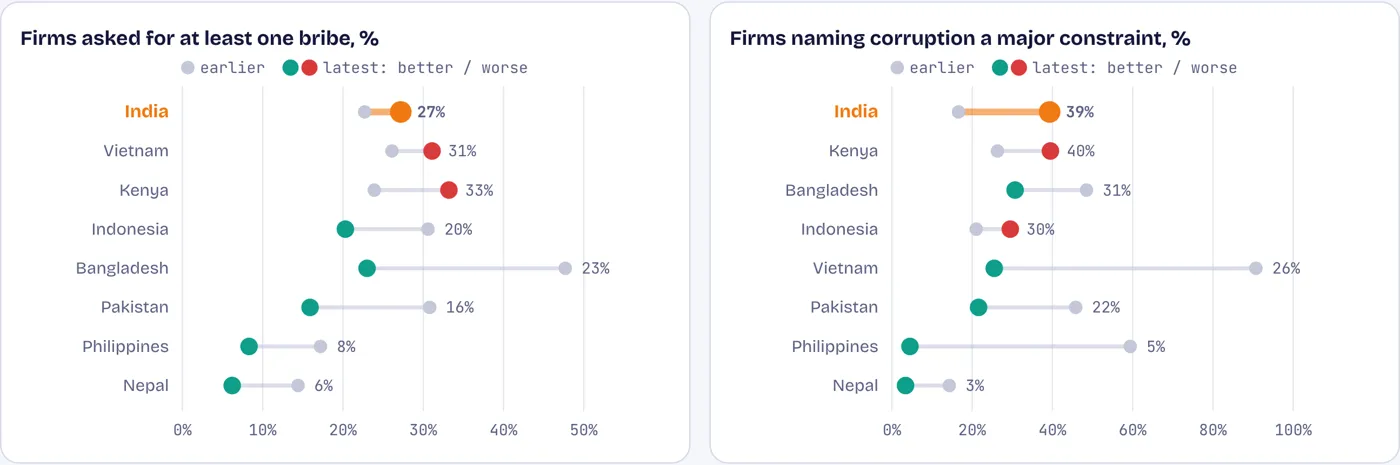
More firms meet bribe demands and see corruption as a major obstacle than a decade ago
World Bank Enterprise Surveys: firms asked for at least one bribe, and firms naming corruption a major constraint, latest two surveys. Tap or hover a row.
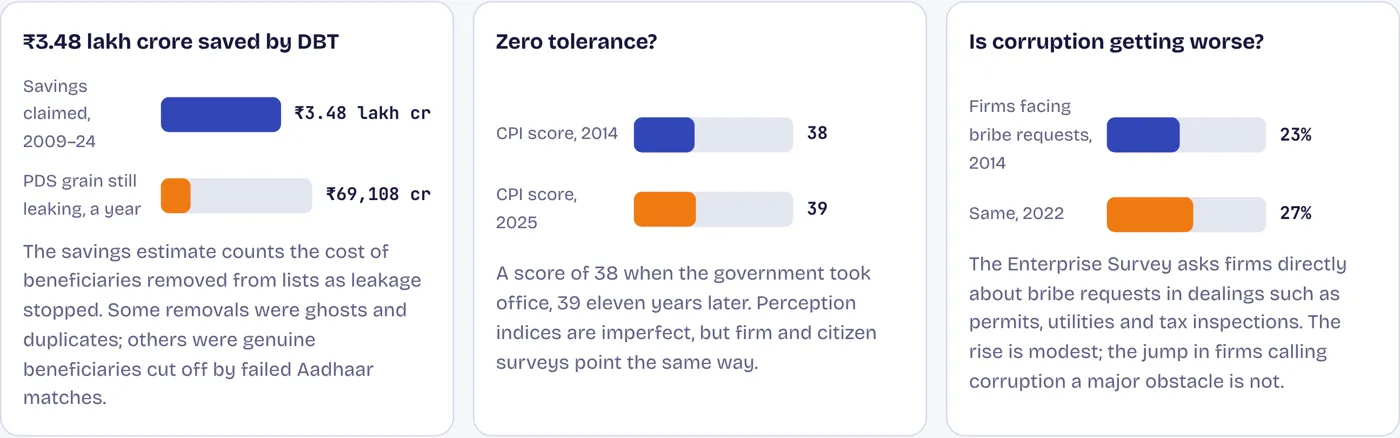
Between the 2014 and 2022 surveys, the share of Indian firms facing at least one bribe request rose from 23% to 27%, and the share calling corruption a major obstacle more than doubled, to 39%. Over similar periods Bangladesh, Pakistan, Nepal and the Philippines reported falls.
Source: World Bank Enterprise Surveys, via World Bank WDI. Survey years differ by country (shown on tap or hover).
Leaks in welfare
Direct transfers closed some leaks; grain still goes missing on a large scale
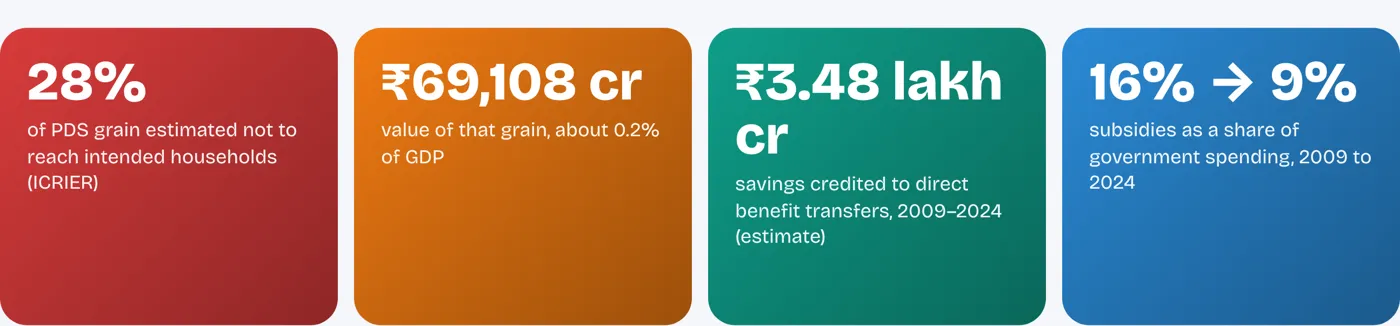
Paying benefits straight into Aadhaar-linked bank accounts removed duplicate and ghost beneficiaries, and the government credits it with large savings. In food, which still moves physically through ration shops, a study by the research institute ICRIER estimated that 28% of the grain supplied never reached the intended households.
Source: ICRIER via Moneylife; DBT estimate via Business Today and All India Radio News.
Money and politics
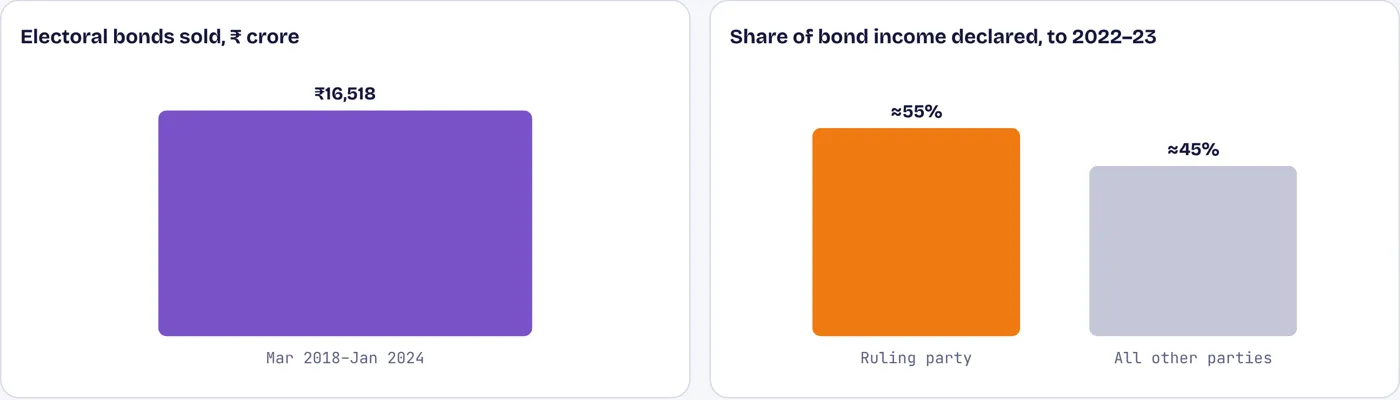
₹16,518 crore flowed to parties through anonymous bonds before the Supreme Court struck them down
Electoral bonds sold, March 2018 to January 2024, and the ruling party’s share of bond income received up to 2022–23
Electoral bonds let companies and individuals give unlimited, anonymous sums to political parties. In February 2024 the Supreme Court held the scheme unconstitutional, saying voters had a right to know who funds parties. The ruling party received about 55% of bond income declared up to 2022–23; all major parties accepted bonds.
Source: Association for Democratic Reforms data via ETV Bharat; Supreme Court judgment, 15 February 2024.
Contested numbers
Three numbers that need a second look
Source: Business Today; ICRIER; Transparency International; World Bank Enterprise Surveys.
The takeaway
Technology closed some leaks, but corruption that runs through police stations, permits, ration shops and party funding has not shrunk with growth. Every rupee lost is a road unbuilt, a ration not eaten, and trust in the state spent.