Staying in school
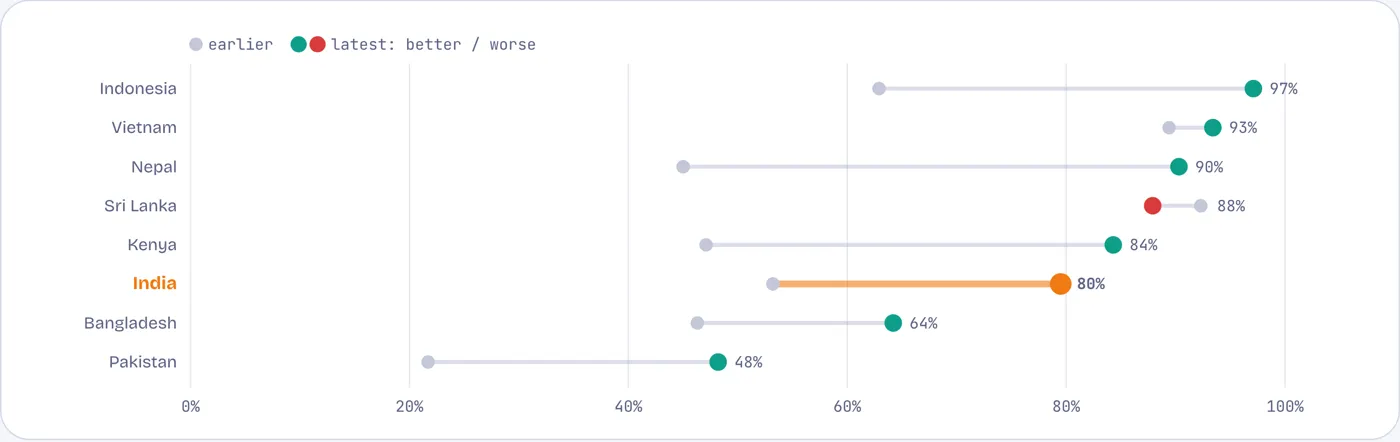
Secondary enrolment rose fast but still trails poorer Nepal and Kenya
Gross enrolment in secondary school, % of the age group, 2004 → latest. Tap or hover a row.
India’s secondary enrolment rose from 53% to about 80% in twenty years, a large gain. Nepal, poorer than India, has overtaken it at 90%; Indonesia and Vietnam are near universal. UDISE+, India’s own school census, puts the secondary-level gross enrolment ratio lower, at 69% in 2024–25, and the secondary retention rate at 47%.
Source: UNESCO via World Bank WDI; UDISE+ 2024–25 via Careers360.
What teenagers can do
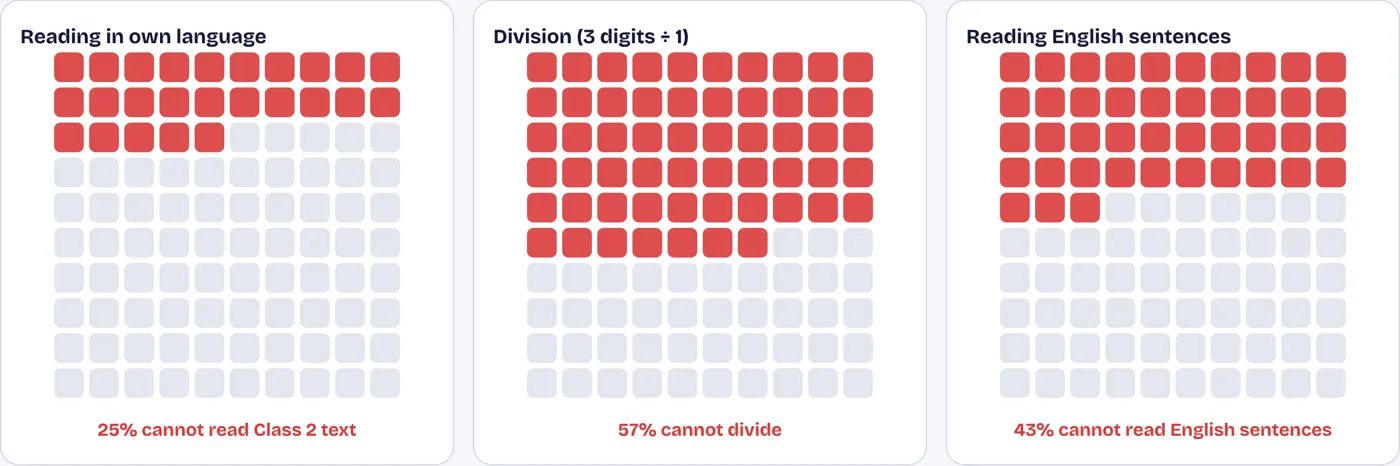
A quarter of rural 14–18-year-olds cannot read a Class 2 text fluently
Rural Indians aged 14–18, ASER “Beyond Basics” survey, 2023: 100 squares, one per 1%
These are young people who have mostly completed eight years of school. One in four still cannot read a simple story meant for seven-year-olds in their own language; 57% cannot divide a three-digit number by a single digit. The learning gaps of Class 3 do not close by Class 10; they are carried into the workforce.
Source: ASER Centre, ASER 2023 “Beyond Basics”, via The Week / PTI.
Who leaves
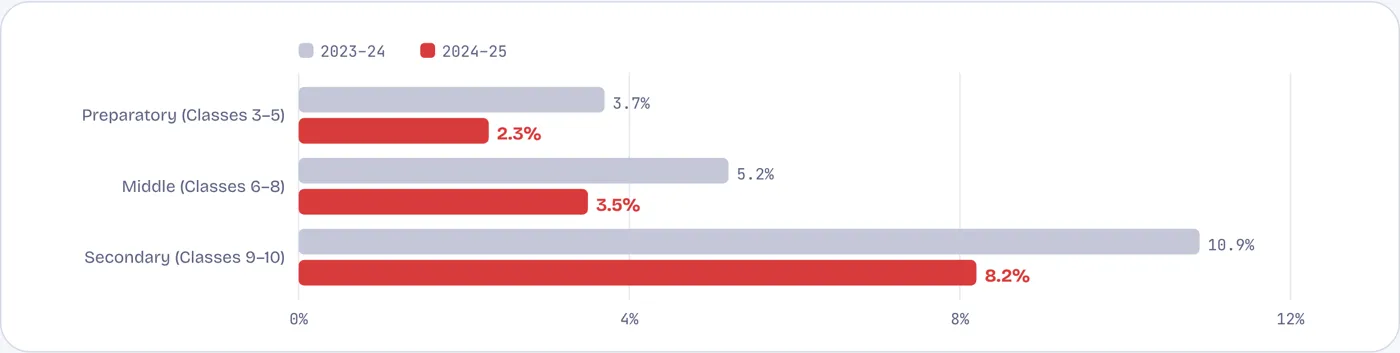
Dropout jumps at the secondary stage
Annual dropout rate by school stage, %, UDISE+ 2023–24 and 2024–25
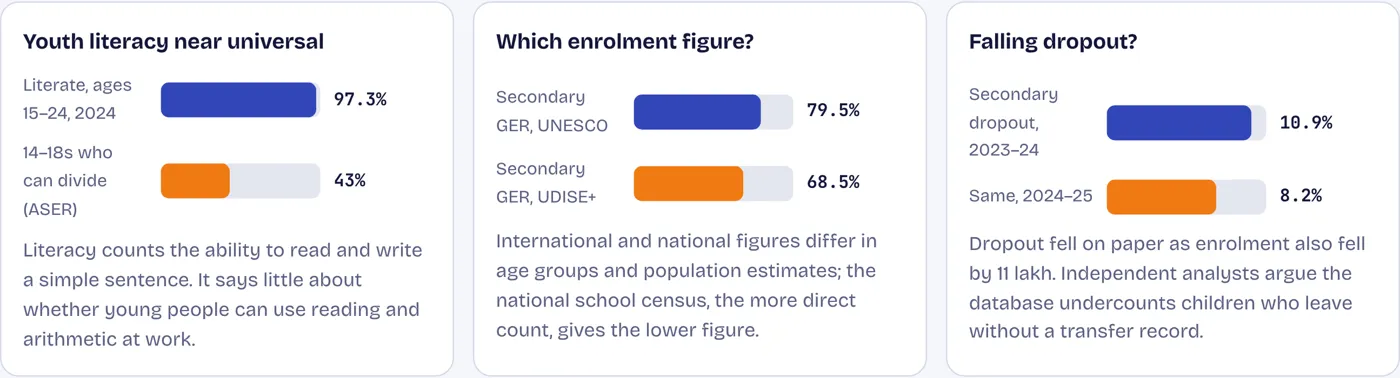
Dropout is low in the early grades and rises sharply in Classes 9–10, when children are old enough to work or marry and schools are farther away. Rates improved in 2024–25, but total enrolment fell by 11 lakh, and analysts question how completely the database tracks children who leave.
Source: Ministry of Education, UDISE+ 2024–25, via Careers360.
Who teaches
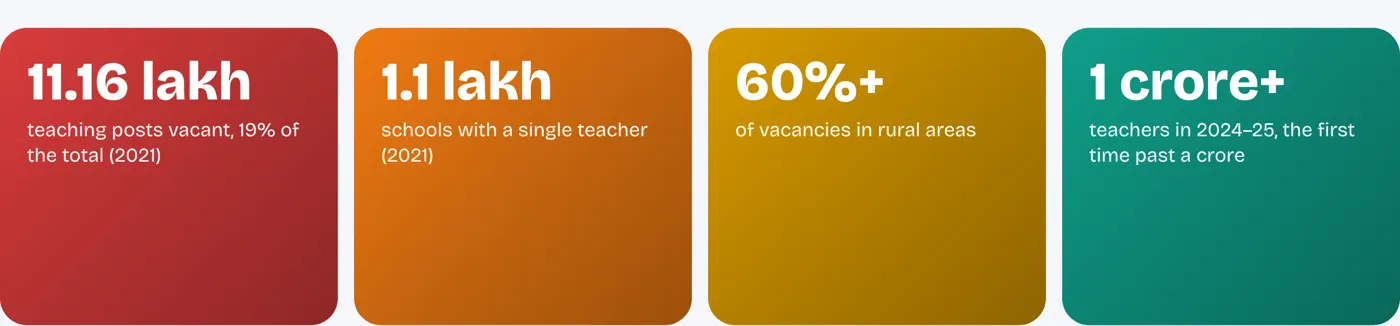
Eleven lakh teacher posts vacant; one lakh schools with a single teacher
UNESCO’s 2021 report on Indian education found 19% of teaching posts vacant, most in rural areas, and over a lakh schools run by one teacher. The total number of teachers crossed one crore in 2024–25, and single-teacher schools fell slightly, but the shortage is concentrated where learning is weakest.
Source: UNESCO, State of the Education Report for India 2021, via Business Today; UDISE+ 2024–25.
The cost
Weak schooling shows up later as idle youth and unemployable graduates
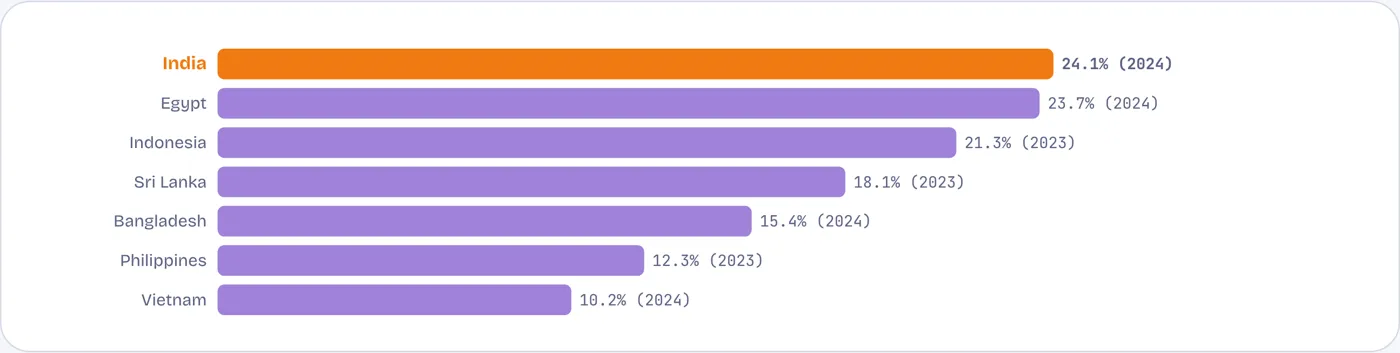
Young people (15–24) not in employment, education or training, %, latest year
About a quarter of young Indians are neither working nor studying, against about one in ten in Vietnam. Even those who do finish college face 13% unemployment. Each cohort that leaves school without basic skills will spend forty working years in low-productivity jobs; that is the real price of the learning gap.
Source: ILO, via World Bank WDI.
Contested numbers
Three numbers that need a second look
Source: UNESCO via WDI; UDISE+ 2024–25; ASER 2023; youth literacy from UNESCO via WDI.