The scale
A workforce the size of a large state, growing three times over
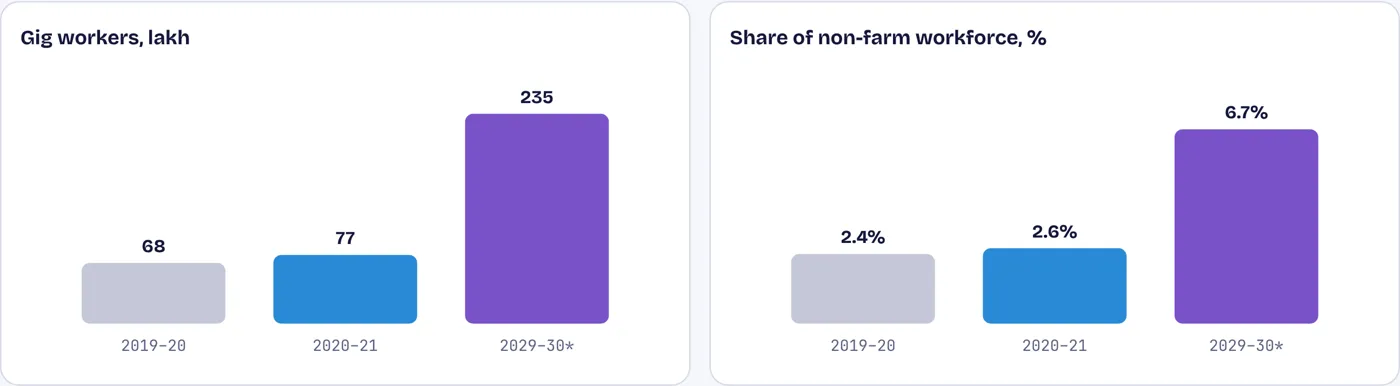
Gig workers, lakh, and share of non-farm workforce, NITI Aayog estimate and projection
NITI Aayog counted 77 lakh gig workers in 2020–21, 2.6% of the non-farm workforce, and projects 2.35 crore by 2029–30, 6.7%. India already has about a fifth of the world’s platform workers. Gig work has become a common door into urban employment for young men who cannot find salaried jobs.
Source: NITI Aayog, India’s Booming Gig and Platform Economy (2022), via Business Today; ILO via Outlook Business.
The work
Long days, thin margins
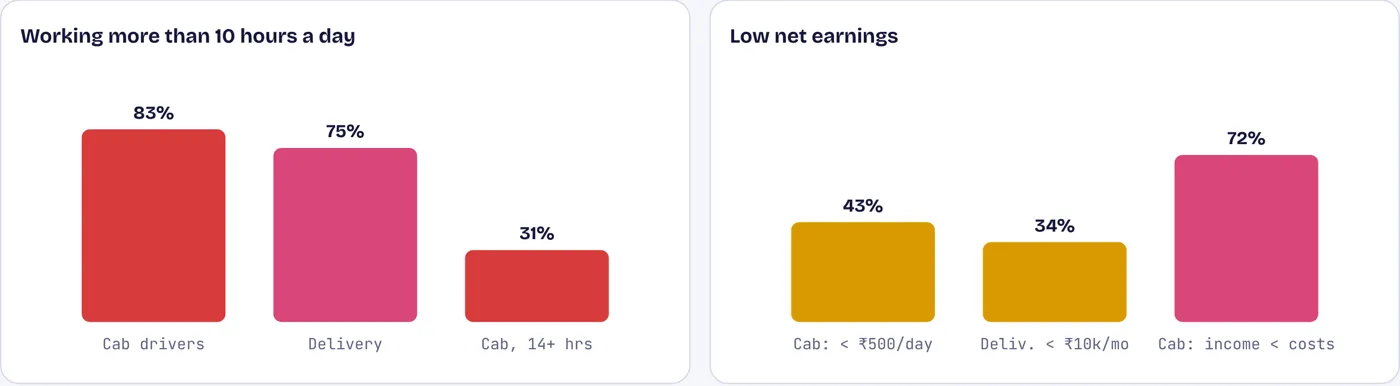
App-based cab drivers and delivery workers, 8 cities, 2024 survey of 10,336 workers, %
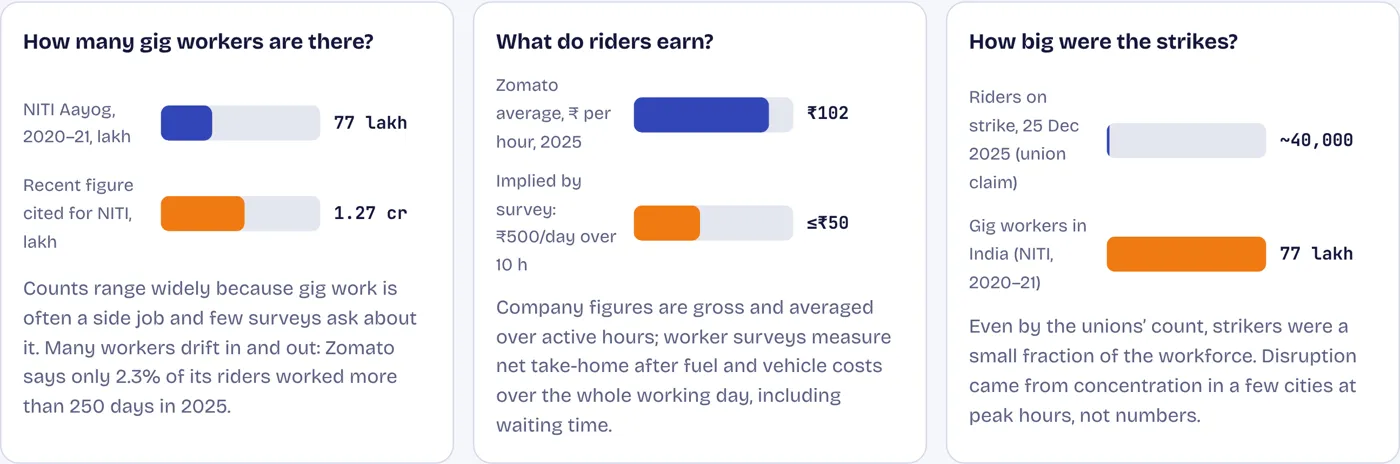
83% of cab drivers and 75% of delivery workers worked more than ten hours a day; almost a third of cab drivers worked over fourteen. After fuel, food and vehicle costs, 43% of cab drivers took home under ₹500 a day, and a third of delivery workers under ₹10,000 a month. NCAER found food-delivery workers’ real monthly pay in 2022 was 11% below 2019. Company figures paint a better picture: Zomato reports average earnings of ₹102 an hour in 2025.
Source: PAIGAM and IFAT survey (March 2024), via The Quint; NCAER (2022) and Zomato (2025), via Outlook Business.
The risks
Four in ten face violence at work, and nearly half have no insurance
Share of gig workers, %
Nearly half of app-cab drivers and four in ten delivery workers reported violence at work. Nearly half of gig workers have no insurance of any kind. Road accidents on delivery runs are rarely recorded as workplace injuries, and an account can be blocked by the algorithm with no hearing.
Source: PAIGAM and IFAT (2024); CIIE.CO survey of 4,016 gig workers (2022), via Outlook Business.
Who they are
Young, urban and schooled: the profile of a restless workforce
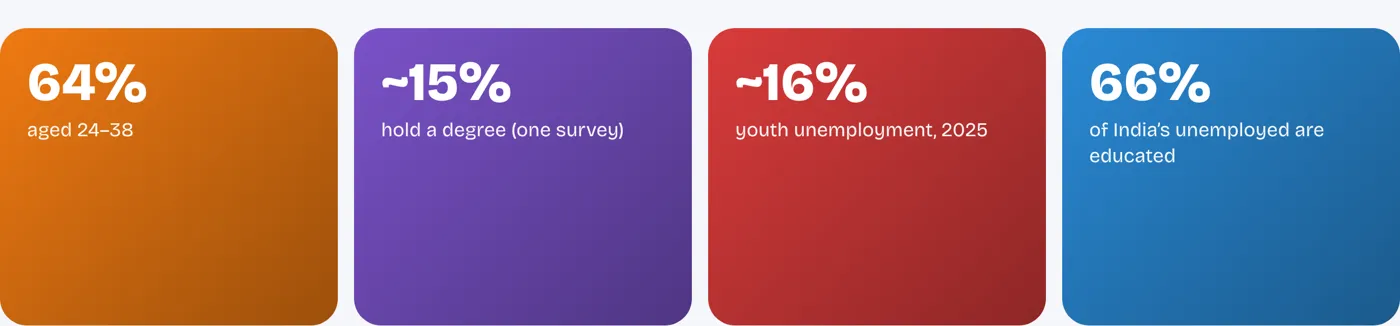
Characteristics of gig workers and the labour market around them
Two-thirds of gig workers are between 24 and 38. Most have finished middle or high school, and one in seven has a degree. They work in the same cities, wait at the same corners and share the same phone groups. Around them, youth unemployment is near 16%, and two-thirds of India’s unemployed are educated. Connected, urban and stuck: groups like this have often been at the front of street protest elsewhere.
Source: Assocham–Primus Partners (2021) and CIIE.CO (2022), via Outlook Business; ILO via World Bank WDI (youth unemployment, 2025); India Employment Report 2024 (ILO and IHD).
The first strikes
From scattered protests to nationwide strikes
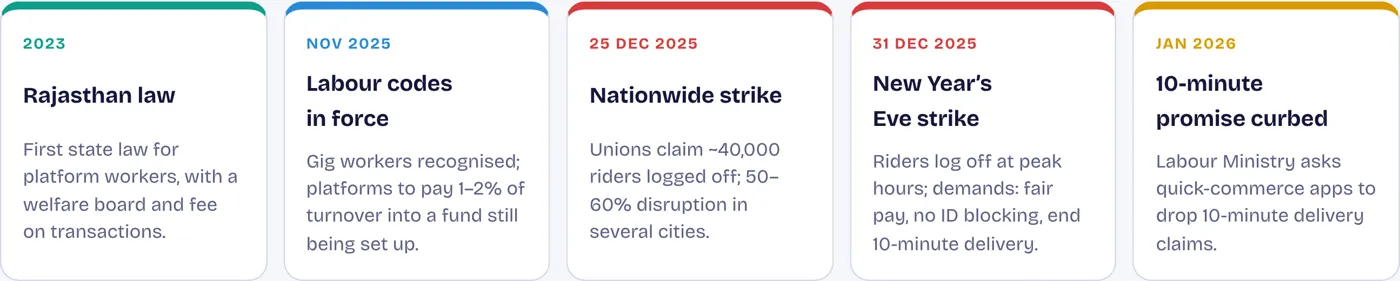
Key events, 2023–2026
The December 2025 strikes were the largest coordinated stoppages by delivery workers so far. They won something: in January 2026 the Labour Ministry asked quick-commerce platforms to stop promising 10-minute delivery. But participation was uneven, platforms brought in replacements and incentives, and in Bengaluru the strike fizzled. The workforce is restless but fragmented.
Source: GroundXero; Al Jazeera; Gulf News; Deccan Herald; Medianama.
Contested numbers
Three numbers that need a second look
Source: NITI Aayog; Zomato; PAIGAM; union statements.