The harvest
Rice alone outweighs wheat; pulses and oilseeds are an afterthought
Production, million tonnes, 2024–25 (final estimates)
India produced a record 358 million tonnes of foodgrains in 2024–25. Rice and wheat made up three quarters of it. Pulses, the main protein for most Indians, came to 26 million tonnes, less than a fifth of the rice crop.
Source: Ministry of Agriculture final estimates, via Outlook Business (21 November 2025).
The surplus
Government granaries hold more than twice what the buffer requires
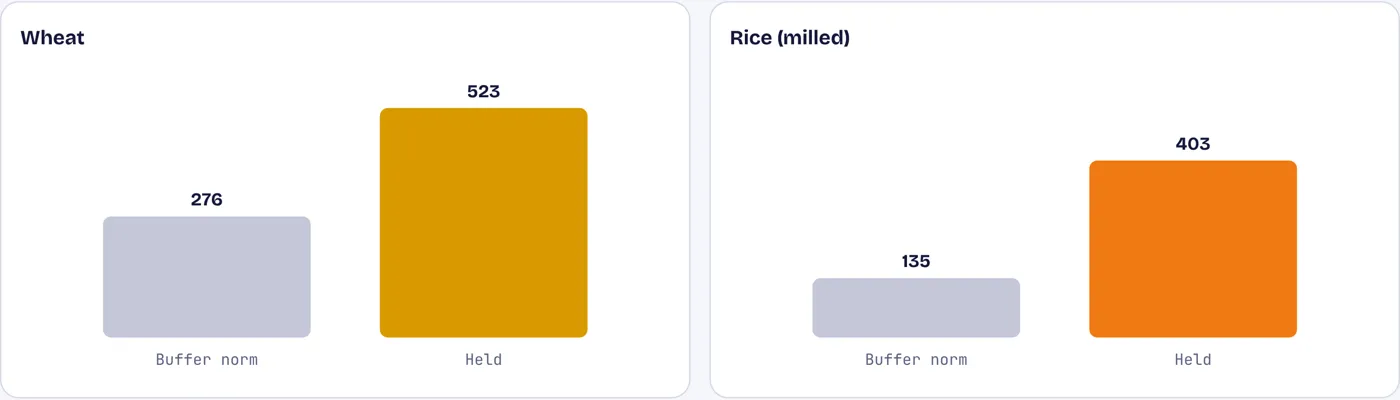
Central pool stocks vs buffer norm, lakh tonnes, 1 July 2026
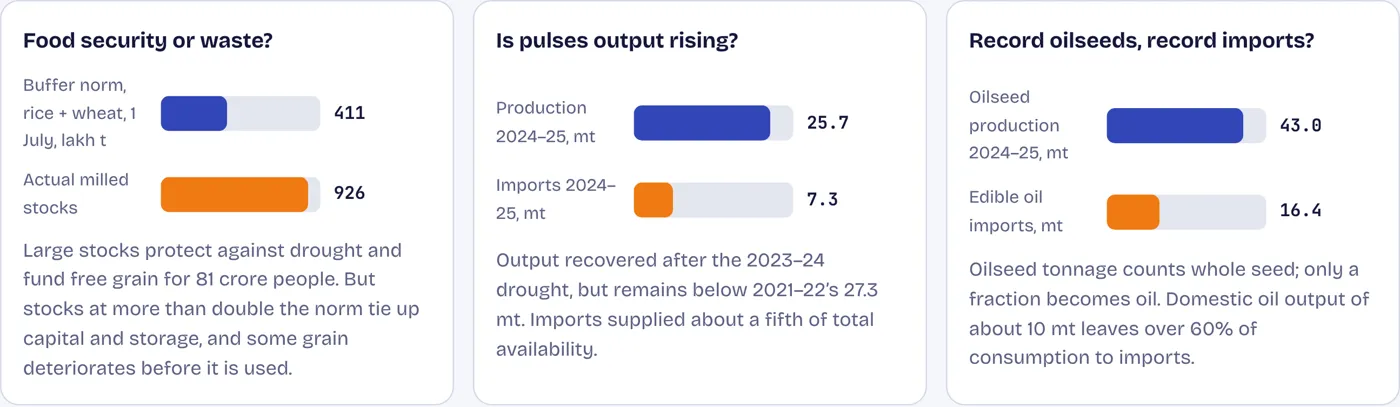
On 1 July 2026 the Food Corporation held 523 lakh tonnes of wheat against a norm of 276, and 403 lakh tonnes of rice against 135, with a further 206 lakh tonnes of rice still in unmilled paddy. Storing, insuring and eventually selling off this surplus costs the exchequer every year.
Source: FCI data via Business Today (8 October 2026).
The shortfall
Imports fill the gaps the grain-first policy leaves
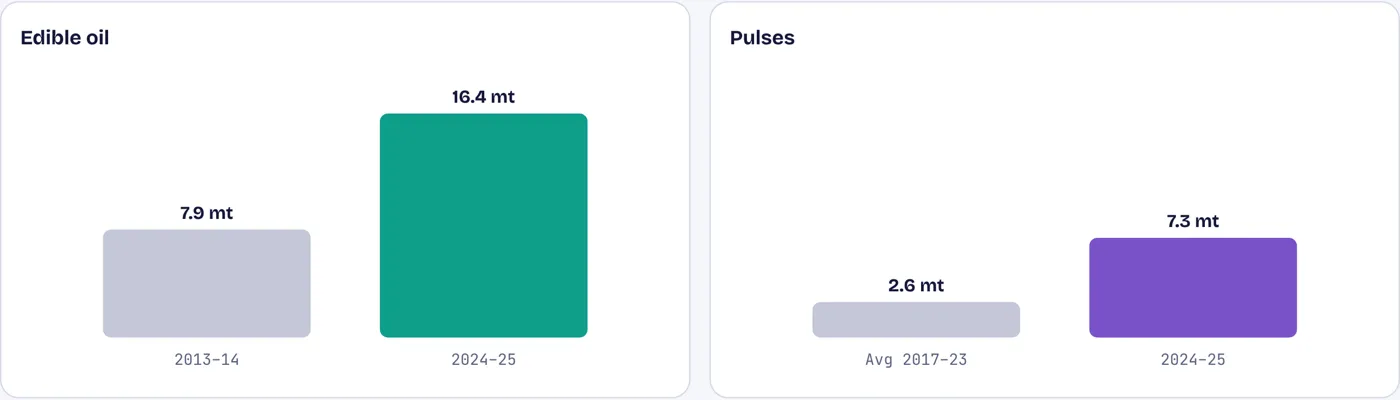
Imports, million tonnes
Edible oil imports more than doubled in eleven years to 16.4 million tonnes, costing $20.8 billion and meeting over 60% of demand. Pulses imports hit a record 7.3 million tonnes in 2024–25, nearly three times the average of the six years before.
Source: SEA and trade data via Vajiram & Ravi; Ministry of Agriculture.
Why
The state buys mainly rice and wheat, and mostly from a few states
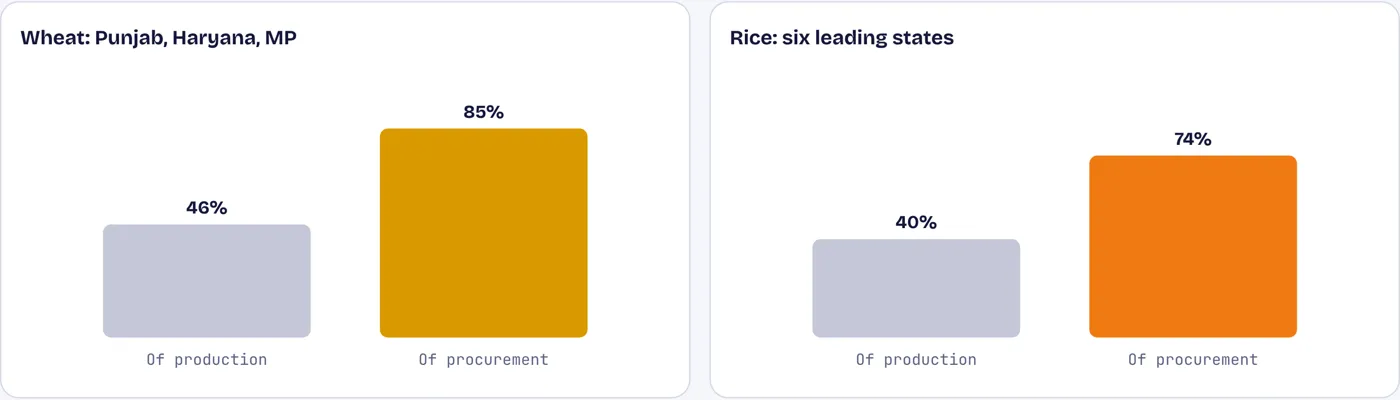
Share of national production vs share of central procurement, %, 2019–20
Minimum support prices are announced for 23 crops, but assured purchase exists almost only for paddy and wheat. Punjab, Haryana and Madhya Pradesh grow 46% of India’s wheat but supply 85% of what the government buys. In Punjab the state bought 92% of the rice crop. A farmer there has every reason to keep planting paddy.
Source: PRS Legislative Research, MSP and public procurement.
The hidden export
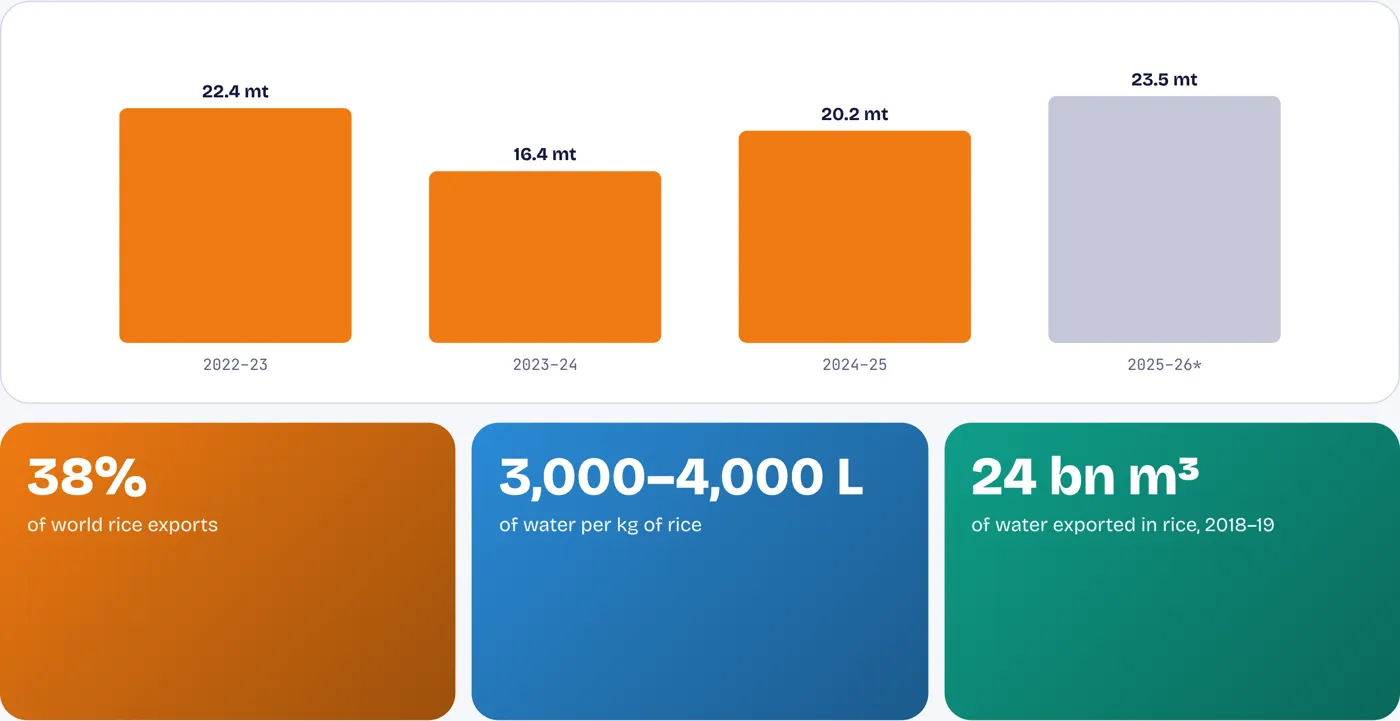
India sells 38% of the world’s traded rice, and ships out its groundwater with it
Rice exports, million tonnes, by financial year (2025–26 projected)
Each kilogram of rice takes roughly 3,000–4,000 litres of water. Rice exports in 2018–19 carried about 24 billion cubic metres of water abroad. Much of it was pumped from aquifers in Punjab and Haryana that are already drawn at 136–156% of recharge.
Source: ThePrint (exports, Ashok Gulati on water use); Journal of Applied and Natural Science (2021) via Outlook Business (virtual water); CGWB 2025.
Volume, not yield
India harvests far less grain per hectare than its neighbours
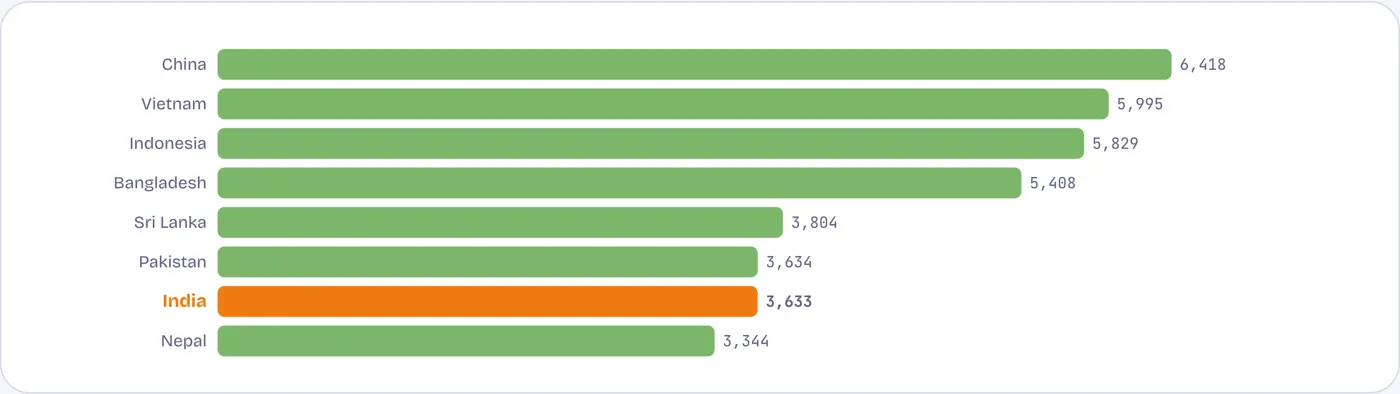
Cereal yield, kg per hectare, latest year
India’s cereal yield is 3.6 tonnes a hectare, close to Pakistan’s and far below China’s 6.4 or Vietnam’s 6.0. Record harvests come from planting more land and pumping more water, not from getting more out of each field.
Source: FAO via World Bank WDI (AG.YLD.CREL.KG); 2024 for India and Bangladesh, 2023 for others.
Contested numbers
Three numbers that need a second look
Source: FCI; Ministry of Agriculture; SEA.