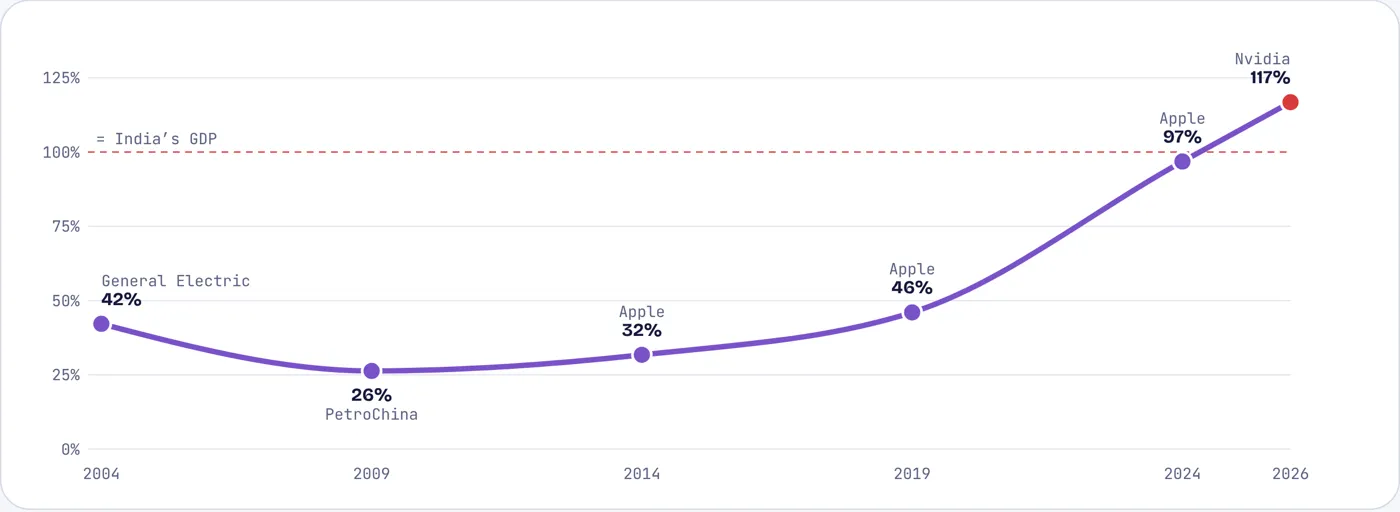
World’s largest company, as % of India’s GDP
42%→117%
GE in 2004; Nvidia in 2026
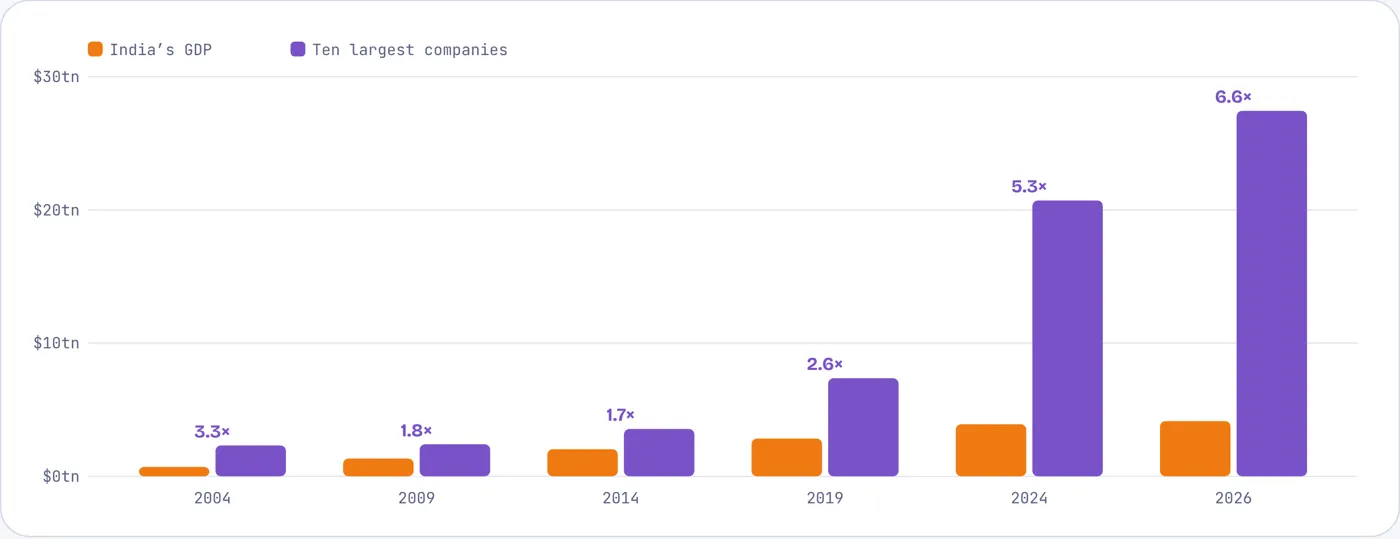
World’s ten largest companies, multiple of India’s GDP
3.3×→6.6×
2004 to 2026
India’s ten largest companies, share of the world’s ten
3.6%
mid-2026 market values
In 2004 India’s economy produced more each year than the world’s largest company was worth, twice over. Today three companies are each valued above India’s annual output, and the ten largest are worth more than six Indias. Size at the table has shifted, and India has learned what that costs.
The race
India’s economy grew almost sixfold; the ten largest companies grew twelvefold
India’s GDP vs combined market value of the world’s ten largest listed companies, US$ trillion. Tap or hover a bar.
From 2004 to 2014 India gained on the giants: its output almost tripled while the top ten grew by half. Since 2014 the top ten, now mostly American technology firms riding cloud computing and AI, have grown nearly eightfold. India’s economy doubled.
Source: market values at 31 March 2004 and 31 December of each later year (30 June for 2026), compiled from FT Global 500 and company data via Wikipedia; India’s GDP from World Bank WDI (2004–2024) and IMF WEO April 2026 (2026).
The crossing
The single largest company is now worth more than India’s annual output
Market value of the world’s largest listed company as % of India’s GDP in the same year
General Electric was worth 42% of India’s GDP in 2004. Apple was worth 97% in 2024. By mid-2026 Nvidia, at $4.8 trillion, was worth 117% of India’s projected $4.15 trillion output.
Source: as above.
The table
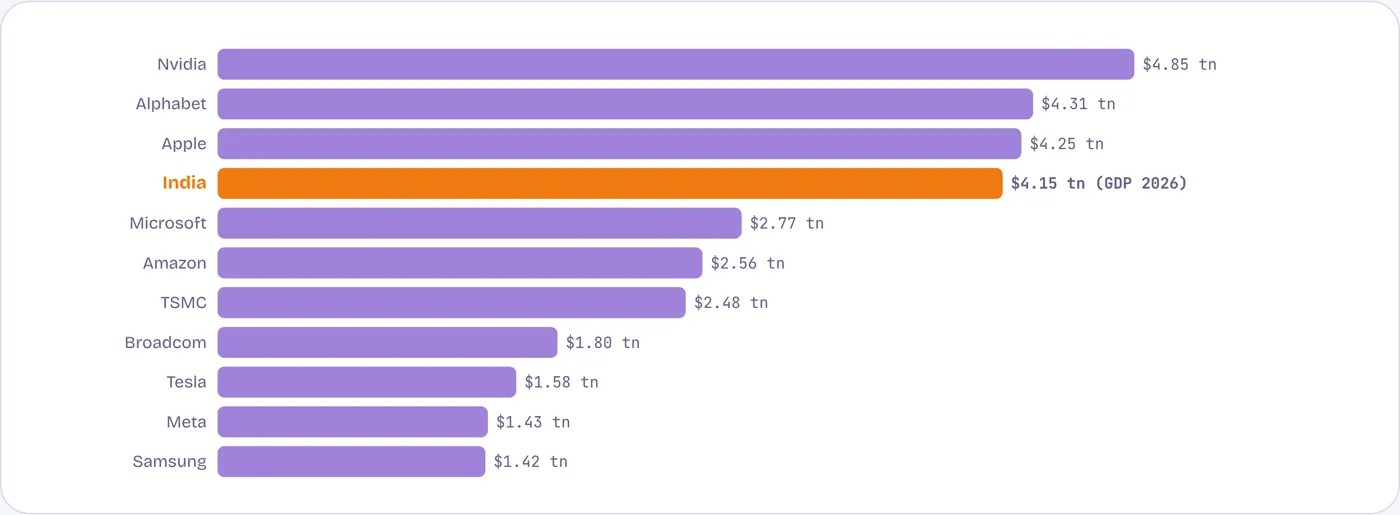
Three companies are each worth more than India produces in a year
Market value of the world’s ten largest listed companies at 30 June 2026, with India’s 2026 GDP, US$ trillion
Nvidia, Alphabet and Apple each top India’s GDP. Eight of the ten are American, one Taiwanese, one South Korean. None is Indian, and none is Chinese, a change from 2009, when PetroChina headed the list.
Source: company market values via Wikipedia (Q2 2026); IMF WEO April 2026.
India’s own giants
All of India’s ten largest firms together are worth a fifth of Nvidia
Market value, US$ trillion, mid-2026
Reliance Industries, India’s most valuable company, is worth about $206 billion, one twenty-third of Nvidia. India’s ten largest together come to about $1 trillion. The whole Indian stock market, at $5 trillion, is roughly the value of one American chipmaker.
Source: PTI via Outlook Business (India top ten, 3 May 2026, converted at ₹94 per US$); BSE via Bajaj Broking (17 June 2026); Wikipedia (Nvidia, world top ten).
Spending power
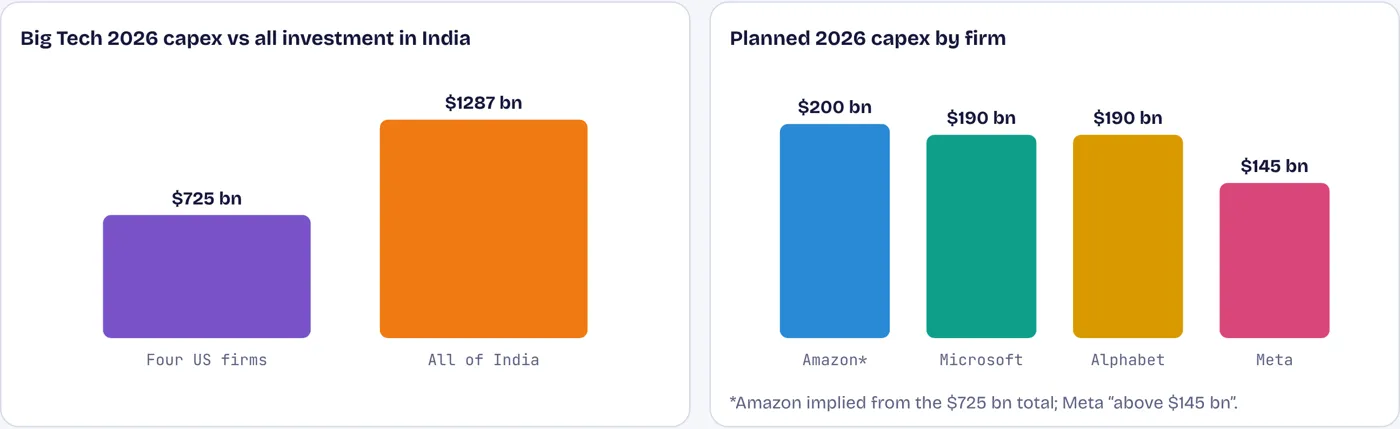
Four American firms will invest more than half as much as the whole Indian economy
Planned 2026 capital spending of Amazon, Microsoft, Alphabet and Meta vs India’s total investment (gross capital formation, 2024), US$ billion
India invests about $1.3 trillion a year across every government, company and household. Four technology companies plan $725 billion of spending in 2026, mostly on AI data centres. A firm with that budget can choose where to build, and countries compete to be chosen.
Source: company guidance compiled by the Financial Times, via Tom’s Hardware (30 April 2026); World Bank WDI (India gross capital formation, 32.9% of GDP in 2024).
The record
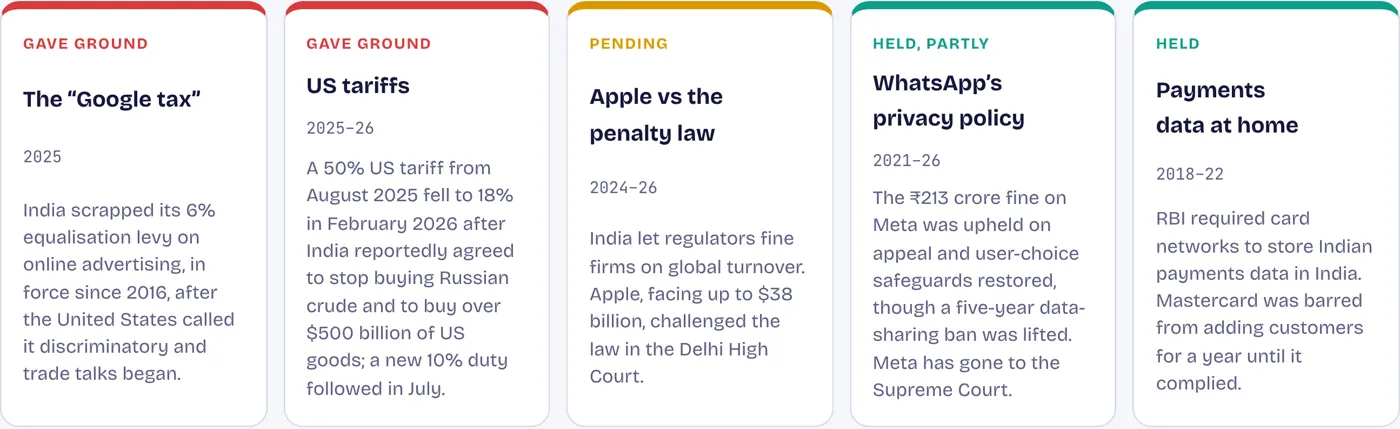
Against a superpower India gave ground; against single firms its rules mostly held
Five recent tests of India’s bargaining power
When India faced the United States, which speaks for its companies, it gave ground: it dropped the “Google tax” and accepted a trade deal that ended Russian oil purchases. When India applied its own laws to individual firms, the firms paid fines, moved data and went to court, but complied.
Source: Indian Express via Vision IAS (equalisation levy); TIGI and India Briefing (tariffs); Reuters via 9to5Mac (Apple); Exchange4media (WhatsApp); Business Standard (RBI and Mastercard).
Contested numbers
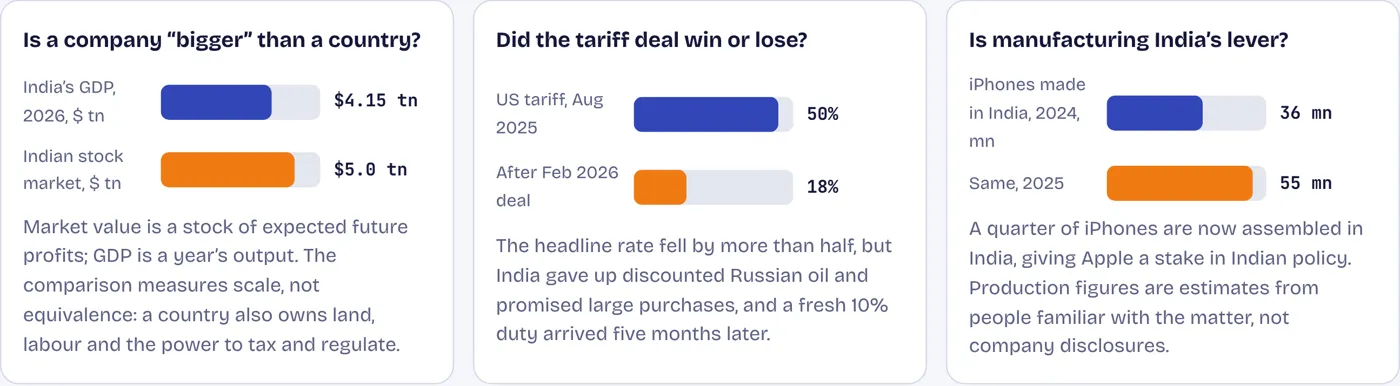
Three numbers that need a second look
Source: IMF; BSE; TIGI; Bloomberg via BGov.