The invoice
Six problems, each costing up to five percent of GDP a year
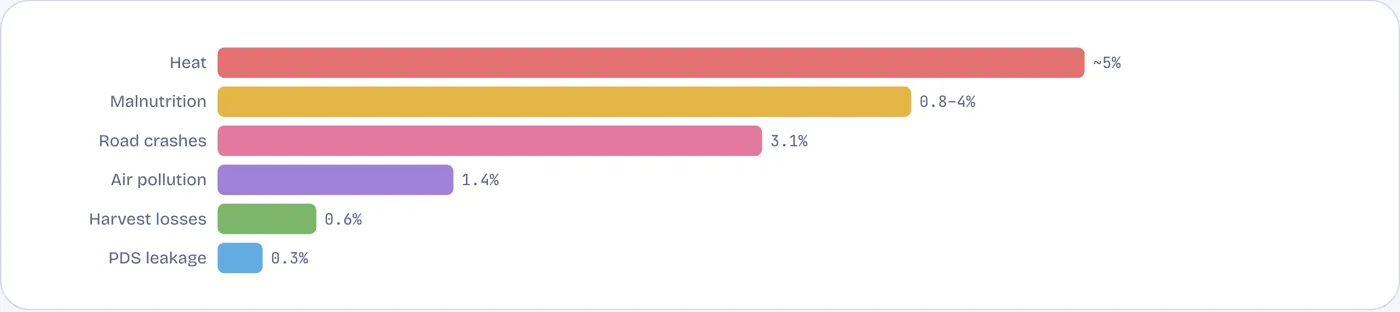
Estimated annual economic cost, % of GDP, latest available estimate. Tap or hover a bar.
The estimates come from different studies, years and methods, and some overlap (heat and air pollution both cut working hours). They should not be added to a precise total. But the order of magnitude is clear: together these problems cost India something like a tenth of its output every year, more than the economy grows in a typical year.
Source: Lancet Countdown 2025 (heat); World Bank (road crashes); India State-Level Disease Burden Initiative, Lancet Planetary Health 2020 (air pollution); ORF review of studies (malnutrition, 0.8–4%); NABCONS 2022 (post-harvest loss, ₹1.53 lakh crore); ICRIER (PDS leakage, ₹69,108 crore). Rupee figures converted to % of annual GDP.
Spent vs lost
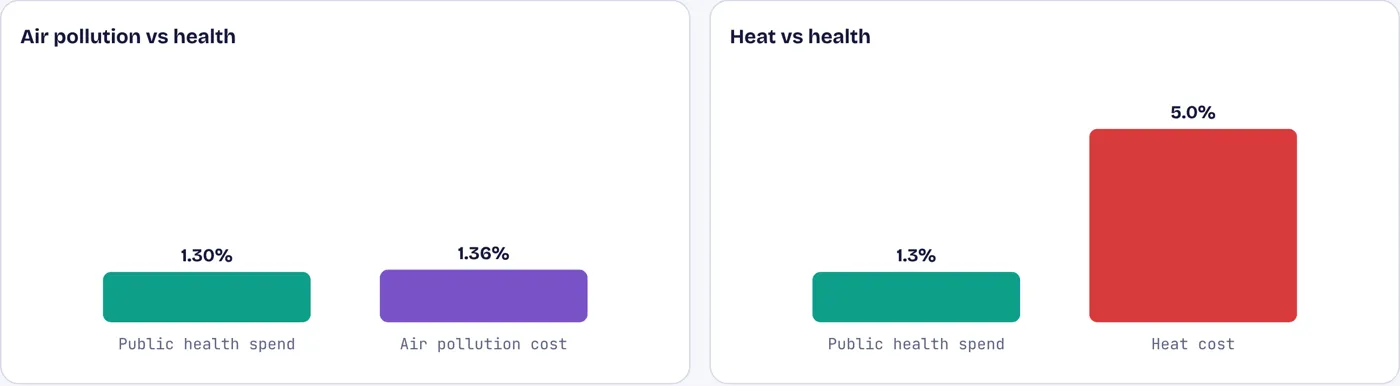
Air pollution alone costs more than India spends on public health
Annual cost of a problem vs annual public spending, % of GDP
India’s governments spend about 1.3% of GDP on health. Air pollution costs 1.36% in lost output; heat costs about four times that. Money spent preventing these losses would partly pay for itself.
Source: as above; public health spending from National Health Accounts.
The human toll
Behind the percentages are lives
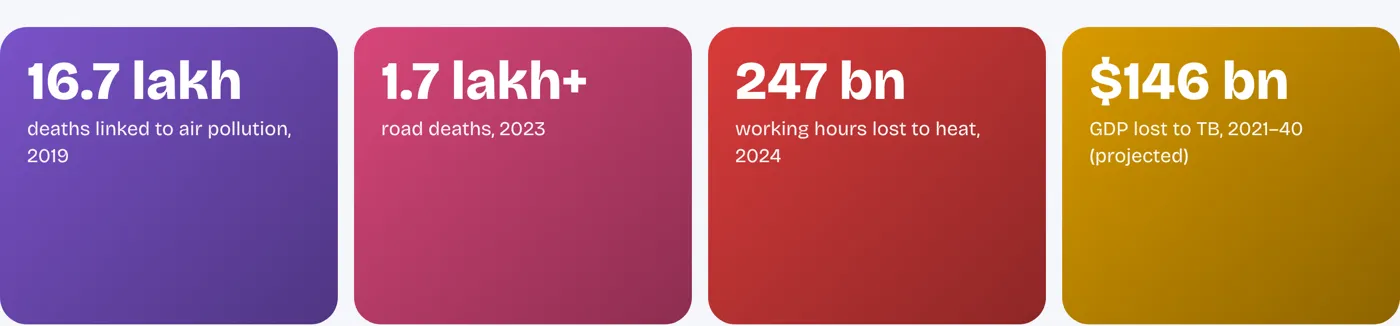
Deaths and lost work attributed to each problem, latest year
Air pollution was linked to 16.7 lakh deaths in 2019, nearly one death in five. Road crashes killed over 1.7 lakh people in 2023. Heat cost 247 billion working hours in 2024. Tuberculosis is projected to cost $146 billion of GDP between 2021 and 2040 if current trends hold.
Source: IHME/Lancet Planetary Health (air); MoRTH Road Accidents in India 2023 (roads); Lancet Countdown 2025 (heat); 2024 modelling study via Business Today (tuberculosis).
The largest line
The biggest cost is the paid work India’s women are kept out of
GDP gain from closing the gender gap in work, and annual costs above, % of GDP
McKinsey estimated in 2018 that if Indian women took part in paid work at the rate of the best-performing country in the region, GDP would be 18%, or $770 billion, higher by 2025. That opportunity is larger than all the costs above combined. With fewer than a third of women in the labour force, it remains mostly unclaimed.
Source: McKinsey Global Institute, The Power of Parity: Advancing Women’s Equality in Asia Pacific (2018), via People Matters.
Contested numbers
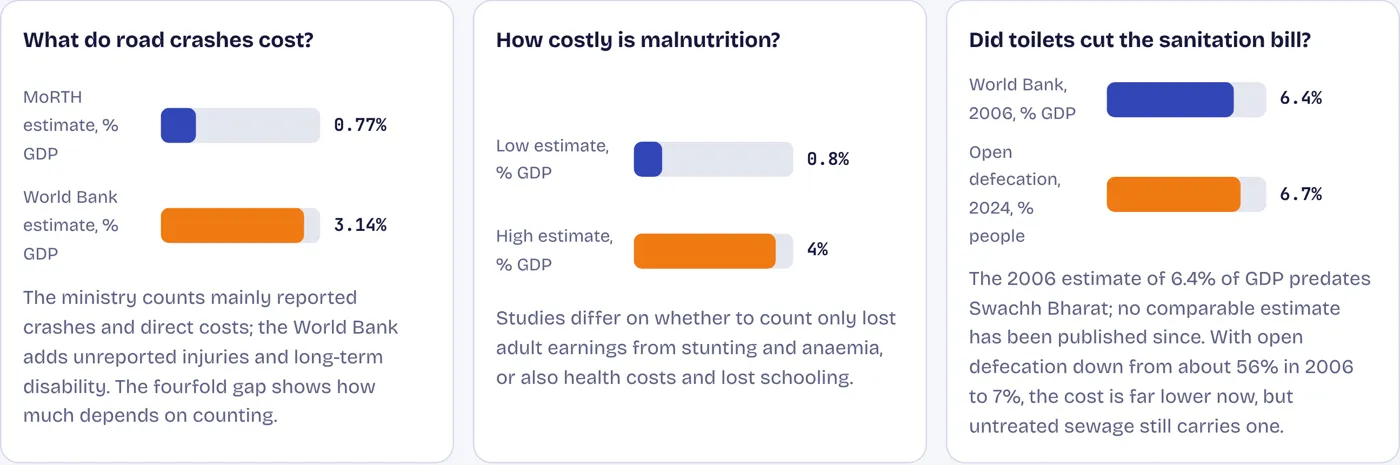
Three numbers that need a second look
Source: MoRTH and World Bank via PIB/Drishti; ORF; World Bank Water and Sanitation Program (2010).