India grew 5% a year per person for twenty years. Turned into wires, roads and school places, that growth bought more than in most countries at India’s income. Turned into nutrition, health and clean air, it bought less. The next decade’s test is the rate at which income becomes wellbeing.
The conversion scorecard
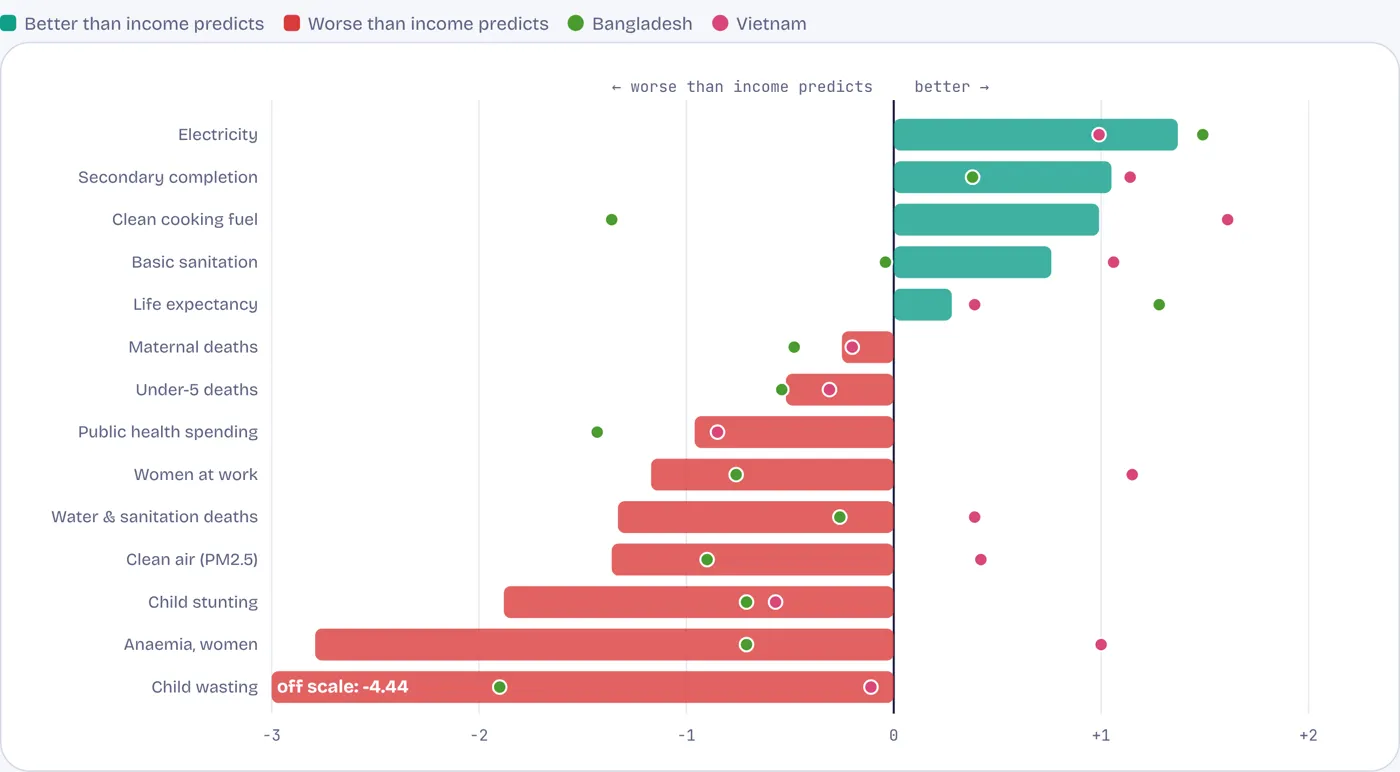
India turns income into wires and school places better than its peers, and into nutrition, health and clean air worse
India’s result against what its income predicts, for 14 outcomes. Each bar compares India with about 150 countries, allowing for income per person; right of centre means better than expected. Dots show Bangladesh and Vietnam. Tap or hover a row.
The pattern is the argument of the two previous parts in one picture. Where the state had to build and connect, India beat the income line: electricity, clean cooking fuel, toilets, school completion. Where it had to deliver a service every day, feed children, keep women in work or clean the air, India falls well short of countries as rich as it is. Child wasting is the extreme case: more than three times the rate India’s income predicts.
Source: calculated from World Bank WDI, latest year 2015–2024 for each country; outcomes regressed on log income per person (PPP, 2021 prices) across countries with over a million people. Scale: India’s gap divided by the typical gap across countries.
The gap to normal
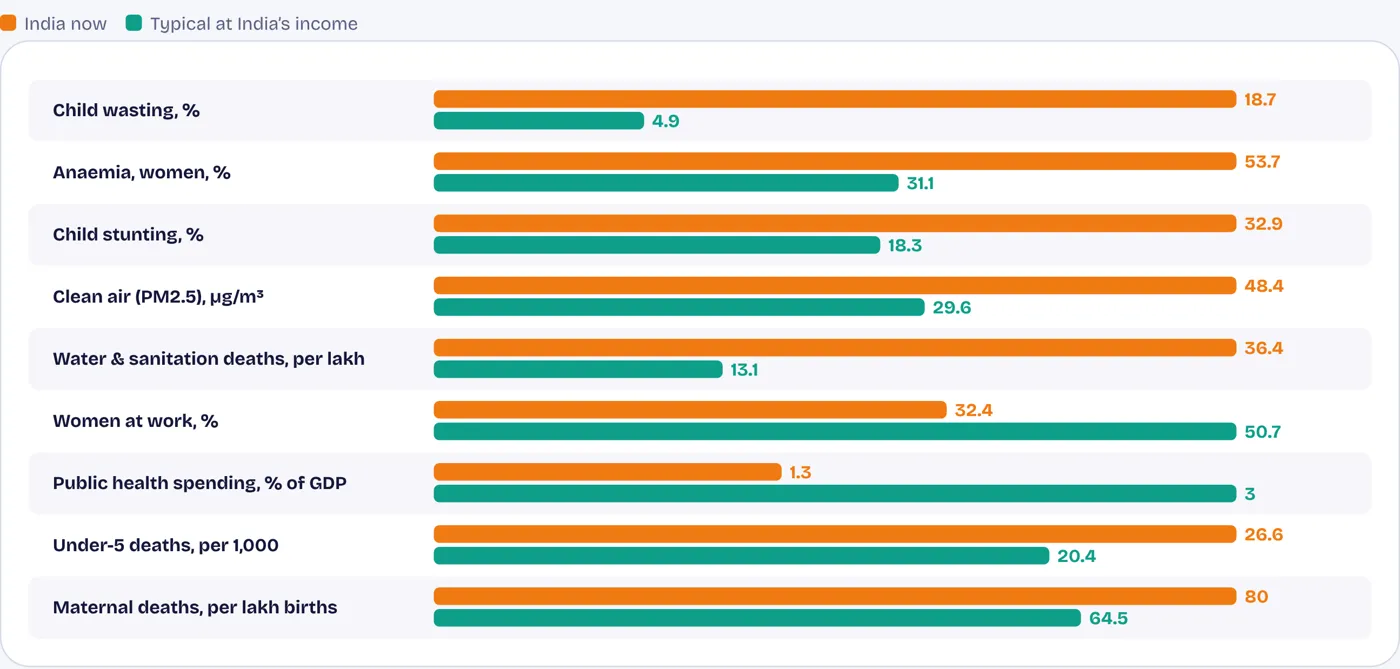
Just reaching what India’s income already predicts would transform nine outcomes
India today against the level typical for a country with India’s income, for outcomes where India falls short. Bars scaled within each row.
None of these requires India to become rich first. They are the levels countries at India’s present income already reach. Closing them would almost halve child stunting, cut anaemia among women by two-fifths and bring nearly ten crore more women into the labour force.
Source: as above. “Typical” is the value predicted by the cross-country regression at India’s income.
Human development
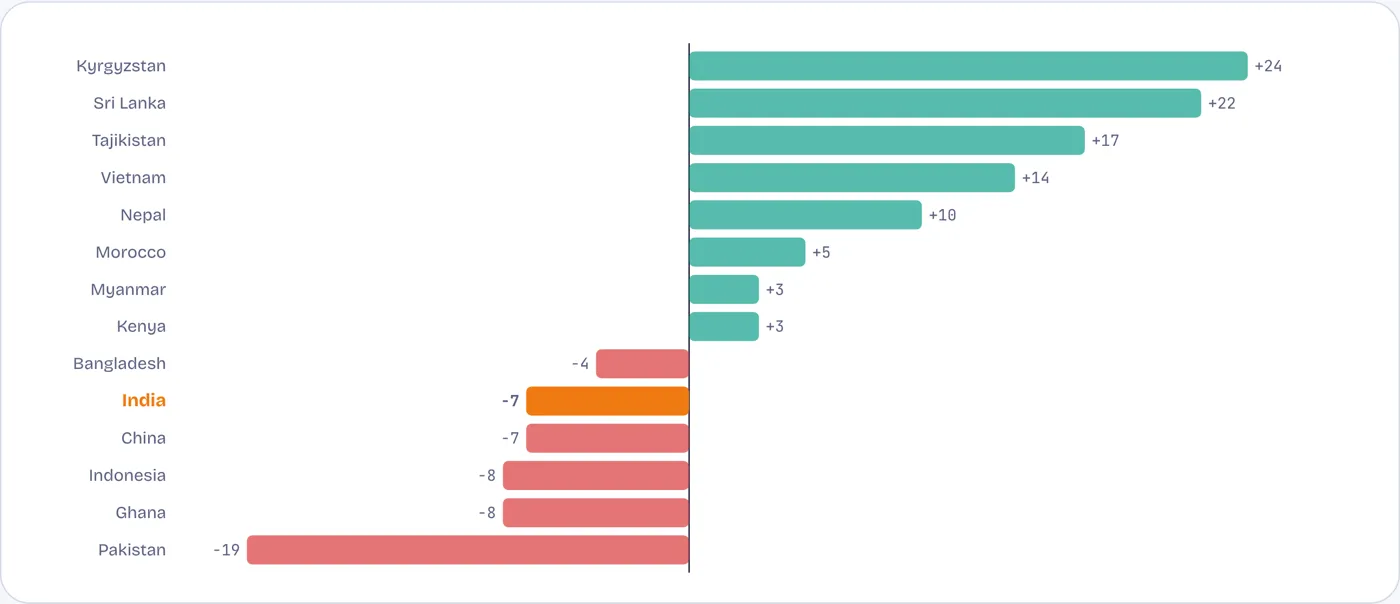
Poorer countries rank higher on human development than on income; India ranks seven places lower
Rank by income per person minus rank by Human Development Index, 2023. Positive: more wellbeing than income would suggest.
Sri Lanka, Kyrgyzstan, Vietnam and Nepal get more health and schooling from each dollar than India. A proposed target for 2036: India’s human development rank at least equal to its income rank, closing the seven-place gap.
Source: UNDP, Human Development Report 2025.
Two futures
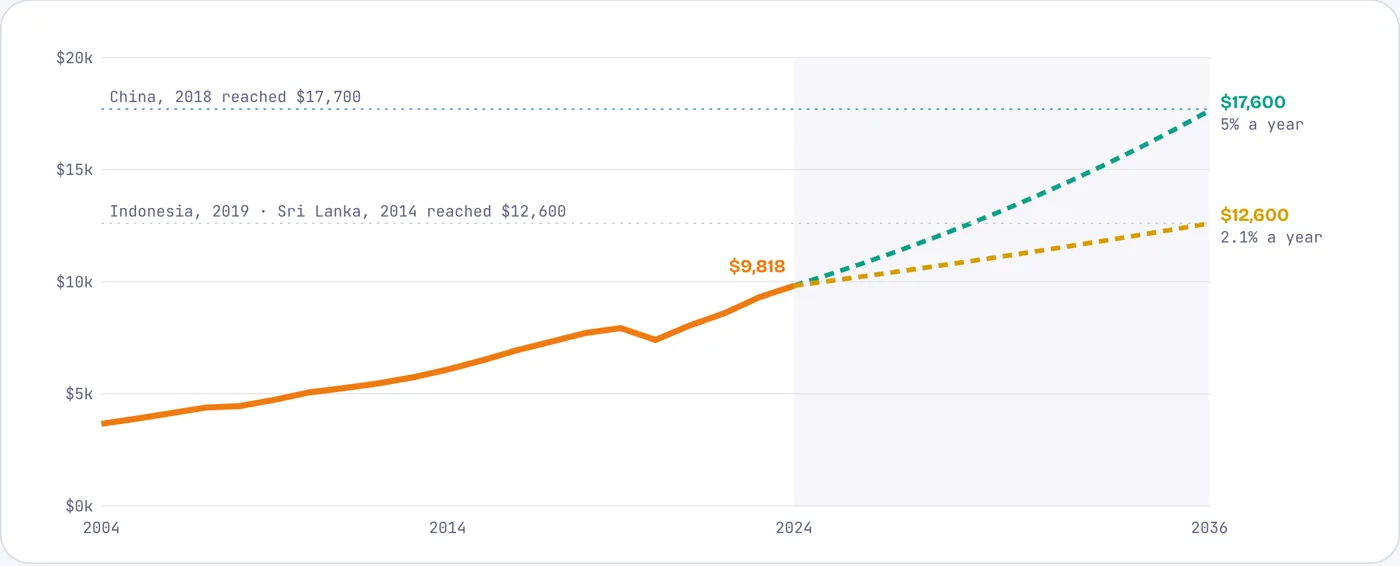
At 5% a year India reaches China’s 2018 income by 2036; at the typical pace, Indonesia’s of 2019
India’s income per person, PPP, 2021 prices: actual 2004–2024 and two paths to 2036. Tap or hover a point.
India’s growth since 2004 averaged 5.1% a year per person. Keeping that pace takes income to about $17,600 by 2036. Slowing to 2.1%, the median for countries that reached India’s income, would leave it at about $12,600. Either way, what citizens feel depends on the conversion rate as much as on the growth rate.
Source: World Bank WDI, GDP per person, PPP (constant 2021 international $); projections are simple compound growth from 2024.
The base rate
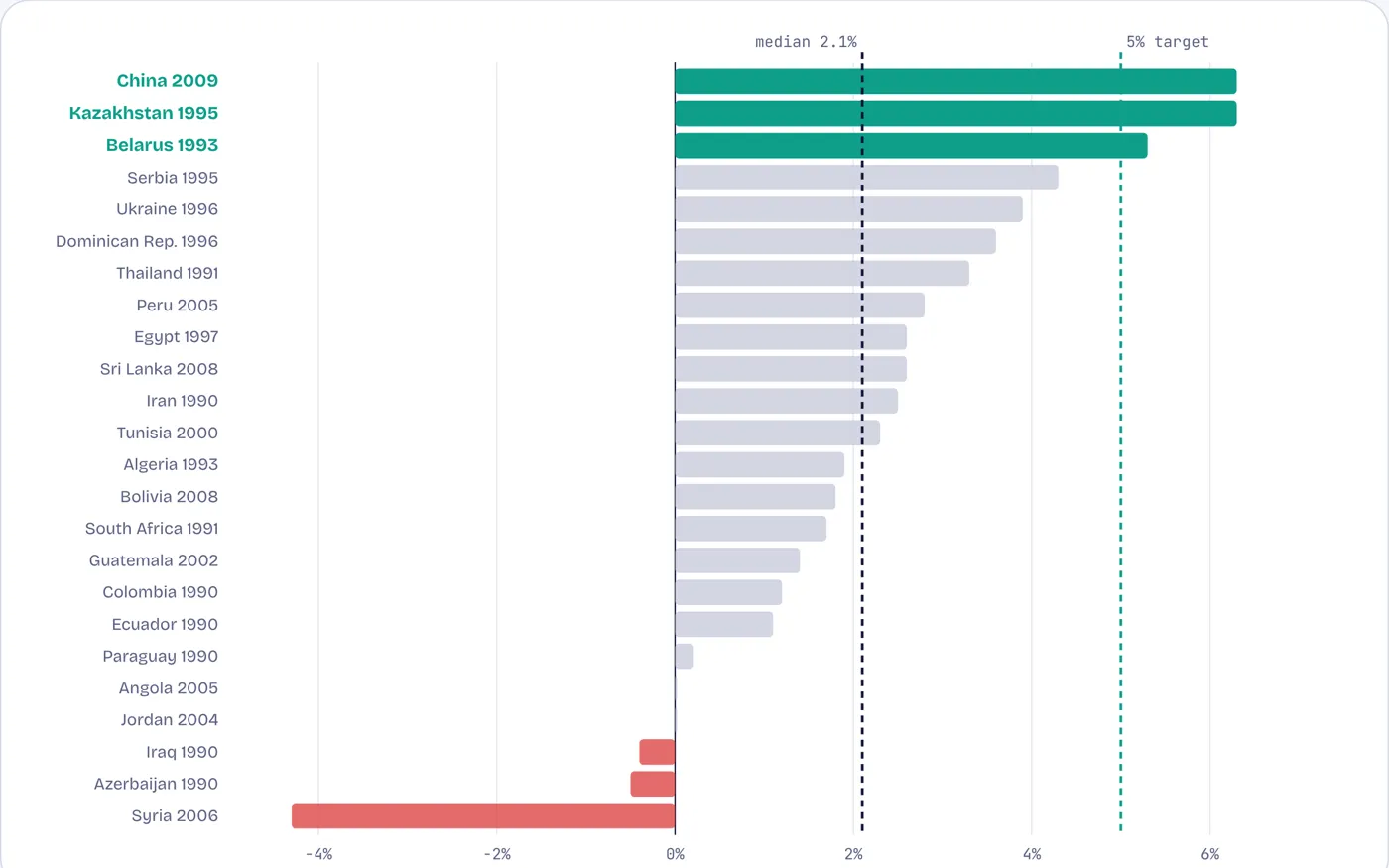
Only 3 of 24 countries at India’s income kept up 5% growth for the next fifteen years
Average yearly growth in income per person over the 15 years after each country reached India’s 2024 income (within 10%), 1990–2009. Tap or hover a bar.
China, Kazakhstan and Belarus managed it; the median was 2.1%. India has already done 5% for twenty years, but sustaining it from a higher base is rare. That is why converting growth into capability, healthier and better-taught workers, more women at work, matters: it is what keeps growth going.
Source: calculated from World Bank WDI; countries with at least 5 million people in 2004.
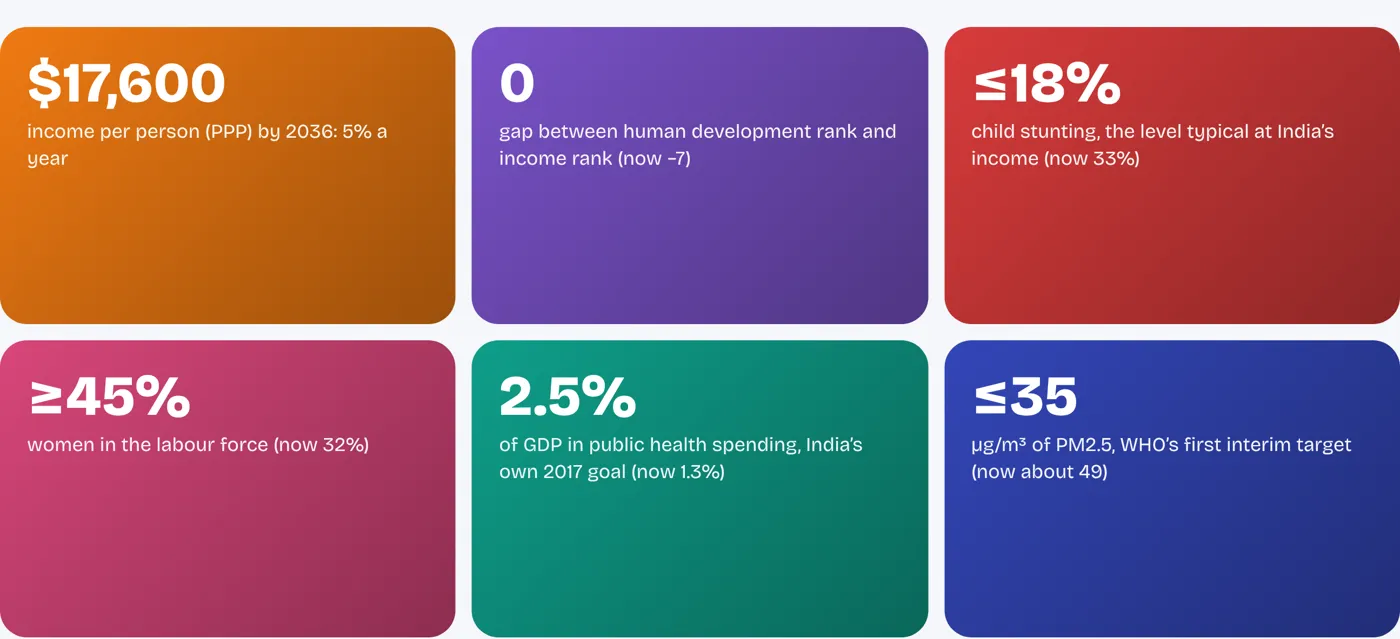
Proposed targets for 2036
Six numbers for the decade
These are proposals, anchored on what countries at India’s income already achieve, not official goals. The chapters that follow set out how: investing in people, work for the many, and cities that work.
Source: Targets proposed here; anchors from the calculations above, UNDP and the World Bank’s Country Economic Memorandum (2025).
Contested numbers
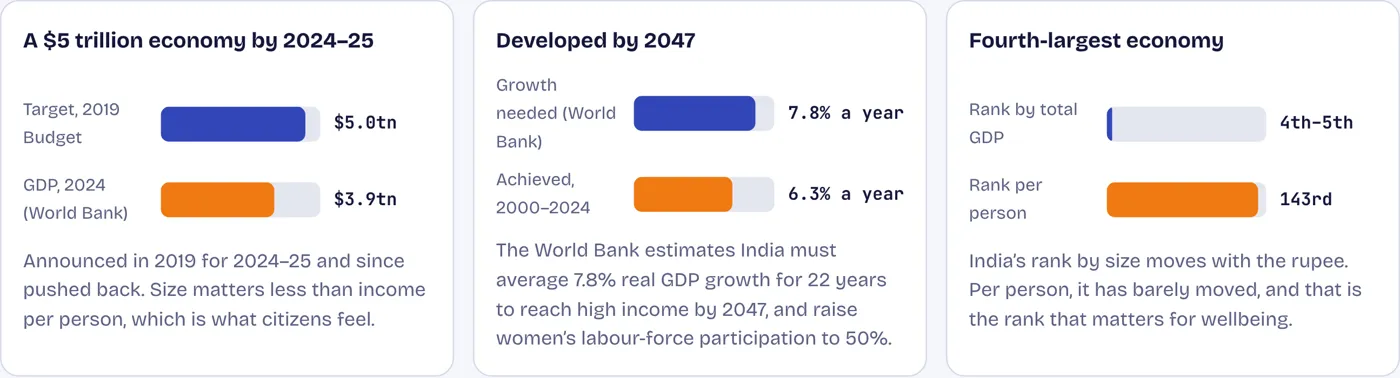
Three numbers that need a second look
Source: Union Budget speech (2019); World Bank WDI; World Bank press release (February 2025); The Wire.
The takeaway
Growth is the means, not the measure. If India grows as fast in the next decade as in the last, and converts that income into wellbeing only as well as a typical country does, its citizens will live very differently by 2036.