India’s biggest conversion gaps are in its people: children who are too short and too thin, women who are anaemic, pupils who cannot read, a health system run on a shoestring. Closing them is mostly a matter of money spent steadily, and of measuring what children actually learn and eat.
Health spending
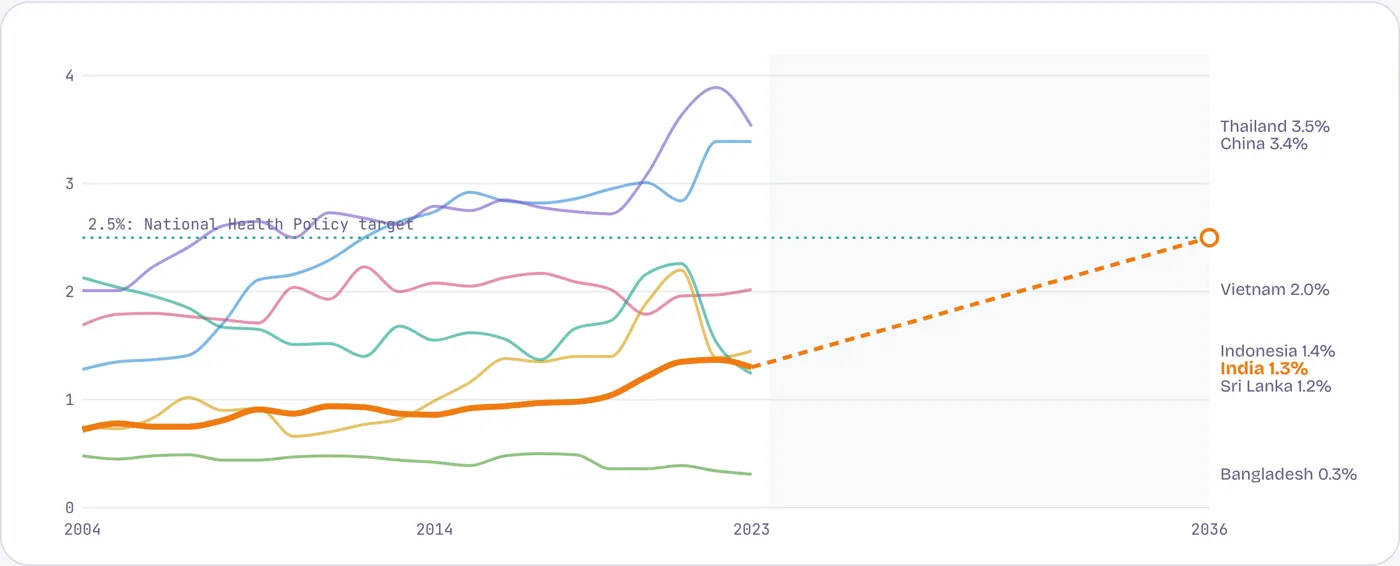
China and Thailand raised public health spending past 3% of GDP; India is at 1.3%
Government health spending, % of GDP, 2004–2023, and a path for India to 2.5% by 2036. Tap or hover a line.
India set itself a target of 2.5% of GDP in its National Health Policy of 2017, to be reached by 2025. On WHO’s measure it reached 1.3%. China went from 1.3% to 3.4% in two decades; Thailand, whose universal coverage scheme began in 2002, spends 3.5%. Reaching 2.5% by 2036 needs a rise of about a tenth of a percentage point of GDP each year, a pace India matched during the pandemic.
Source: WHO Global Health Expenditure Database, via World Bank WDI. India’s National Health Accounts, which count more spending as public, put the 2021–22 figure at 1.84%.
What public money buys
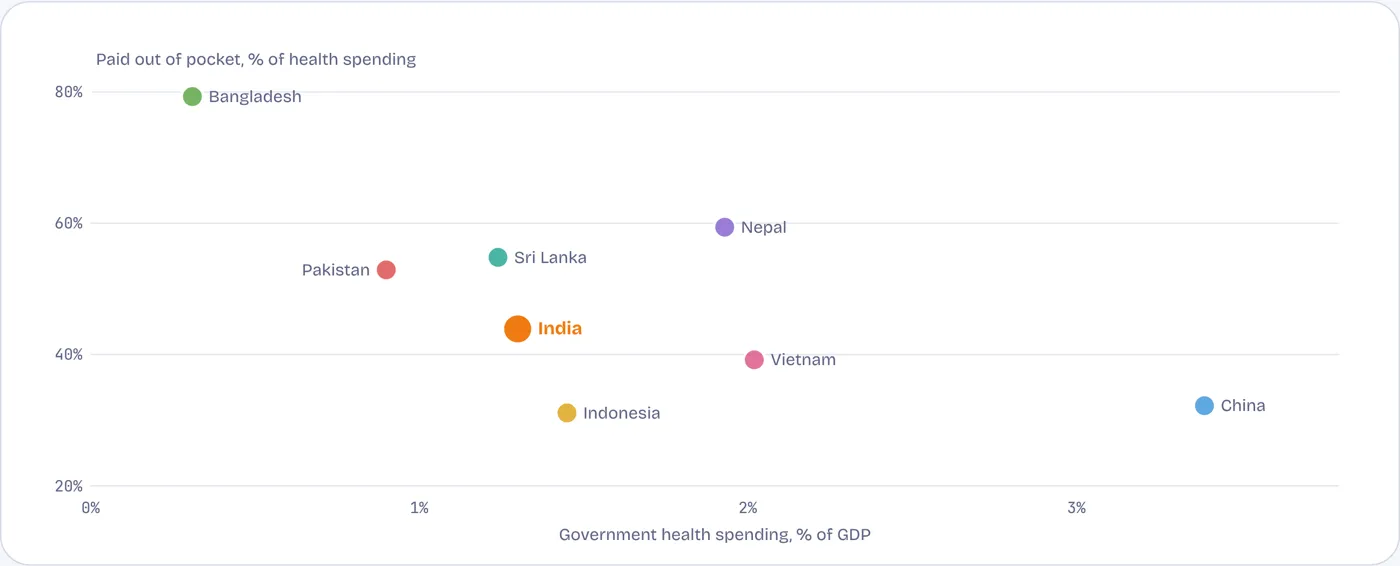
Where governments pay more, families pay less at the point of care
Government health spending, % of GDP, against out-of-pocket payments as a share of all health spending, latest year. Tap or hover a dot.
Indian families still pay 44% of the country’s health bill from their own pockets, against about 31–32% in China and Indonesia. In the peer panel, countries whose governments spend more generally leave less to be paid out of pocket, the payments that push families into debt when someone falls ill.
Source: WHO Global Health Expenditure Database, via World Bank WDI.
Learning
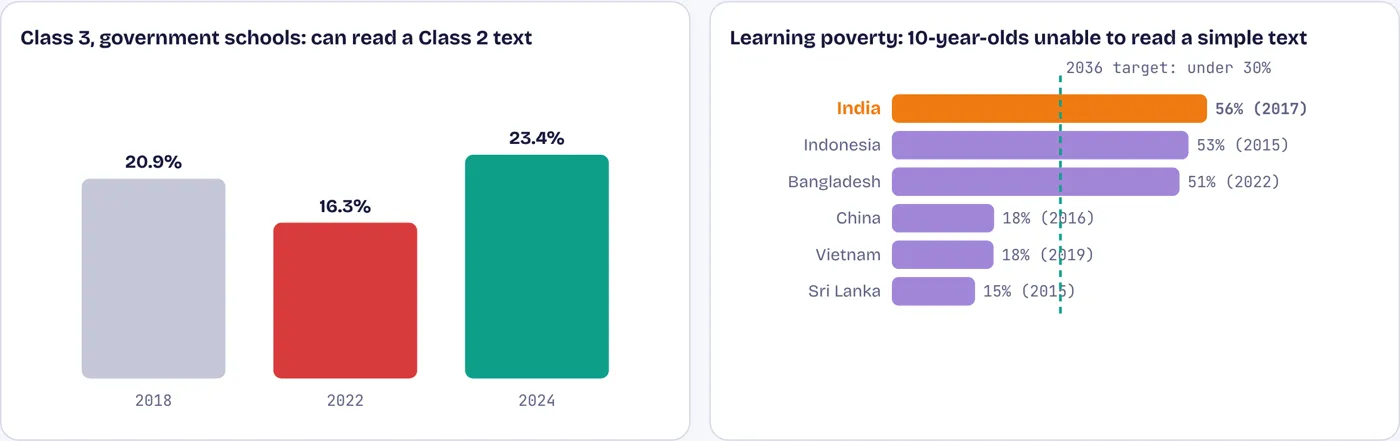
A focus on early reading has started to work; the gap to Vietnam is still vast
Class 3 children in government schools able to read a Class 2 text, and learning poverty in India and peers
After the pandemic collapse of 2022, the share of Class 3 children in government schools who could read a simple text rose to 23%, above its 2018 level, after states made early reading and arithmetic the priority of the first grades under the NIPUN Bharat mission. Vietnam, China and Sri Lanka keep learning poverty below 20% while spending a smaller share of GDP on education than India. A target of under 30% by 2036 is ambitious but has been done.
Source: ASER 2018, 2022, 2024 (rural, government schools); World Bank learning poverty estimates, latest year in brackets.
Nutrition
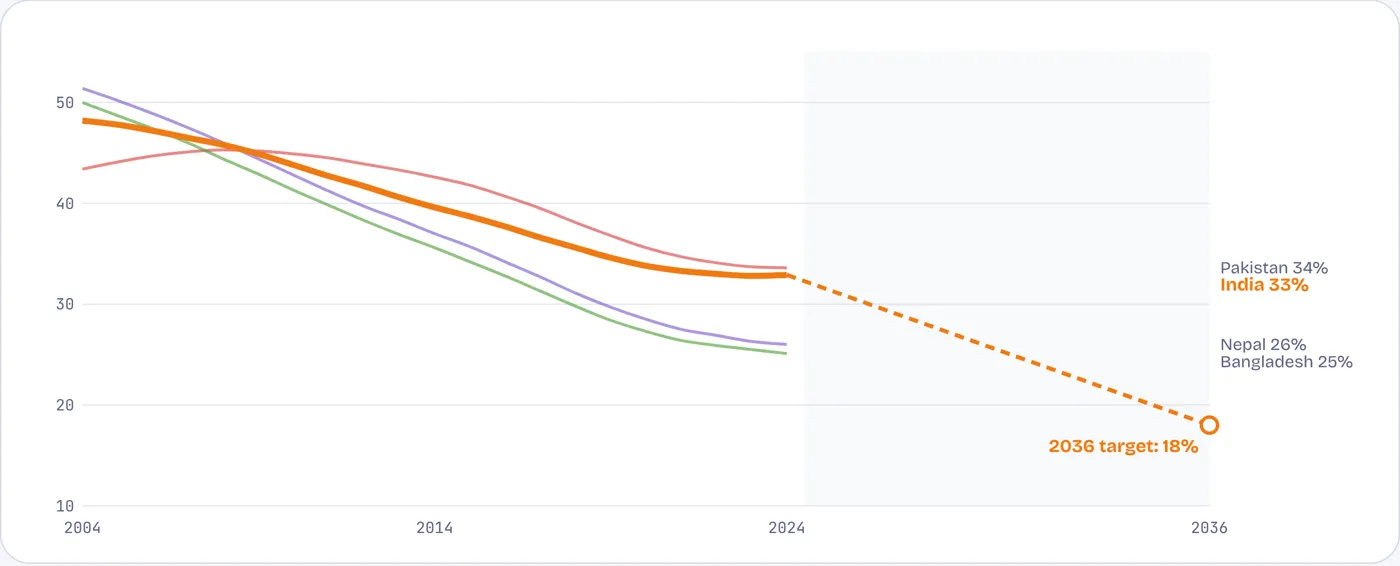
Bangladesh and Nepal cut stunting faster than India; at their pace India reaches 18% by 2036
Children under five who are too short for their age, %, 2004–2024 (UNICEF-WHO-World Bank estimates), with a path for India to 18% by 2036. Tap or hover a line.
Bangladesh and Nepal started with more stunted children than India in 2004 and now have fewer. Studies credit their gains to more schooling for mothers, sanitation, community health services and rising household incomes. India’s rate fell from 48% to 33%; cutting it to 18%, the level typical at India’s income, needs a faster fall than the last twenty years.
Source: Joint Child Malnutrition Estimates, via World Bank WDI.
The state lens
Some Indian states are already near the target; others are twice as far
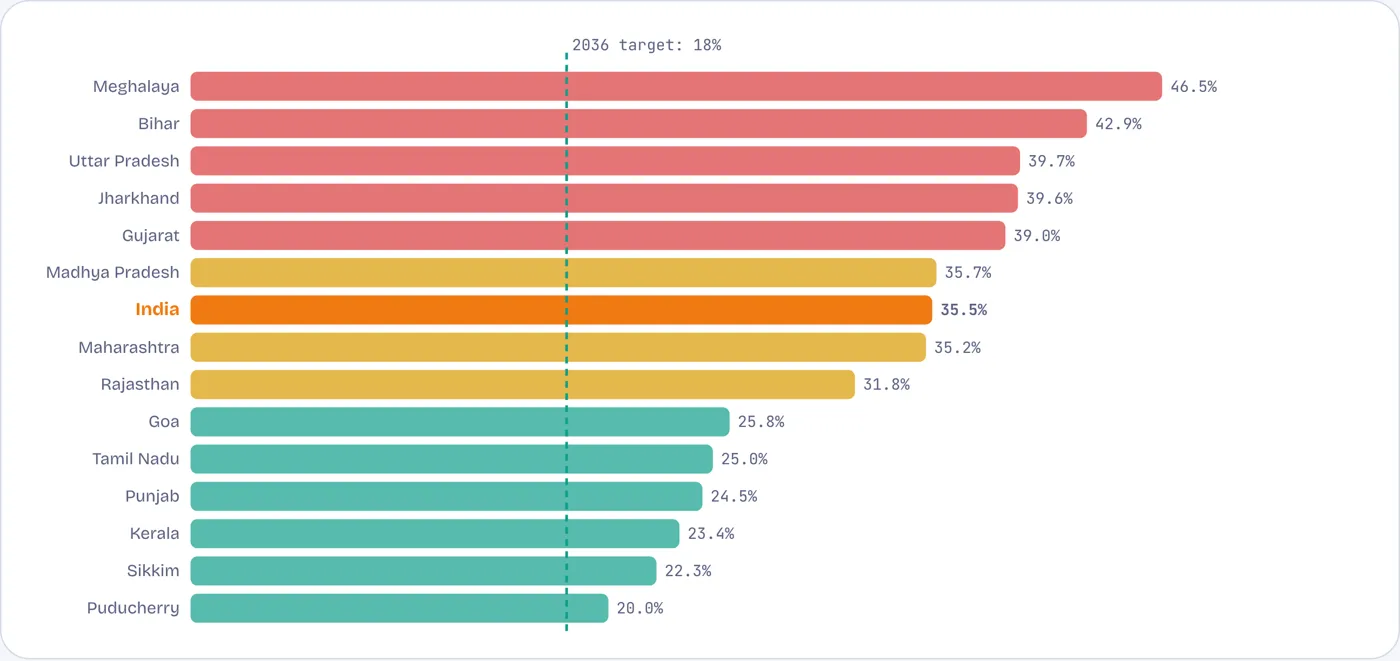
Children under five who are stunted, by state, NFHS-5 (2019–21), %
Puducherry, Sikkim, Kerala and Punjab already have stunting near or below 25%. Meghalaya, Bihar, Uttar Pradesh, Jharkhand and Gujarat are near or above 40%. The national target is mostly a target for a handful of large northern and western states, which is where money and attention should go first.
Source: Ministry of Health and Family Welfare, NFHS-5 state fact sheets, via PIB.
The bill
Doubling public health spending costs about 1.2% of GDP
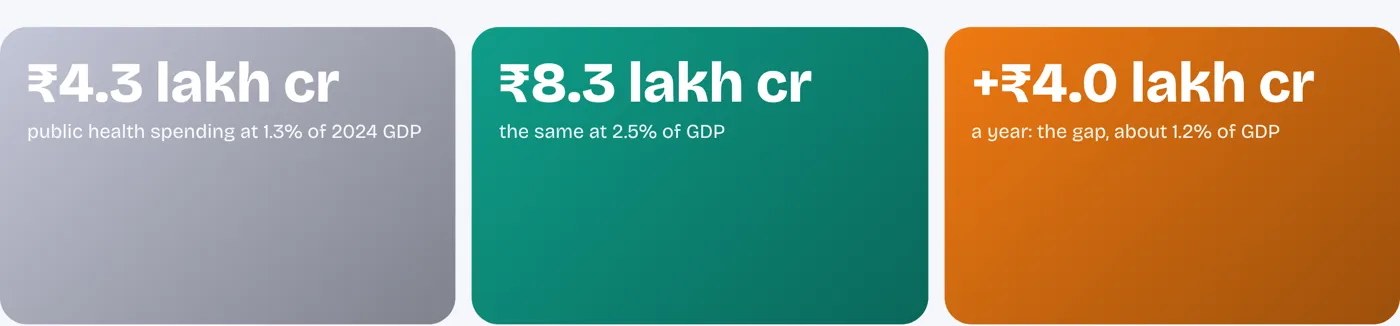
At 2024 prices, India’s governments spent about ₹4.3 lakh crore on health. At 2.5% of GDP they would spend about ₹8.3 lakh crore. Spread over twelve years of growth, the extra is affordable; the hard part is that most health spending is by the states, so it has to be shared between them and the centre.
Source: Calculated from World Bank WDI (GDP at current prices, 2024: ₹330.7 lakh crore) and WHO government health spending share.
Proposed targets for 2036
Six numbers for people
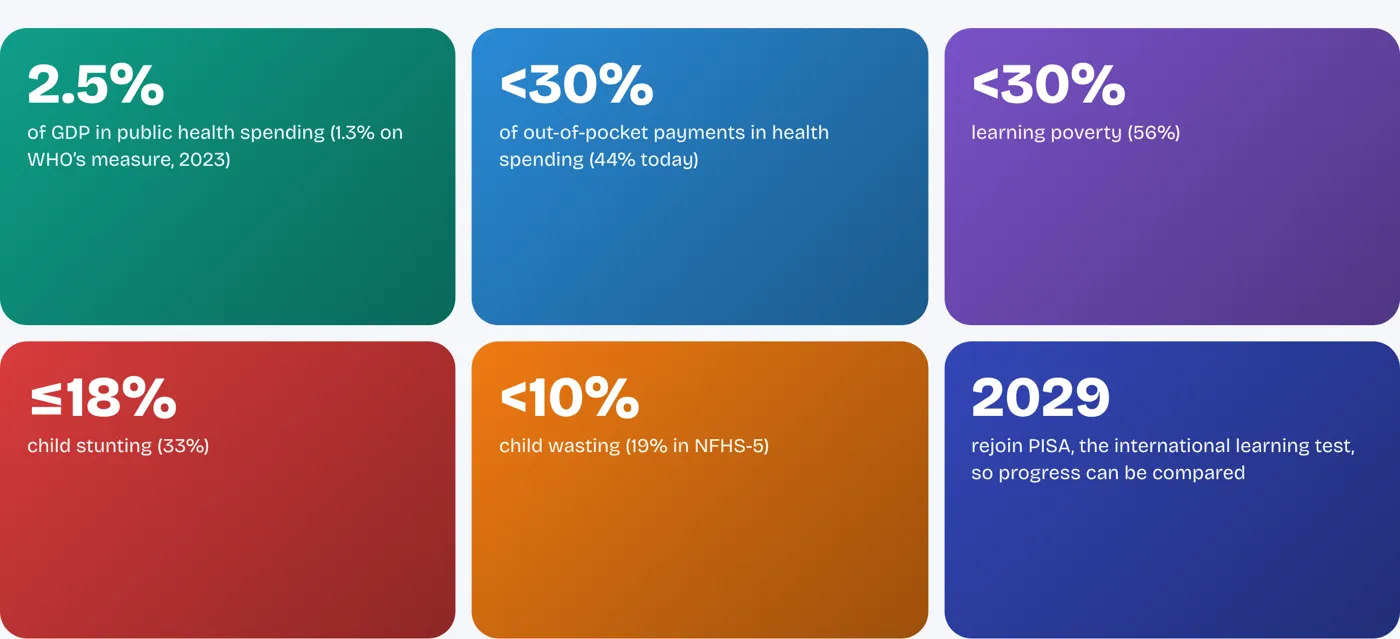
Each target is a level that some country at or below India’s income has already reached, or a goal India has set itself and missed. Each can be checked by an independent survey, if the surveys are run on time.
Source: Targets proposed here; anchors from WHO, UNICEF, the World Bank, NFHS and India’s National Health Policy (2017) and National Education Policy (2020).
Contested numbers
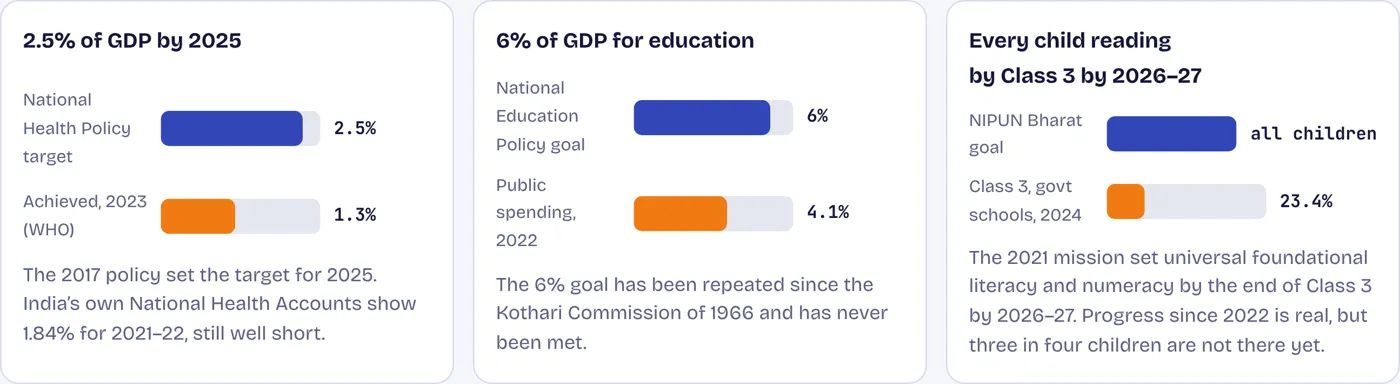
Three numbers that need a second look
Source: National Health Policy 2017; National Education Policy 2020; NIPUN Bharat guidelines (2021); WHO via WDI; ASER 2024.
The takeaway
India has built schools, clinics and an insurance scheme. What it has not done is spend enough, steadily enough, on what happens inside them: food for children, teaching for reading, and care that families do not pay for at the door.