India’s growth came from services and capital, not from moving millions into factory jobs. The next decade needs work that farm labourers and women can take: labour-intensive manufacturing, built for export, in places where people already live.
Leaving the farm
Every fast-growing economy moved workers off the land; India’s move stalled and then reversed
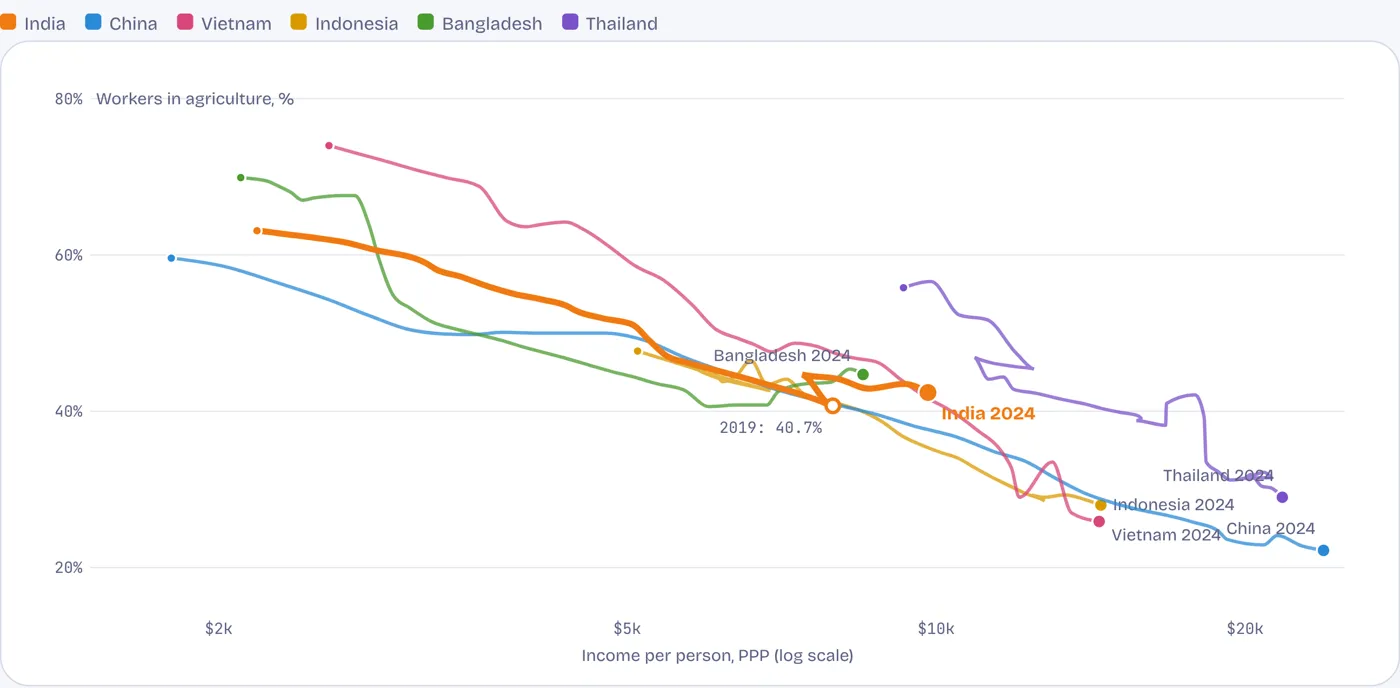
Share of workers in agriculture against income per person (PPP, log scale), 1991–2024. Each line is one country’s path; dots mark 1991 and 2024. Tap or hover a line.
As incomes rise, people leave farms for factories and towns. China, Vietnam, Indonesia and Thailand all followed that path. India followed it until 2019, when the farm share reached 41%. Then it turned back: by 2024, 42% of Indian workers were again in agriculture, as the pandemic and a lack of better jobs pushed people home. Bangladesh shows the same recent reversal.
Source: World Bank WDI; ILO modelled employment estimates; income per person PPP, constant 2021 international $.
The arithmetic of jobs
India needs about 80 lakh new jobs off the farm every year
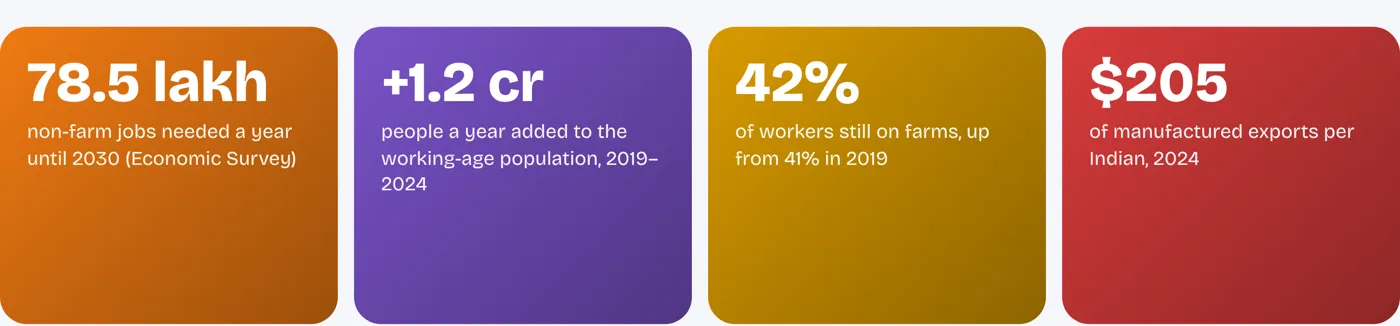
India’s working-age population grows by more than a crore a year, and the labour force grew faster still after 2019 as more women were counted as working. The government’s own Economic Survey estimates that the economy must create about 78.5 lakh non-farm jobs a year until 2030 just to absorb the new workers.
Source: World Bank WDI (population aged 15–64; labour force, ILO estimates); Economic Survey 2023–24, via DT Next.
Factories
A path back to 20%: what Bangladesh and Vietnam reached
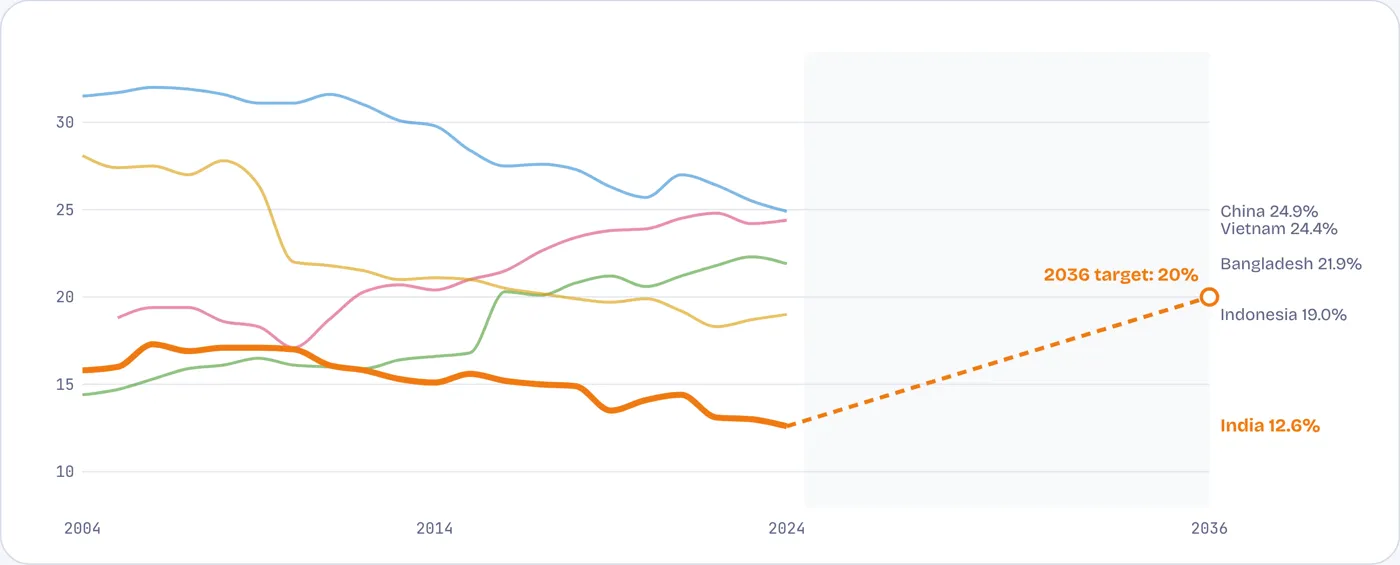
Manufacturing value added, % of GDP, 2004–2024, and a path for India to 20% by 2036. Tap or hover a line.
Bangladesh’s factories are 22% of its economy, Vietnam’s 24%. India’s share has fallen to 12.6%. Getting to 20% in twelve years means manufacturing growing about four percentage points a year faster than the rest of the economy.
Source: World Bank WDI (national accounts).
Selling to the world
Vietnam exports fifteen times as many manufactured goods per person as India
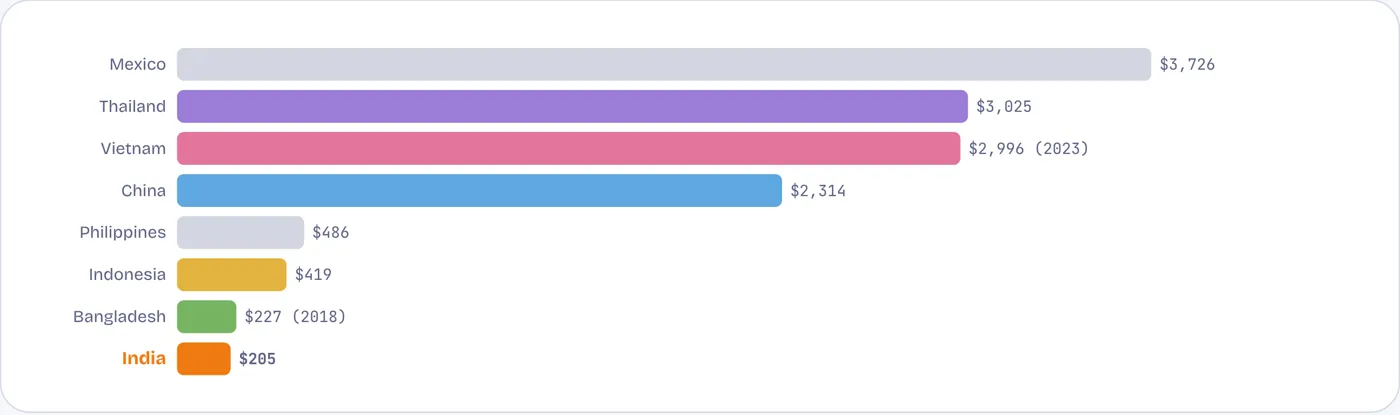
Manufactured goods exported per person, US$, latest year
The economies that built factory jobs at scale did it by selling to the world: garments in Bangladesh, electronics in Vietnam, almost everything in China. India sells about $200 of manufactured goods per person a year; Vietnam sells about $3,000. Export markets are large enough to employ millions without waiting for Indian demand to grow.
Source: calculated from World Bank WDI (merchandise exports, manufactures share, population). Bangladesh: 2018, latest available.
Women at work
A path to 45%: what Indonesia already has
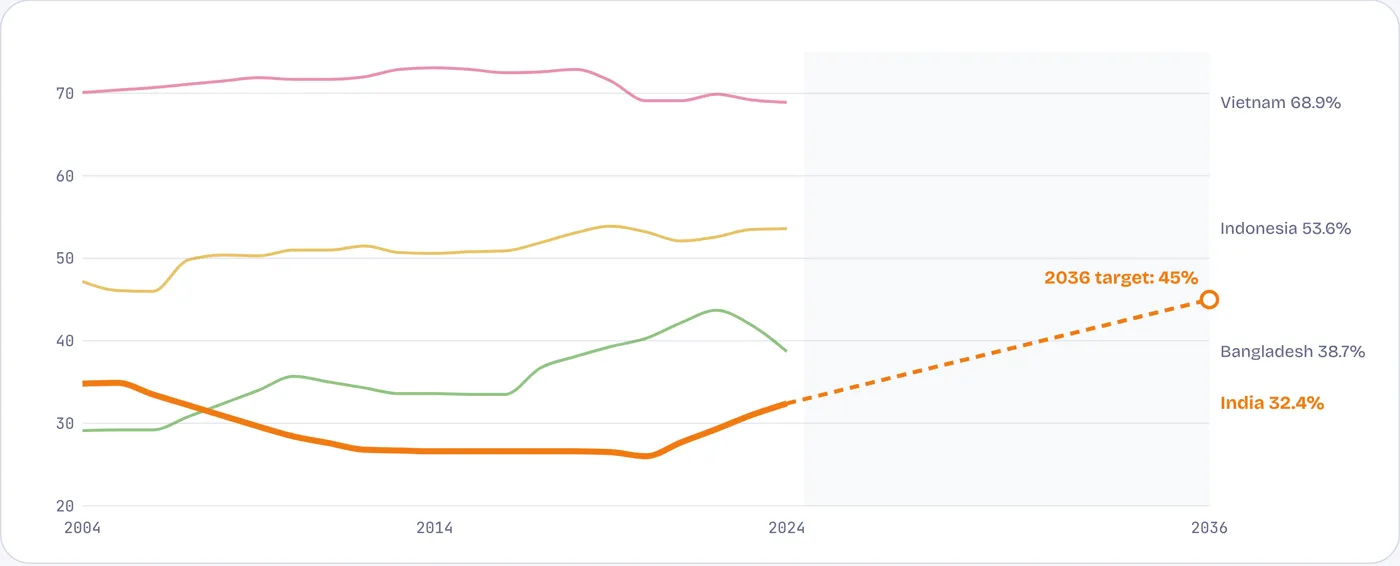
Women’s labour-force participation, ILO estimates, % of women aged 15+, 2004–2024, and a path for India to 45% by 2036. Tap or hover a line.
Indonesia has 54% of its women in the labour force and Vietnam 69%. A target of 45% for India by 2036 is roughly the World Bank’s path to 50% by 2047. It needs jobs women can reach: factories and offices near home, safe transport, childcare, and hostels for women who migrate for work, as electronics plants in Tamil Nadu that house women workers in hostels have begun to show.
Source: ILO modelled estimates, via World Bank WDI; World Bank Country Economic Memorandum (2025).
Proposed targets for 2036
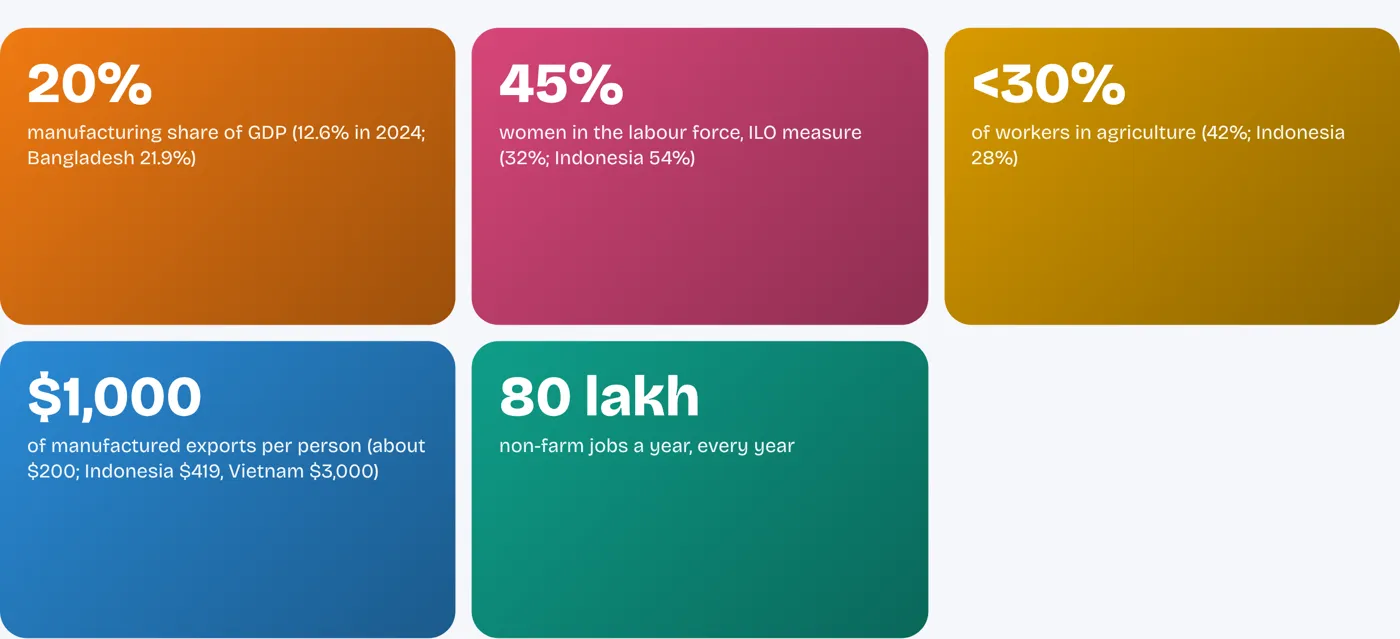
Five numbers for work
These targets do not ask India to copy China. Each has already been reached by Bangladesh, Vietnam or Indonesia, all poorer than China.
Source: Targets proposed here; anchors from World Bank WDI and the World Bank’s Country Economic Memorandum (2025).
Contested numbers
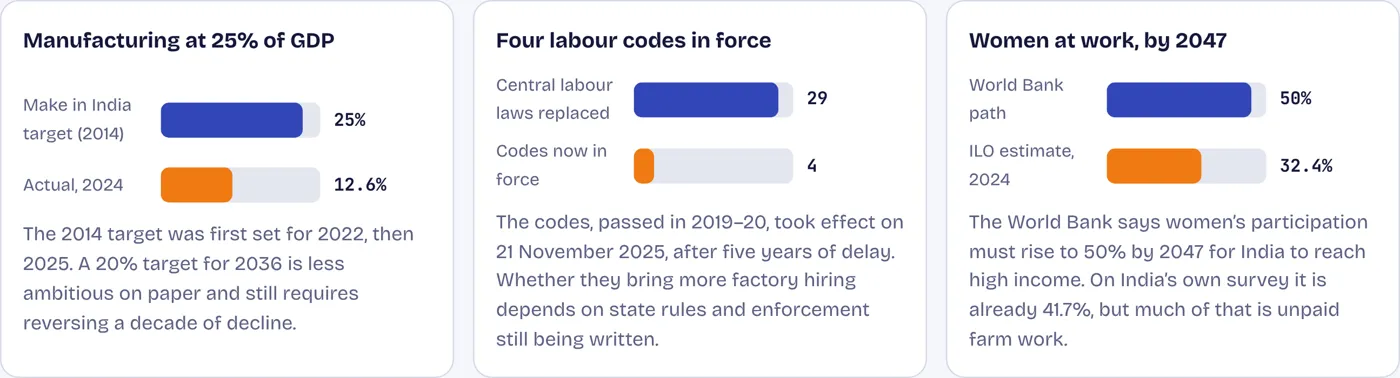
Three numbers that need a second look
Source: Make in India (2014); Ministry of Labour notification (November 2025), via K&S Partners; World Bank (February 2025); ILO via WDI.
The takeaway
Growth that does not create work for farm labourers and women leaves most Indians watching it. Factory jobs built for export, and the conditions that let women take them, are how growth reaches the many.